




To quick understand the challenges facing Fatimah’s family, play the interactive game below:
A group of boys swims near a jetty littered with green mussel shells in Muara Angke. From the shore, Fatimah is on her way to visit a friend in the neighboring settlement, Tembok Bolong, which survived a fire that razed a dense stretch of coastal housing.
“My friend was caught in the fire, but it turns out she’s still alive,” she says, half joking.
“Because she was asleep when the fire broke out,” she adds after seeing her friends’ shocked expressions, before laughing at her own joke.
The eleven-year-old, who usually works shelling green mussels, quickens her pace, afraid of a guard dog outside a nearby factory. She has had a few days off from shelling mussels because her older brother, who usually accompanies their father when he harvests green mussels, is busy preparing for her engagement in another city.
Once she’s past the barking dog, Fatimah responds to a question about the scorching afternoon heat with another quip.
“It’s hot, usually really hot too, but at least it’s hotter than hell!” she jokes.
Read more: Mothers and Children Trapped in Heat Along the Rail Tracks: How Kampung Muka Adapts, Rebuilds, and Cools
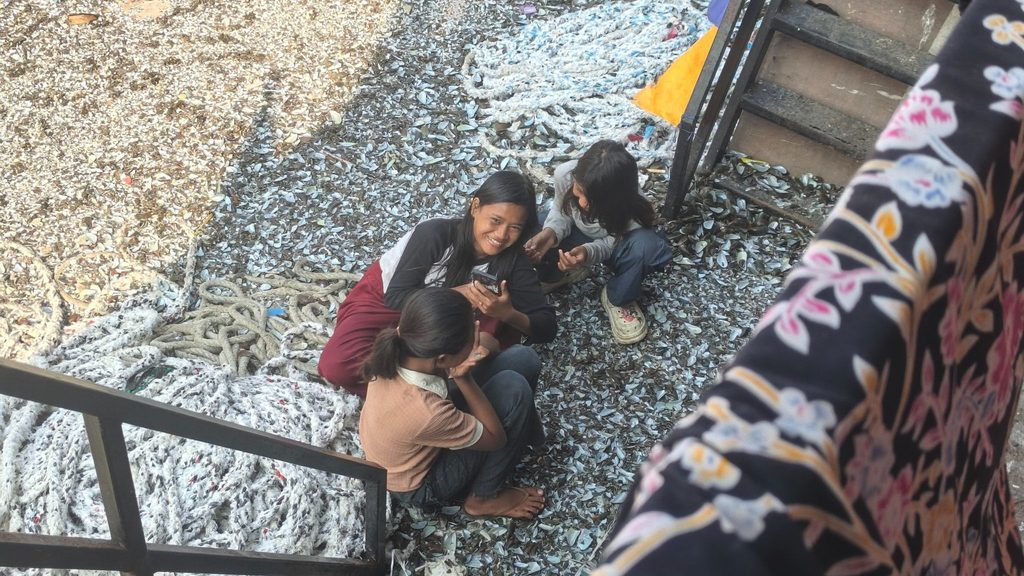
That joke is how Fatimah copes with a heat that has become part of her everyday life. In RT 06, Muara Angke, North Jakarta, heat, fires in the neighboring settlement (which has burned three times in the past three years), tidal flooding, and the threat of eviction all occupy the same living space.
Fatimah is the youngest of five siblings. She lives with her mother, Ipah (53), and her father, Kalil (58). Every member of her family works as a fisher and green mussel farmer. For more than ten years, Kalil has also organized coastal fishers.
They now live in a stilt house built through a program run by the Indonesian Defense University together with the Ministry of Defense. The house is only about a year old and stands right on land being prepared for the Giant Sea Wall (GSW) mega-project.
From the porch, the sea that once sustained the family’s livelihood looks different now. Sand sediment has piled up, reclaimed land encroaches from all sides, and the mussels once found along the coast have grown scarcer. Ipah and Kalil’s family now relies mostly on the green mussels they cultivate themselves.
Heat, Sweat, and a Shrinking Space to Play
In their simple stilt house, an electric fan is the only defense against the heat. According to Kalil and Ipah, the roof is made of zinc sheeting painted red, so that from a distance it looks like roof tiles. Heat seeps in easily and lingers inside the house.
“We just use the fan. It runs day and night. Not AC, AC is expensive, we can’t afford it,” Ipah says.
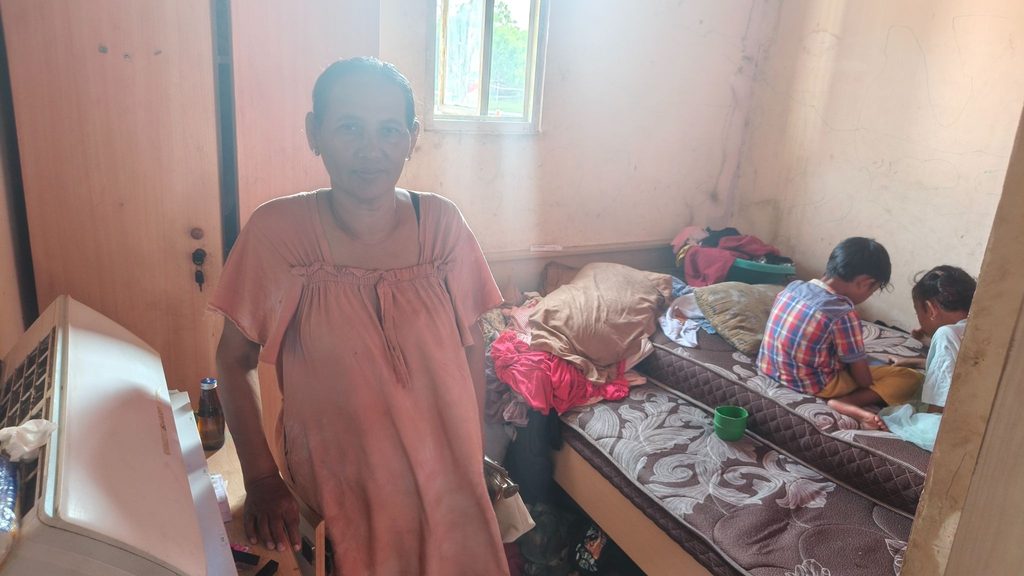
Their household electricity is free because they use solar panels. But the capacity is limited, enough for lighting and a fan, not for air conditioning.
When the fan isn’t enough to fend off the heat, the sweat of the children and grandchildren who spend much of their time with Ipah becomes another problem. Heat rash is a common complaint she sees on her children and grandchildren, especially during the dry season.
“If we don’t use the fan, yes, there’s a lot of sweat. It comes out in little spots,” Ipah says.
Fatimah also feels the heat at school. Her classroom still relies on fans; with her usual wit, she compares it to her older sibling’s school, which already has air conditioning.
“School uses fans, and with fans it’s still hot. My sister’s school has AC,” she says.
Even so, the heat hasn’t yet made it hard for her to concentrate. “It’s fine, really, just sweaty,” she says. But she has noticed other changes among her friends.
“Friends at school rarely go outside anymore.”
Read more: “Where’s Your Headscarf?”: Misogynistic Rules Run Rampant, Women’s Bodies Continue to Be Regulated
Fatimah herself prefers the mangrove forest behind the settlement as a place to play. The mangroves were planted in 2016 and are one of the few open spaces near her home.
“I usually play in the mangroves, it’s cooler there. There are snakes, but that’s okay.”
Ipah and Fatimah’s family experiences all this against the backdrop of Jakarta’s rising temperatures. Forecast data from the BMKG Maritime Meteorological Station at Tanjung Priok for Muara Angke Port shows daytime temperatures reaching 31 degrees Celsius on August 12–13, 2026.
On August 12, the temperature was forecast to reach 31 degrees Celsius around 1:00 p.m., with humidity ranging between 58 and 83 percent. Similar conditions occurred the following day, with temperatures again reaching 31 degrees Celsius in the afternoon and humidity of 58–83 percent. North Jakarta during that period was forecast to be sunny, with temperatures ranging from 26–30°C and humidity of 58–83 percent, while forecasts for August 16, 2026 showed temperatures of 26–31°C with humidity of 56–86 percent.
The Jakarta Environmental Agency (DLH DKI Jakarta), in a written statement to Konde.co on September 4, confirmed that the risk of extreme heat in Jakarta falls into the medium-to-very-high category, with areas of very high risk concentrated in North Jakarta, West Jakarta, and parts of Central Jakarta.
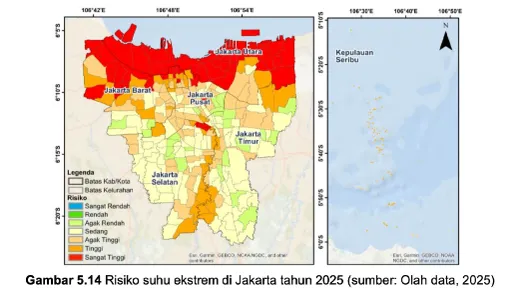
Based on the Jakarta Environmental Agency’s 2025 data analysis, North Jakarta and West Jakarta are the epicenters of the highest levels of vulnerability. At least 20 urban villages (kelurahan) in northern Jakarta, including Muara Angke, face a high-to-very-high potential impact from climate change. The impacts cover health, access to clean water, and housing conditions for vulnerable groups such as women, children, the elderly, and people with disabilities.
Read more: Feminist Dictionary: A Critique of Choice Feminism—Women’s “Choices” Are Not Merely Personal Consequences
Regarding women and children specifically, the Environmental Agency stated that mapping vulnerable groups matters because limited access to resources, health services, information, and social protection can heighten risk when climate impacts occur. As such, information on regional and community-group vulnerability is a key consideration in pushing for more targeted adaptation measures, particularly in dense and vulnerable coastal areas.
The mapping results show that areas with high vulnerability levels are generally located in northern Jakarta, especially coastal and island areas. These areas are vulnerable to sea level rise, tidal flooding, and seawater intrusion, which can affect environmental conditions, community activities, health, and access to clean water.

For Ipah and Kalil’s family, the heat is more than familiar on their skin, it’s not simply discomfort; it also shapes how the family spends money and divides its time.
During the dry season, Ipah’s water bill can reach around Rp300,000 a month, compared to roughly Rp80,000 normally. A neighbor’s borehole becomes their fallback when the water at their stilt house often runs low or turns brackish.
For Fatimah, the heat also means that money she earns shelling green mussels after school has to be set aside for more cold drinks.
“Shelling mussels, well, it’s my own money, for buying ice.”
After school, she joins in shelling mussels from around noon until evening. From that work, she usually brings home about Rp40,000 a day. That’s enough to buy ice cream for around a thousand rupiah and es cekek, an iced drink in various flavors.
Read more: After the Days of Hell in Jakarta: The Death of Ita Martadinata as Recalled by Ita Fatia Nadia
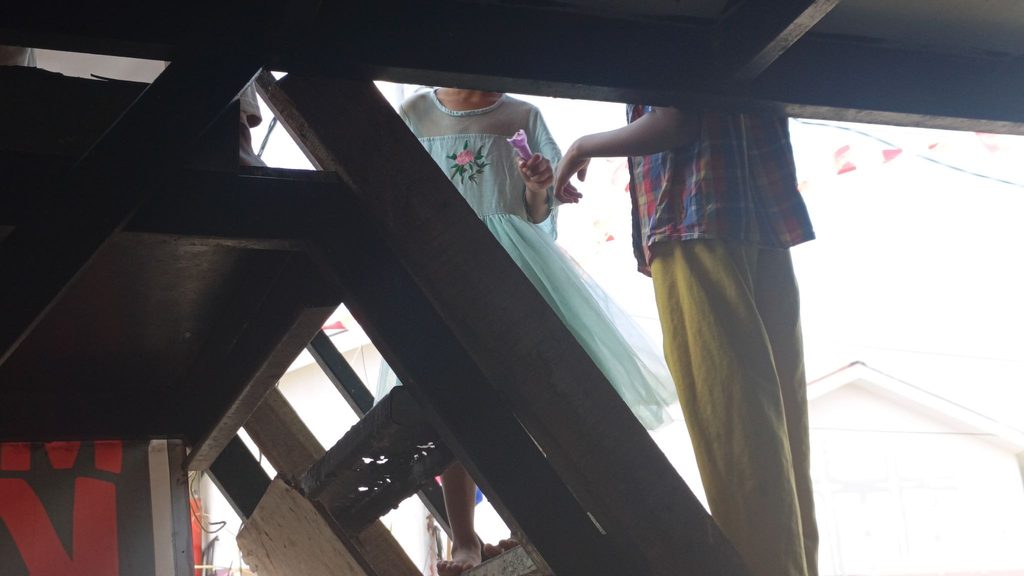
“From noon, I get home around noon, until evening. I’m used to the heat by now, sometimes it just gets too hot.”
In Muara Angke, shelling mussels is not an unusual job for a girl. Ipah herself did the same work when she was Fatimah’s age.
Central Statistics Agency (BPS) data show that around 2.39 percent of children aged 10–17 in Indonesia were classified as child laborers in 2023. In the context of a fishing family like Fatimah’s, working from a young age is intertwined with family needs and work passed down from earlier generations.
The Sea No Longer Gives the Same Yield
Kalil sees the changes on the coast not through statistics or climate maps, but through what was once easy to find in the sea and is now nearly gone.
“Marine life like kerang bulu, kerang mentok, kerang darah, kerang batik, kerang salju, kerang bambu [various local mussel and shellfish species]. They used to be alive out there, now there’s none,” he says.
In the past, most of the family’s income came from what they caught at sea. Various kinds of shellfish, sea snails, and fish could be brought home and sold. Now that yield has shrunk considerably. The green mussels they farm themselves have become one of the family’s main sources of income.
Kalil feels this change did not happen on its own. He links it to changes in the coastal landscape, including the sand used for development and land reclamation.
“The sand from Pasir Putih beach, it’s dumped there by outsiders, for beach reclamation. That’s what’s killing the livelihoods of coastal fishers,” he says.
He believes the effects won’t end once the reclamation work stops. “For 30 to 50 years to come,” he says.
Ipah has felt the same change from another angle, mussel prices. Since the late 1990s, she has sold mussels and was one of the people who bought the catch from fishers in her village. She remembers the change through the selling price, which used to be very low.
“The change is obvious. Back then it went for 1,500 a kilo. Now it’s 20, 19, 17 thousand.”
Read more: I’ll Be Back in Jakarta: Stories of Rural Women Who Move to the City
The price she refers to, around Rp1,500 per kilogram, dates to 1997–1998, while the current price is around Rp17,000–20,000. Assuming Indonesia’s cumulative general inflation since that period is roughly 8–9 times, Rp1,500 would be equivalent to around Rp12,000–13,500 today. So the price of mussels may have nearly doubled in real terms.
When supply is tight, prices can even spike further.
“Recently it was still expensive, we sold at 35 a kilo. 30, almost 40,000 a kilo too.”
According to her, the price of mussels isn’t determined solely by the catch in Muara Angke. Mussels from Cilincing, Dadap, Tangerang, and Banten can all enter the market at the same time. When harvests from various regions are abundant, prices come under pressure.
Ipah was once among the first people in her village to buy mussels from fishers. Now competition has changed. There are far more buyers, she says the number has reached the hundreds.
Changes in the sea’s yield have also pushed the family to change how they make a living. Over the past two or three years, Kalil and Ipah have started farming green mussels more seriously themselves.
Ipah’s family now uses rope lines and jerry cans as part of their farming system. This method was chosen because it’s easier to transport than bamboo, especially since road access changed.
“Carrying bamboo on the toll road, that part’s hard. It’s too long. That’s why we switched to rope, it’s more compact,” Ipah says.
Read more: Indonesia’s Garbage Emergency: Scavengers Buried Under Mountains of Garbage in Bantar Gebang
To start the farming operation, they briefly relied on a loan from what residents call “bank emok,” a daily-interest loan common in the neighborhood, also known as a loan shark scheme. Once the business was running, Kalil began buying rope in bulk from Brebes. In the most recent shipment, the amount reached nearly nine tons.
On land, the mussels still require many hands. Once harvested, shelling them becomes part of the household economy. One drum of mussels can be paid around Rp35,000–40,000.
Children and teenagers take part in this work, just as earlier generations did.
“Since they were little. My first child started at age 7, my second at age 3, they started selling mussels early,” Ipah says.
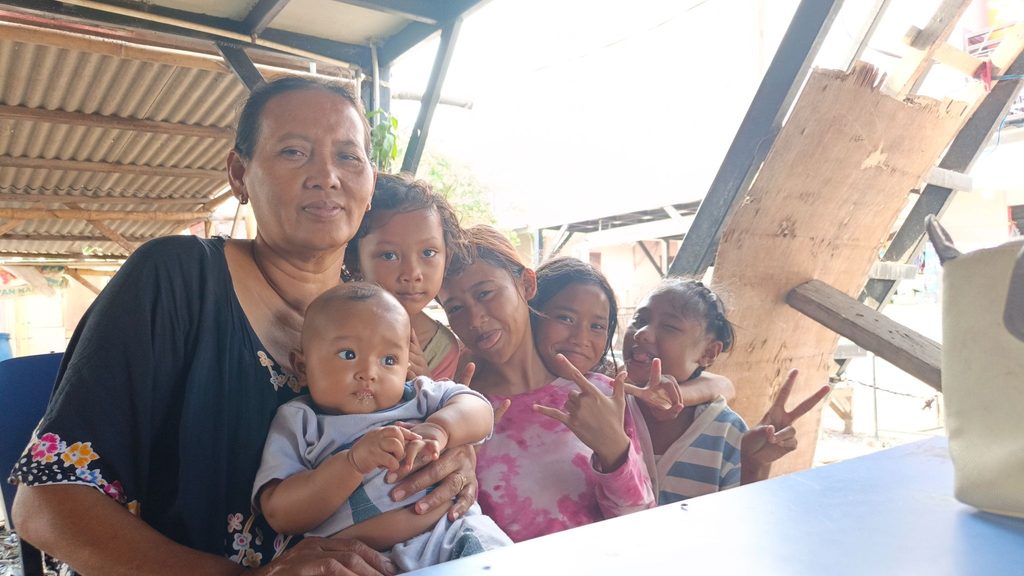
For fishing families like theirs, work doesn’t have a clear boundary between home, school, and earning a living. Children grow up watching their parents work and gradually take part themselves.
Pressure on small-scale fishers’ livelihoods is also reflected in national fisheries data. An ocean health index report released in early 2026 recorded that the “livelihoods and economies” score for fishers dropped from 70 to 64. The fisheries sector absorbs around 5.38 million workers, far below the agriculture sector’s 36.46 million.
Kalil also raises the issue of fuel. He says fishers in his area don’t always get access to subsidized diesel at the price they should.
Read more: Indonesia’s Garbage Crisis: The Irony of Women Amid the Stench of Garbage
“I have to buy at Rp10,000, while others can get it by the ton, buying at Rp6,800 and selling it at that price [Rp10,000],” he says.
Another problem comes from marine pollution. Kalil says the change in water color and disappearance of fish are the clearest signs fishers can recognize.
“The water turns a rotten color. You can tell because there are no fish. They all scatter,” Kalil says.
According to Kalil, such conditions can be seen up to around two miles from the shoreline and can persist for several days. He also questions how such pollution incidents are handled.
As someone who lives off the sea, he says these changes don’t need an annual report to be felt. As mussels become harder to find, prices shift, fuel grows expensive, and seawater changes color, livelihoods shift bit by bit.
Rising Seas and a Shrinking Living Space
Heat is not the only change Ipah and Kalil’s family has to face. In Muara Angke, seawater is also increasingly flooding into their living space.
Kalil has lived as a fisher for decades. He remembers the tidal cycle in his own way.
“Three months of high tidal flooding, three months of konda [neap tide, minimal tidal movement], three months of dry low tide, three months of major tidal flooding,” he explains.
The major tidal floods usually arrive around December. When the water starts coming in, residents raise the road and their houses as best they can.
“We fill it in, however we can manage. Some already have the money, the capital, to buy rubble, stone, cement.”
The cost can reach hundreds of millions of rupiah. For residents who can’t cover it alone, the remaining options are to share the burden together or do nothing at all.
“It’s a collective effort. We pool the money together.”
Flooding is felt most by children. Roads that normally connect homes to the rest of the settlement turn into standing water. To leave the house, children must be careful not to slip, or they need to be carried.
“It’s hard to walk from here to the front. Their legs get tired. Wobbling around. The kids keep getting carried. They ask to be carried,” Kalil says.
School is also affected when the floodwater rises high enough.
“When it’s a big flood, it reaches the school. There’s flooding but sometimes school still happens, only if the school itself floods do they get a day off,” Ipah recounts.
Read more: 2025 Year-End Edition: Women’s Resistance in the Season of Arrests and the Year of #DemocracyApocalypse
Tidal flooding becomes even more complicated because Jakarta’s coast faces more than one pressure at once. Land subsidence lowers the ground surface even further, while rising sea levels add pressure from the other direction.
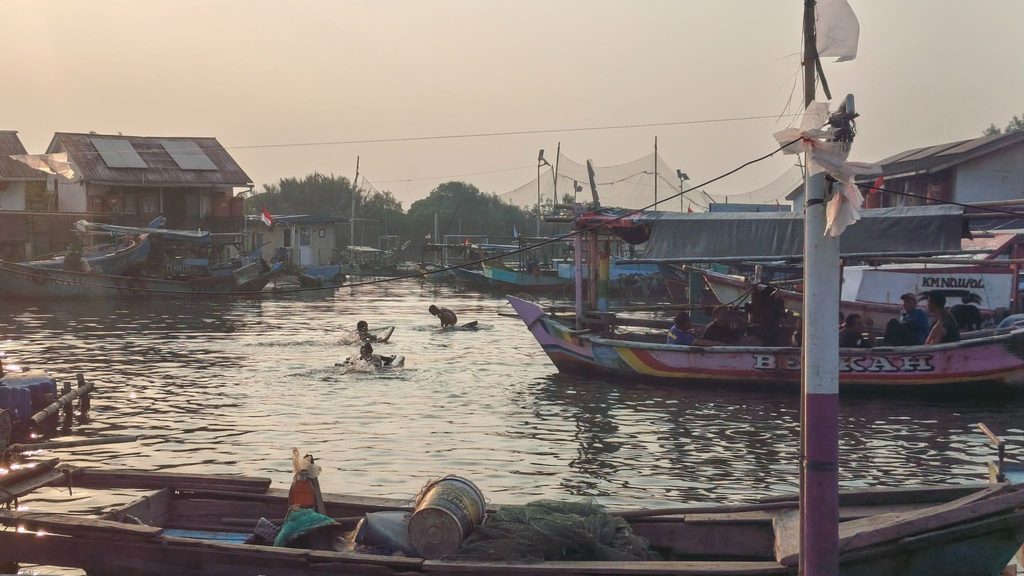
BRIN climate and meteorology researcher Eddy Hermawan has estimated that the combination of these various factors could bring the area affected by flooding to 160.4 square kilometers, or around 24.3 percent of Jakarta, by 2050.
In Muara Angke, land subsidence is also not a distant issue from daily life. Data from the Jakarta Water Resources Agency (Dinas Sumber Daya Air DKI Jakarta) recorded land subsidence in the area at around 7 centimeters per year in 2023. The most recent figure used by the government for the 2025–2026 period is around 4.5 centimeters per year.
Partly for this reason, the government is pushing forward with the sea wall construction as one way to address the threat of coastal flooding. On paper, the wall is presented as protective infrastructure. But for residents living along the coastline, such as Ipah and Kalil’s family, this construction directly intersects with the space they have long used to live.
Around Ipah and Kalil’s home, that space is more than just their dwelling. It includes the road their children walk on, the place where boats are moored, and space for both work and play.
New House, Old Threat
The changes at sea are unfolding alongside changes on land. For Kalil, the memory of having to leave a home behind is nothing new.
He experienced eviction once before, when he lived in Kaliadem in the early 2000s. He no longer remembers exactly whether it happened in 2003 or 2004. But one thing has stuck with him: the night when the heavy equipment arrived, while his wife had given birth to their third child just 15 days earlier.
“My wife had just given birth 15 days before. Our third child was 15 days old. Still a newborn. That night the excavator just showed up,” he says.
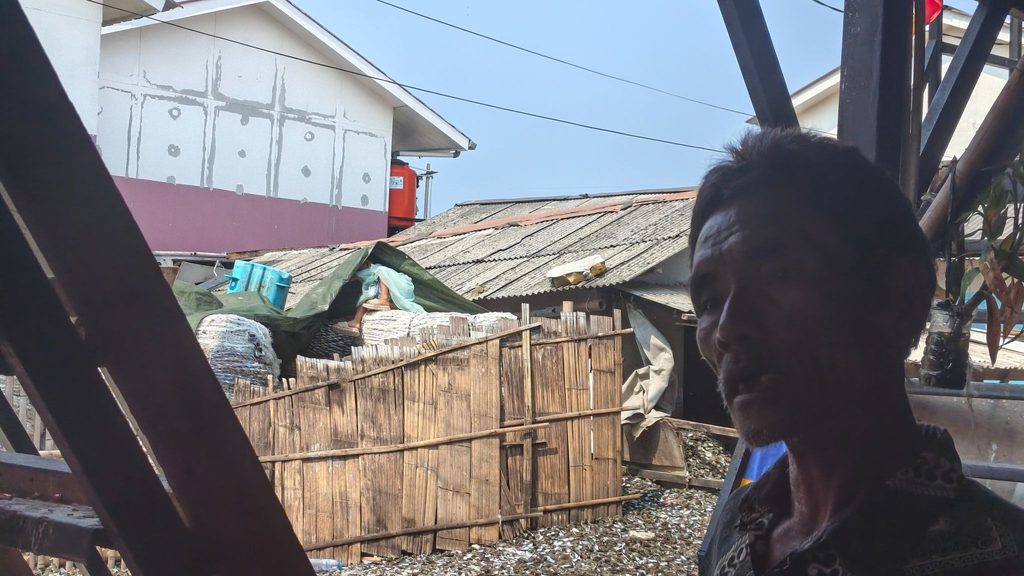
That’s why, when talk of resident evictions resurfaced in Muara Angke, that old experience felt close again.
The house Kalil and Ipah now occupy hasn’t stood for long. It was built through a program run by the Indonesian Defense University together with the Ministry of Defense, around the time Prabowo Subianto was inaugurated as president. Construction moved relatively fast, over a little more than a month, by Kalil’s recollection.
“This house went up right as Prabowo was about to become president. It came together suddenly, in a little over a month,” Kalil says.
Their old house was torn down and replaced with a stilt structure with a red-painted zinc roof that from a distance looks like roof tiles. During roughly two months of construction, Kalil’s family moved between rented rooms.
Read more: 2025 Year-End Edition: A Season of Persecution Without Transition in the Age of #DemocracyApocalypse
But the new house came without the legal certainty Kalil says was promised beforehand.
“Where are the documents they promised at that first meeting, when it was first supposed to happen, that Prabowo would sign the certificate for this house? It never happened,” he says.
Not even two years into living there, residents were instead presented with a proposal to relocate to public housing flats (rumah susun) through the neighborhood administration (RT/RW).
“Not even two years, just over a year, and suddenly there’s this proposal from the RT/RW for a rumah susun. What a waste, right,” Kalil says.
Kalil frowns at this, it isn’t just about moving house for him. Everything about this space has become part of the living space that has long sustained his family, a family of fishers native to Indramayu.
That’s why Kalil rejects the term “normalization” used in discussions about restructuring the settlement.
“‘Normalization,’ just call it eviction, plainly. But the polite way to say it is normalization,” he says.
He also questions how decisions about the GSW project’s zoning were made. In his view, residents should have been involved before the concept, design, and zoning were decided.
“Before the concept, before the design, before the zoning was set, this zone green, this one yellow, this one red, we should have been involved,” he says.
He recalls a similar experience when a futsal field and a mangrove area were built near the settlement. According to Kalil, residents only found out about the decision once the project was already underway.
Read more: Stop Tech Misogyny: The Long Chain of Gender-Based Cyber Attacks and Disinformation
“Once it’s done, that’s when they spring it on you like that. Same as this mangrove, built without any communication with the community. The community just has to comply.”
That futsal field, he says, also took over space fishers had previously used to moor their boats.
“Before there was no field, so our movement as fishers wasn’t restricted. Fishers had more freedom.”
Now, when the tide goes out, boats have a harder time getting in and out.
Kalil feels that this kind of change doesn’t always come as an outright eviction. Sometimes it arrives bit by bit: a mooring space that shrinks, a road that changes, a house asked to relocate, or a new facility that takes over old space.
The stilt house, once hoped to offer more decent housing, ultimately stands amid the same uncertainty as before. The house is new, but the question of whether they’ll be allowed to stay remains unresolved.
The Giant Sea Wall and the Shadow of Eviction
That uncertainty has grown sharper as construction of the giant sea wall begins moving closer to the settlement.
The Giant Sea Wall is part of a coastal flood management plan under the National Capital Integrated Coastal Development (NCICD) framework, with a sea wall planned to stretch from Serang to Gresik. The project was designated by Prabowo Subianto as a National Strategic Project in 2025, with an estimated construction value of around Rp1.68 quadrillion.
The Jakarta government had previously targeted a groundbreaking in September 2026, but this has reportedly been pushed back to October 2026. In Jakarta, the planned length of the wall has also changed, from around 12 kilometers to 19 kilometers, under central government coordination.
Within the NCICD segment, Muara Angke is among the locations for 350 meters of construction in 2026. Overall, the plan for Jakarta’s sea wall spans 28.2 kilometers, with around 11.8 kilometers already completed.
Beyond the project’s scale, Kalil says, the issue isn’t just the length of the wall or the value of the investment. He sees it in the distance between the project and his home.
Kalil says he was once asked to link the assistance for building the stilt house to approval of the sea wall project.
“…Pak Kalil has to approve the sea wall excavation, the giant sea wall, because Pak Kalil already got the stilt house,” Kalil says, recalling the words of a former sub-district head (camat) who served as the field coordinator.
Kalil rejects the idea that the stilt house obliges him to approve the project.
“I don’t agree with reclamation, let alone the wall. Reclamation and the wall are one package, one argument, along with the National Strategic Project status.”
Read more: Stop Tech Misogyny: When AI Becomes a Tool for Manipulating Women’s Bodies
That stance cannot be separated from the long history of the Jakarta Bay reclamation, which has long been a source of conflict between the government, developers, and coastal communities.
In 2016, former Jakarta Provincial Legislative Council (DPRD DKI Jakarta) member from the Gerindra faction, Mohamad Sanusi, was sentenced to seven years in prison and fined Rp250 million after being found guilty of accepting a Rp2 billion bribe from Ariesman Widjaja, president director of PT Agung Podomoro Land. The bribe was related to deliberations over a draft regional regulation on Jakarta Bay reclamation.
The name of businessman Sugianto Kusuma, alias Aguan, of the Agung Sedayu Group, also came up in the legal process and news coverage of the reclamation case. The Corruption Eradication Commission (KPK) at the time barred Aguan from traveling abroad. In case documents, his name was mentioned in connection with discussions about giving money to DPRD DKI members to speed up deliberation of the reclamation regulation. However, Aguan was not among those convicted in Sanusi’s bribery case.
That case became one episode in the long-running saga of Jakarta Bay reclamation. Construction of the reclaimed islands continued nonetheless.
Islands C and D are part of a plan for 17 reclaimed islands in Jakarta Bay that has been in the works since the 1990s. Both are being developed by PT Kapuk Naga Indah (KNI), a company under the Agung Sedayu Group. The principal approval for Island D’s reclamation was issued in 2007, while Island C received its principal approval in 2012.
Read more: Prabowo-Gibran’s One-Year Report Card From A Gender Perspective
In 2018, Jakarta Governor Anies Baswedan renamed Island C as Pantai Kita (Our Beach) and Island D as Pantai Maju (Progress Beach). Island G was also renamed Pantai Bersama (Together Beach) through Jakarta Governor’s Decree No. 1744 of 2018.
These three reclaimed areas later developed and became connected to the network of property developments around Pantai Indah Kapuk. Pantai Maju is known as Golf Island, while PIK2 was developed as a separate area that is physically linked to the PIK area through various infrastructure.
In other words, while reclamation was halted for the 13 islands that had not yet been built, the land that had already been formed remained in place and was subsequently managed under a new scheme. Pantai Kita and Pantai Maju have continued to develop as property areas on Jakarta’s northern coast, while across the water, Muara Angke residents continue to grapple with the same changes to their marine space.
“If it’s reclamation on the islands, construction just continues,” Kalil says.
This experience has led residents to see the sea wall as more than just infrastructure to hold back seawater. They also see what might change once the project is finished: mooring space that grows even tighter, changed access to the sea, roads flooding again, and the possibility their homes will have to be relocated.
Read more: Arrests at the End of the Day: Arrested While Hanging Out, Allegations of Sexual Harassment
In early 2025, the presence of a roughly 500-meter bamboo sea fence at three points in the waters facing Island C also raised questions about activity and control over marine space. For coastal residents, changes like this again raise the question of who has the right to determine the use of space that has long been part of their lives.
Kalil sees the issue through things that hit closer and closer to daily life: boats that are hard to moor, tidal water reaching the road to school, mussels that are increasingly hard to find, and children losing space to play.
The newly built stilt house has not automatically resolved any of that.
Extreme heat under that red-painted zinc roof arrives alongside rising water, shrinking space, and development that keeps moving forward. And amid it all, children and women like Fatimah and Ipah have to live through these coastal changes day after day.
Enduring and Resisting Amid the Threat of Intimidation
One of the most exhausting parts of survival for Ipah and Kalil’s family goes beyond the sea wall itself, it begins with the language the government uses to justify it. Time and again, in various forums, Kalil has faced the same argument: that the project cannot be refused because it carries national strategic status.
“This is a strategic project, sir. A central government strategic project, sir,” he says, mimicking a line he has heard repeatedly from representatives of UP3 (the Public Service Monitoring Unit), the Public Works Agency, the Transportation Agency, the Marine and Fisheries Agency, and the sub-district office.
Kalil’s answer is always the same whenever the government comes calling: the people should be treated as strategic first, not the project.
“It’s the fishing community that should be made strategic first. Not the project first,” he says.
He doesn’t want these issues to distract from what he sees as the root problem. “We don’t want to be distracted by side issues. Let’s settle this reclamation matter first,” he says.
His argument rests on the constitution. “We’re basing this on Article 1, Paragraph 1 alone, sovereignty is the highest authority. We, the people of the Nusantara, follow the sovereignty of the Nusantara,” he says, referring to the constitutional provision that sovereignty lies with the people. According to Kalil, this is the basis for arguing that a national strategic project should involve affected residents from the design process, not merely through outreach after a decision has already been made.
Read more: From MBG Watch to Protests, Civil Society Demands an End to MBG
This resistance has not come without risk. He recalls being threatened by Mobile Brigade (Brimob) police officers while voicing similar concerns during the G20 meeting in Bali. He even had to be kept safe overnight by the Jakarta Legal Aid Institute (LBH Jakarta) at a hotel before he could return to voice his views the next day.
“Even though there were a lot of threats from Brimob, friends from LBH Jakarta, their director, kept me safe that whole night,” he says.
In his own village, he has staged a symbolic act, displaying protest banners in response to unilateral claims by the RT/RW that residents had approved the sea wall.
“I’ll write it out, I’ll put up this banner, in line with the same tune the RT/RW was singing the other day.”
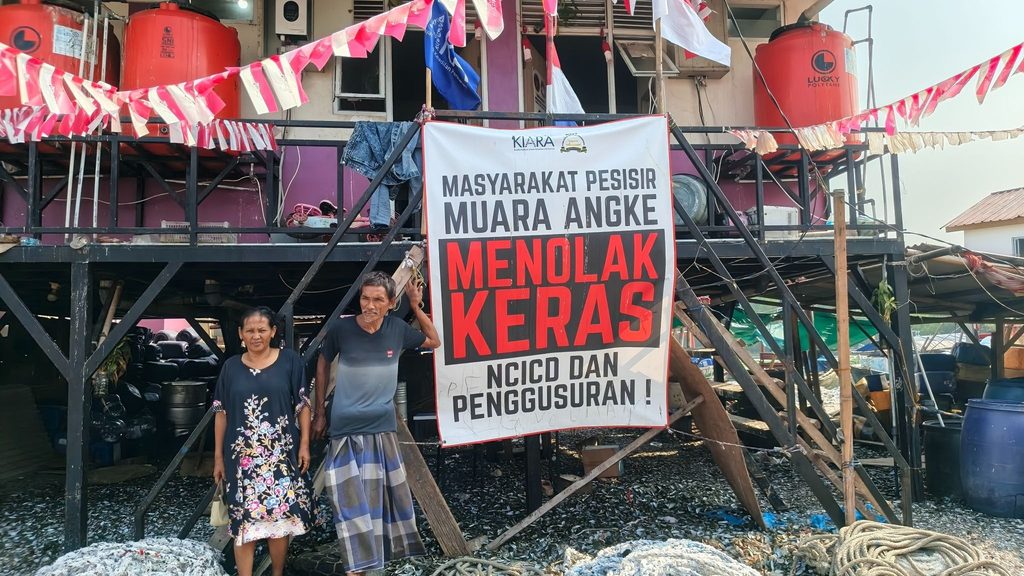
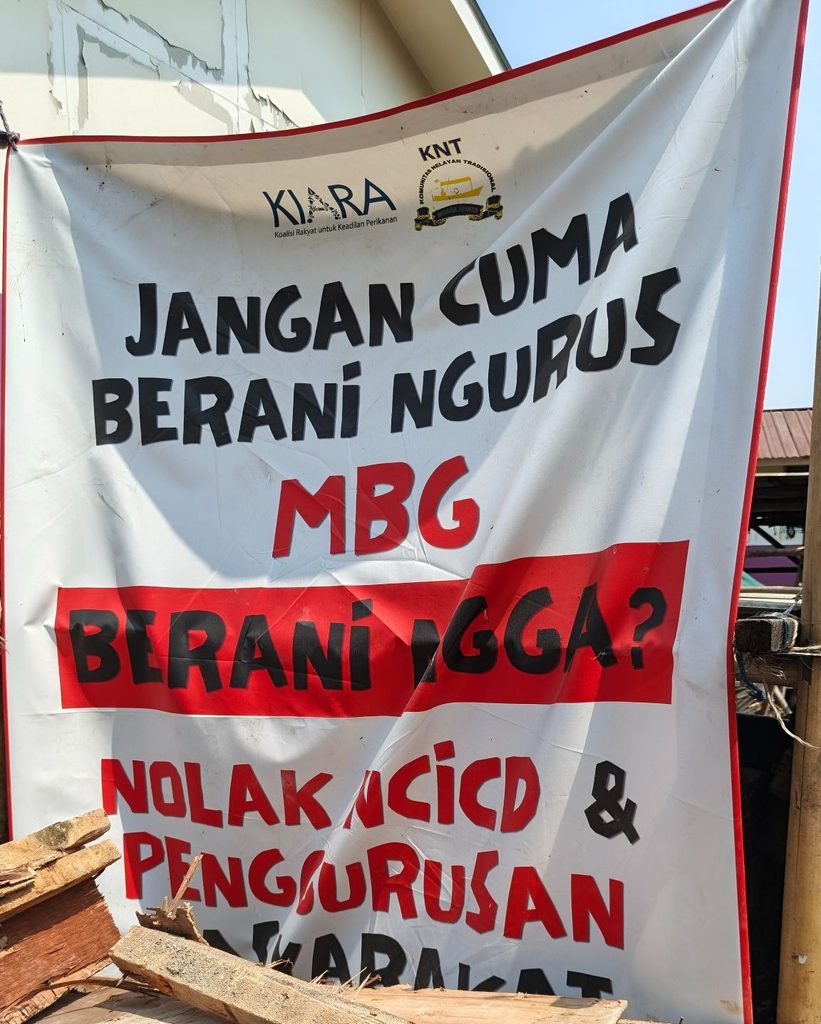
Kalil’s activist spirit was actually formed long before the Giant Sea Wall issue began consuming much of his energy. Since he was young, he has been involved in solidarity work among fishers across regions.
Read more: MBG Must Be Stopped: Poisoning Scandals, Gender Bias, And The Shadow Of The Military
He recalls a time when he took part in the migration of around 200 fishers from Demak to Jakarta, because incomes back home were too small. When the number of migrants grew too large and Jakarta “couldn’t handle taking them all in,” they were redirected to Cirebon. Kalil helped escort and accompany those groups several times, even though the pay was far smaller than what he earned as a mussel diver.
“Diving could earn up to Rp150,000, but escorting people to Cirebon only paid Rp3,500,” he says.
He was willing to sacrifice that income because he felt he was gaining experience and knowledge while he was still young.
“Because I still had that young spirit, I needed a lot of experience and knowledge.”
At the time, the difference in mussel prices between regions was one reason the migration made economic sense for fishers from Demak.
“Back there, it used to be Rp200,000 per kilo, while we were taking it from an area with a population where it was only Rp50,000 per kilo,” he says.
Read more: Celebrity Politics: How Can We Avoid Being Fooled by Image Polishing?
The risks of Kalil’s family’s resistance have even reached the courtroom.
Two of Kalil’s children, Rois Akbar and Winda Kholipah, once faced criminal proceedings after becoming involved in a conflict linked to opposition against the Jakarta Bay reclamation. According to LBH Jakarta records, the two are Muara Angke residents who were active in opposing the reclamation. In 2017, Rois and Winda were reported for alleged assault following an altercation at Kalil’s home. LBH Jakarta described them as victims of criminalization.
The case went to court. In 2018, the North Jakarta District Court issued an acquittal, ruling that Rois and Winda’s actions constituted self-defense. Prosecutors then filed a cassation appeal, but in April 2019 the Supreme Court rejected the appeal through Ruling No. 1010 K/Pid/2018, upholding the earlier decision.
Heat and a Climate Crisis That Is Not Gender-Neutral on the Coast
UN Women projects that by 2050, climate change could push as many as 158 million more women and girls into poverty, 16 million more than men. One reason is the unequal division of roles.
In many disaster and climate crisis situations, women are often on the front lines as caregivers, water fetchers, and providers of household needs. As resources grow scarcer, that workload increases, while women’s access to resources, education, and decision-making remains limited.
This pattern is reflected in research by the National Research and Innovation Agency (BRIN) in four coastal cities in Java: Jakarta, Semarang, Pekalongan, and Demak. The study involved 80 women and 20 children in Jakarta, Semarang, and Pekalongan, and 75 women and 25 children in Demak.
Damaged infrastructure and lost livelihoods have made many coastal families increasingly vulnerable. Laely Nurhidayah, a researcher at BRIN’s Center for Legal Research, explains that women and children were the focus of the study because women carry a double burden: caring for children and family while also earning a living to meet daily needs. Around 80 percent of the women studied experienced a drop in income due to the impacts of climate change.
This finding aligns with what Fikerman Saragih, Secretary General of the Coalition for Fisheries Justice (KIARA), has observed in two fishing villages in North Jakarta, Muara Angke and Cilincing/Rawa Badak.
There, the livelihood crisis does not stop at reduced income. Fikerman has seen an increase in violence against women, physical, verbal, and economic, as families struggle more to sell and process their catch to meet daily needs.
Read more: Celebrating Pride Month 2025, How LGBT Survives in a Situation of Discrimination: Konde.co Research
Children also bear part of the economic burden.
“The first is that their access to school gets cut off. Because in some places, children choose to help their parents, help their fathers as fishers or their mothers as fisherwomen. So they end up going out to sea too,” Fikerman tells Konde.co.
Economic pressure can even lead to child marriage. According to Fikerman, some families see marriage as a way to reduce or shift the economic burden.
“And the second impact is early child marriage, where because of economic pressure, parents see marrying off their child as a way to reduce the economic burden on the family, or to shift that burden onto another party. This happens in Muara Angke too,” Fikerman says.
The link between economic vulnerability and child marriage also appears in BRIN’s research. The study recommended targeted intervention to prevent child marriage as one of the indirect impacts of economic vulnerability among coastal families.
The livelihood crisis has also lengthened coastal women’s workdays. Findings from the Indonesian Coastal Women’s Union (KPPI) recorded that coastal women’s daily working hours can reach 15 to 18 hours.
That work begins with domestic duties, preparing provisions and fuel for husbands heading out to fish, and managing the household and children. After that come economic tasks: cleaning, sorting, and processing the catch into salted fish or shrimp paste (terasi) for sale.
This productive work is often seen as merely “helping the husband,” and so it goes uncounted as labor.
Read more: Sexism in Student Arrests and Maternal Activism Mothers Defend Their Children’s Struggles
Pressure on fishers’ livelihoods is also tied to changes in fishing grounds. Fikerman links this to the history of reclamation in Jakarta, including the Jakarta Bay reclamation project mentioned earlier by Kalil.
“The first thing in Jakarta, specifically in Muara Angke, on the coast and in the sea, it started with the reclamation agenda. Reclamation that was underway during Pak Ahok’s term until it was stopped during Pak Anies’s term,” he says.
According to KIARA’s observations with coastal communities, the area used for reclamation was a fishing ground for local fishers, including an area residents call the “big table reef” (karang meja besar).
“But after the island reclamation out at sea, in that fishing area, the big coral reef was destroyed, and they could no longer catch fish or mussels in that area, so they had to go much farther out to sea,” Fikerman states.
Fisheries remain an important source of livelihood in North Jakarta. In 2024, BPS North Jakarta recorded fish production from the Kamal Muara and Kalibaru fish auction sites at more than 14 million kilograms, with a production value in the hundreds of billions of rupiah. In the same year, North Jakarta’s open unemployment rate reached 6.18 percent.
According to Fikerman, fishers face pressure from multiple directions at once: the climate crisis, competition from large-scale fishing industries, and water pollution. Large vessels weighing tens to hundreds of tons compete with traditional fishing boats that generally weigh between 2 and 10 tons. Waste discharge adds further pressure on Jakarta’s waters.
Amid this situation, there is a group Fikerman says is often overlooked: elderly coastal residents.
“Because they can’t do much anymore, and they’re very dependent on their surrounding environment,” he says.
Read more: Is Our Public Transportation Gender Responsive and Inclusive? Konde.co Research Results (1)
This vulnerability is compounded by another issue: the lack of legal recognition for women’s work as fishers.
“We’ve recorded that since the Ministry of Marine Affairs and Fisheries was established, up through this year, 2026, as of August 23, 2026, not a single woman in the Jakarta area has been officially recognized as a fisher.”
Fikerman says a similar problem exists nationally.
“In the Indonesian context, there are still only 31 women who have managed to obtain recognition as fishers, and they are all concentrated in Demak Regency. Meanwhile, women fishers elsewhere in Indonesia, like those in Sikka, in Kupang, in Pari, in Demak, Jepara, Kendal, and other regions, still have not received recognition for their profession as fishers.”
The lack of recognition means that women’s identity as fishers is not legally recorded. As a result, they may be blocked from accessing insurance, protection, and welfare programs regulated under Law No. 7 of 2016 on the Protection and Empowerment of Fishers, Salt Farmers, and Fish Farmers.
According to Fikerman, when income from the sea becomes increasingly uncertain and formal protection is unavailable, fishing families also become more vulnerable to falling into informal debt.
“That’s one of the indirect impacts. The direct impact of the climate crisis is that fishers become increasingly hard-pressed and the fish catch declines in the Jakarta Bay area. And the indirect impact, because the drop in catch doesn’t match production costs, is the spread of bank mekar or ‘devil banks’ in Jakarta’s coastal areas.”
Such loans offer quick cash when fishers are in urgent need. However, the interest and pressure from debt collectors can significantly deepen the burden they already carry.
Read more: Is Public Transportation Gender and Inclusion Perspective: The Sweet Promise of Inclusivity, Still Broken Here and There (2)
“Because fishers in Jakarta see these bank mekar, these devil banks, as a quick solution they can access. But what they don’t see is the interest, or the pressure the debt collector puts on them when they don’t have the funds to repay the loan,” Fikerman says.
As income from the sea is no longer enough to meet family needs, coastal residents have developed various ways to cope. Some adjust the timing of their fishing to tidal conditions; others search for fishing grounds farther away.
“They wait for the tide to recede first, then they know, or they even end up looking for other interaction points along the coast, as far as the Serang border area, Serang City’s waters. Some go as far as the Bekasi sea.”
Adaptation also happens within the home. Benaya from RUJAK Center for Urban Studies gives an example from RUJAK’s research at Kampung Susun Akuarium, North Jakarta. Residents have developed two-story homes that, while not specifically designed as cooling technology, follow the principles of passive cooling.
“People in that kampung tend to be aware that certain conditions make them uncomfortable. But some examples of their adaptation, like I said, are things like building their houses with two floors. Without necessarily realizing it, they know that during the day when it’s hot, they can stay cool on the first floor, while the second floor absorbs the heat,” Benaya says.
At night, conditions reverse.
“At night, when the urban heat rises and that heat is finally released, they leave the first floor. They move to the second floor, where it’s much cooler. And that’s actually the case. When we measured it in the field, the second floor was cooler at night, and the first floor was cooler during the day.”
Read more: Is Public Transportation Gender and Inclusion Perspective: Speeding Driver Doesn’t Follow the Route, Passengers Are Afraid to Reprimand (3)
That experience shows residents have their own knowledge for dealing with heat. But according to Benaya, a single house’s ability to adapt cannot be separated from the surrounding environment.
“Because if it’s just one house doing passive cooling, while the other houses keep relying on active cooling, then that passive cooling can actually become more vulnerable. Because pollution keeps rising and the heat zone keeps expanding. So really, for it to work, a whole area needs to adopt passive cooling, that’s how it should be.”
In other words, tackling extreme heat isn’t just a matter of making one house cooler. The surroundings that house sits in also determine whether that strategy can actually work.
Benaya believes that security of tenure is even a prerequisite before discussing house design or cooling infrastructure. This is exactly the issue facing Ipah and Kalil’s new home, which they say still has no certificate.
“When we did research related to heat as well, it turned out that once the issue of security of tenure is clearly resolved, communities tend to adapt much better. It’s the most basic issue,” Benaya says.
On the coast, then, the issue of heat is tangled up with much older concerns: certainty of housing, access to work, recognition of one’s profession, and the ability to obtain assistance when disaster strikes.
This is visible in the issue of tidal flooding. For Fikerman, tidal flooding that recurs constantly has become such a routine part of residents’ lives that its status as a disaster deserves questioning.
“And ultimately, the follow-up question is, can tidal flooding actually be categorized as a disaster occurring in the Jakarta Bay area? Because this flooding happens every day, and people have come to treat it as a normal phenomenon.”
Read more: The Path of Ojol Women, Betting on the Heat of Asphalt and Algorithms: Konde.co Research Results (1)
That status matters because it relates to residents’ access to state rights and assistance. If tidal flooding is only treated as a routine phenomenon, residents may lose the formal channel to obtain the support that should be available to disaster victims.
This question aligns with one of the key recommendations of BRIN’s research titled Compelled Labour and Climate Change. The study found that the existing legal framework, particularly Law No. 24 of 2007 on Disaster Management, does not yet comprehensively address sea level rise and land subsidence.
BRIN is pushing for revisions to this legal framework so that both phenomena can be categorized as disasters, while more thoroughly incorporating climate change risk, adaptation, and mitigation.
BRIN also recommends strengthening women’s economic empowerment, reinforcing labor protections in the informal sector, and targeted interventions to prevent child marriage.
Extreme heat, then, arrives amid problems that were already pressing on coastal communities: recurring tidal flooding, shrinking fishing grounds, falling incomes, women’s long workloads, and minimal legal protection. As all these problems pile up, communities’ capacity to adapt also has its limits.
Amid this crisis of heat, water, and livelihood, the government offers one giant-scale answer for the Java coast, one that Kalil and Ipah flatly reject: the Giant Sea Wall (GSW).
The Giant Sea Wall: A Solution, or a Loss for Fishers?
Nazib Faizal, Deputy for Coordination of Regional Development, Agrarian Affairs, and Spatial Planning at the Coordinating Ministry for Infrastructure, explains that the GSW project is planned to stretch 575 kilometers from Banten to East Java and consists of three types of protection: coastal embankments, sea walls, and green embankments based on mangroves as a nature-based solution.
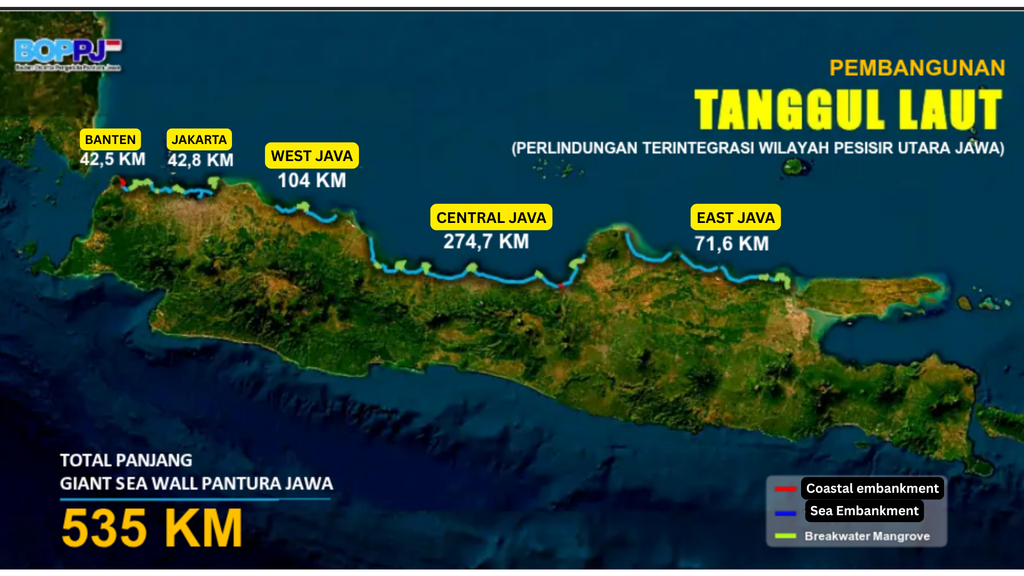
“The embankment is divided into three parts; there’s the coastal embankment, the sea wall, out in the sea, and then the green embankment, which you could call a nature-based solution, in this case, we mean mangroves,” Nazib said in an interview with Konde.co at his office on September 9, 2026.
Construction of the grey infrastructure, the sea wall that fills in parts of the sea to hold back waves, is targeted to break ground in 2027. Meanwhile, the mangrove-based construction is targeted to begin in October 2026.
“Now, regarding groundbreaking, for the grey infrastructure, that means building the sea wall, filling in the sea, so that later it’s as if the waves are blocked out in front. That’s if things go smoothly, God willing, next year. But the nature-based solution, the mangroves, God willing we’ll break ground in October.”
According to Nazib, the government is currently drafting a Master Plan that will serve as the reference for building the GSW. He says the document is being drawn up together with the North Java Coast Management Authority (BOPPJ) and regional governments, including to integrate Jakarta’s existing coastal embankment plans.
Read more: Women Ojol’s Path, Betting on Asphalt and Algorithms: Konde.co Research Results (2)
“So right now the team is working with BOPPJ, the Authority Board, and the provincial government. Like DKI Jakarta already has a plan to build a coastal embankment, and the Ministry of Public Works’ directive is to integrate it, and so on,” Nazib says.
He says the Master Plan will eventually cover the construction plan, financing, and performance indicators. However, at the time of the interview, the document was still being finalized, so details about the final form of construction and the division of responsibilities were not yet fully available to the public.
“That’s going to be laid out in what’s called the Master Plan, which is currently being finalized. Everything will be in there, from the plan itself, to financing, including the KPIs.”
In August 2025, President Prabowo Subianto established the North Java Coast Management Authority through Presidential Regulation No. 77 of 2025. Deputy Minister of Marine Affairs and Fisheries Didit Herdiawan was appointed head of the authority. Above him sits a Steering Committee chaired by Coordinating Minister for Infrastructure Agus Harimurti Yudhoyono, with several ministers as members, including the Minister of Public Works and the Minister of Environment.
Nazib Faizal says the GSW will be built in 15 segments. Jakarta and Semarang are the areas receiving earlier attention because their rate of land subsidence is considered faster than in several other cities, and because of the greater concentration of economic assets that need protection.
Nazib himself acknowledges that GSW’s challenges go beyond just building the wall. The fate of fishers, changes in livelihoods, spatial planning, financing, and inter-agency coordination will all help determine its long-term impact.
Read more: Cabinet Absent, Women’s Issues Absent: Research on 100 Days of Prabowo-Gibran Government
“So hopefully, as the steering team, we can direct this optimally so it aligns with what the President wants, with the goal of really benefiting the community,” Nazib says.
The urgency of the project is seen as rooted in a real threat. Research by Rendi Handika, Joko Widodo, and Andrea Emma Pravitasari, published by BRIN in 2024, titled Combined Land Subsidence Analysis in Jakarta Based on PS-InSAR and MICMAC Methods, found that Jakarta’s average land subsidence rate reaches 5.71 centimeters per year, with the most dominant subsidence occurring in North and West Jakarta.
That research links land subsidence to several factors, including groundwater extraction, natural consolidation of alluvial soil, the weight of buildings and infrastructure, population density, economic and industrial activity, tectonic activity, and land use patterns.
Through MICMAC analysis, excessive groundwater extraction for industrial use emerged as one of the most significant factors.
These figures become even more concerning when paired with sea level rise. At a National Seminar on the Giant Sea Wall on January 10, 2024, then-Coordinating Minister for Economic Affairs Airlangga Hartarto stated that land subsidence along Java’s north coast (Pantura) ranges between 1 and 25 centimeters per year, while sea level rise is estimated at 1 to 15 centimeters per year. The combination of the two is seen as threatening industrial zones, special economic zones, and tens of millions of residents along Java’s north coast.
The World Bank projects that by 2030, rising sea levels could leave around 5.5 to 8 million Indonesians living in areas at risk of tidal flooding. From late 2022 to early 2023, around 80 percent of the Central Java north coast was also reported to have been affected by flooding.
Read more: Records on Prabowo-Gibran’s 100 Days of Work from the Perspective of Women and Social Justice
The problem is, for coastal communities, these figures don’t just point to a need for protection from the sea. They also point to problems occurring on land and in coastal governance.
The Coalition for Fisheries Justice (KIARA) argues that the threat of coastal flooding cannot be separated from how the state has long viewed Jakarta’s coastal kampungs.
“The government’s perspective still sees Jakarta’s coastal areas as slums that need to be redeveloped and relocated,” Fikerman explains to Konde.co via an online call on Sunday, August 23, 2026.
According to Fikerman, coastal kampungs are not simply areas to be redeveloped. Within them are living spaces, jobs, and ways communities manage their environment that have taken shape over many years.
Problems arise when the sea wall is positioned as the primary answer to the climate crisis in Jakarta Bay.
“The government argues that in the Jakarta Bay context, the form of adaptation, or the form of climate change mitigation, is to build the Giant Sea Wall, the massive sea wall,” he says.
KIARA then traced the actual function of the construction. According to Fikerman, GSW needs to be seen not only as coastal protection infrastructure, but also as part of connectivity for industrial areas.
“And it turns out, after we looked into it further, that the giant sea wall is really just part of the infrastructure to ease industrial mobility, connecting industry in East Java, Central Java, West Java with industry in Jakarta and Banten.”
That view is reinforced by KIARA, which links GSW to earlier development experience, including the KOTAKU program that targeted Jakarta’s coastal areas during the first period of Joko Widodo’s presidency. According to Fikerman, the results of that World Bank-funded program were not felt by residents in the way they had hoped.
Read more: Women Activists Ask Government to Strengthen His Commitment at the Commission on Status of Women (CSW)
He also raises residents’ experience when neighborhood restructuring resulted in new housing options. Communities, he says, were offered various forms of housing, including public flats (rumah susun) and stilt houses in areas like Muara Angke, so they could continue their lives after the restructuring.
Because of this, Fikerman argues, the fundamental issue is how the government defines coastal problems in the first place.
“When really we can see how the carrying capacity of Jakarta’s coast is increasingly under pressure,” he says.
In his view, as pressure on the coast keeps growing while the solutions on offer remain centered on a single large-scale piece of infrastructure, there’s a risk that the root problem goes untouched.
The government has also included mangroves as part of the GSW system through a nature-based solution approach. However, the existence of mangroves in Jakarta itself faces ecological and spatial planning problems.
KIARA’s study notes that Jakarta’s mangrove areas continue to shrink. According to Fikerman, legal recognition for mangrove areas is also increasingly hard to obtain. He links this issue to Jakarta’s Regional Spatial Plan (RTRW).
“In terms of climate context, whether adaptation or mitigation, it isn’t reflected at all in the DKI Jakarta Provincial RTRW regulation. So from a spatial planning standpoint alone, we can see this issue isn’t a priority for the DKI Jakarta provincial government.”
Concerns about the direction of development also surfaced at a Pantura community meeting in Semarang in July 2026. KIARA’s Advocacy Manager, Erwin Suryana, highlighted the fact that the GSW groundbreaking plan has changed several times, leaving residents without clarity on the project’s form, stages, and implementation.
Read more: Ahmad Dhani Being ‘Racist’ and ‘Sexist’, Komnas Perempuan Urges DPR-RI to Investigate the Case
Erwin also warned that a project framed as coastal protection can carry broader consequences, including the commercialization of areas and the expansion of investment. He said GSW risks becoming a gateway for new economic clusters and industrial areas along Java’s north coast.
Fishers like Kalil and Ipah, and their children and grandchildren, see this change as potentially shifting their livelihoods away from sea-based work toward other jobs, such as ship laborers or industrial workers, while also thinning out the yield and diversity of their catch.
Similar concerns were previously raised by the Indonesian Forum for the Environment (WALHI). In 2024, WALHI stated that GSW does not address the root ecological damage on the island of Java, which is tied to exploitation for industrial interests, including the factors driving land subsidence.
According to WALHI, building embankments will not be enough to address tidal flooding if pressure on the environment, both inland and along the coast, isn’t addressed at its source. Changes to natural currents caused by infrastructure development and reclamation also have the potential to affect marine ecosystems and fish populations that serve as the livelihood of coastal communities.
From an architectural and urban planning perspective, RUJAK Center for Urban Studies questions whether the GSW design has sufficiently accounted for how coastal communities live and work.
Benaya explains the issue through the condition of Muara Angke. For fishers, the sea is not just an area that needs protection from flooding, but also a place they earn a living.
“With the Giant Sea Wall, this actually restricts their movement. The Giant Sea Wall, as initially conceived, tends not to accommodate the needs of the community there, like fishers, like the fish porters and the loading process.”
Read more: TEDxEast Cempaka Baru Street Women Expose the Face of Capitalism and Patriarchy
A conventional sea wall could potentially cut off the access that has long connected the sea, the docks, and the settlement.
“Because with a conventional Giant Sea Wall, it tends to close off, I mean, community accessibility.”
Fishers need routes to move boats in and out, while unloading fish depends on direct access to the sea. So coastal protection that cuts off that access could create new problems for the very community it’s meant to protect.
The problem also doesn’t stop at the relationship between the sea and the land. Benaya believes tidal flooding and groundwater conditions need to be read as a single system.
“Tidal flooding can’t be resolved by the Giant Sea Wall alone. It can’t be resolved just by cutting off access to the sea,” he says.
He explains that seawater can also enter through the groundwater system.
“But this tidal water also comes in through the groundwater, what’s called saltwater intrusion. So seawater has already entered the groundwater reserves, so no matter how the sea wall is built, that water is already in the ground.”
Hydrogeologically, tidal flooding and seawater intrusion are two distinct issues. Tidal flooding refers to inundation caused by seawater entering land, while seawater intrusion refers to saltwater entering the groundwater system. Both relate to ongoing pressures within the coastal hydrological system, but they cannot be resolved with the same intervention.
Read more: ‘Quickly to Reverse Problematic Policies about Human Rights’ HRW Warns Prabowo-Gibran
“So really, that issue can’t be solved one thing at a time.”
The problem of land subsidence illustrates why this approach matters. As the land keeps sinking, the risk of coastal flooding isn’t determined only by sea level. Soil conditions, groundwater, geological characteristics, and the development built on top all shape an area’s vulnerability.
Thus, a sea wall may reduce exposure to water coming from the sea, but it won’t necessarily stop the process that causes the area behind the wall to keep subsiding and losing its ability to cope with heat, tidal flooding, and other environmental pressures.
Another issue arises from the sheer scale of GSW, stretching from Banten to East Java. According to Benaya, an area that large cannot be treated as a single region with uniform problems.
“Because if, say, there’s a plan to build a Giant Sea Wall across the whole of Java, imagine how much research would need to be done just to match the needs of each Giant Sea Wall location.”
Each area has different characteristics: culture, work patterns, economy, fishing activity, environmental issues, and rates of land subsidence. Benaya points to the assumption that Jakarta is the area sinking fastest, while Demak is actually experiencing even faster land subsidence.
“So if a Giant Sea Wall is built but the area behind it is sinking, well, it’s the same thing anyway.”
The question of who is actually being protected also becomes concrete in Muara Angke. One example concerns the floating houses (rumah apung).
“If, say, the Giant Sea Wall is built, will the floating houses end up outside the wall or inside it? So far, they haven’t been able to answer that.”
Read more: Reflections of the Feminist Movement on the Rejection of JILF: “Who Do We Work With?”
That question, he says, matters for seeing whether the community becomes part of the process of designing the infrastructure, or whether they simply have to adjust once the design has already been decided.
He also views this as a form of disconnect between institutions, whether between the central and regional governments, or with educational institutions and specialized bodies working in a given area.
“Between central government policy, educational institutions, regional government, and specialized institutions or bodies in a given area.”
Poor coordination, he says, can turn a program designed to reduce risk into one that instead deepens existing vulnerability.
Concerns about the lack of data on affected communities were also raised by Hotmauli Sidabalok, an environmental expert from Soegijapranata Catholic University in Semarang, at a KIARA forum in July 2026.
She urged relevant ministries to first deploy teams to gather detailed data on the spread of settlements, population figures, housing units, assets, and livelihoods of communities likely to be affected. She said such data is needed so residents have a basis to demand accountability before construction begins.
“Economy First, Then Social and Environmental Concerns” What About the Public Consultation?
On the Master Plan that RUJAK and KIARA describe as unclear and constantly changing, Nazib Faizal confirms that the document is indeed still being finalized.
“It’s already there (the construction plan). It’s being finalized. It should be clear this month (September), because this simulation covers five years. The prediction is maybe 2045 before the GSW is finally done,” said Nazib Faizal.
The government sees the urgency of GSW as rooted in the large economic value of the Pantura region. Nazib explains that the economic approach comes first as a consideration because the area supports a large share of the national economy.
“23% of Indonesia’s GDP comes from Pantura, basically the industrial areas. Starting from the industrial zones in Brebes, then Semarang, Kendal, Cikampek, North Bekasi, and so on. Are we really going to let them get submerged? So our approach is economy first,” Nazib explains.

After the economy, the government places social issues as the second priority. Nazib points to the inequality visible in North Jakarta, where dense settlements stand right next to luxury apartments.
“Look at North Jakarta, look at the luxury apartments, and right next to them, slums. Are we really going to let that be? Shouldn’t we improve it, give people a decent rusun [flat], with public and social facilities, a city park, and so on? Then we fix up the port, clean up the water, and so on,” Nazib says, describing his vision.
Read more: Sexual Violence in Depok: Alleged Perpetrator is a Legislative Member, Activists Urge to Remove His Position
The environment is positioned as the next priority. Nazib emphasizes the importance of mangroves, the economic value of carbon credits and the blue economy, and managing rivers from upstream to downstream.
“We know mangroves are one of the plants that produce a huge amount of oxygen, right. And that’s tied to carbon credits, or the blue economy, which has really high value.”
“That includes handling things downstream in step with handling things upstream. There’s no point building a neat Giant Sea Wall downstream if the river upstream is full of trash, right, it just becomes a trash collector at the end. There’s the Ciliwung River, the Cisadane River, flowing into Jakarta Bay. We’re working on this too, so that protected areas can, well, become expanded water catchment zones and so on,” he explains.
This order, economy, then social issues, then environment, is one of the points criticized by KIARA, RUJAK, and WALHI. Their criticism isn’t aimed solely at the existence of the sea wall itself, but at questions about what should be protected first and who bears the consequences of its construction.
All three organizations believe GSW risks being built primarily to protect Pantura’s industrial areas and economic assets, while residents who have long lived and worked in coastal areas face uncertainty over their living space, work, and access to the sea.
This issue becomes concrete when the conversation turns to plans to relocate residents into public flats. Benaya earlier linked residents’ opposition to issues of land legality and housing certainty.
Nazib says the government understands that this process cannot be carried out through administrative decisions alone.
Read more: Sexual Violence Around Regional Elections, Regional Head Candidates Alleged as the Perpetrators
“When there’s pro and con, that’s what makes this world dynamic, right. The opposition, there’s definitely a reason for it, right,” Nazib says.
According to Nazib, social and environmental issues should be addressed before construction even begins.
“Early on, Pak Menko (Coordinating Minister for Infrastructure Agus Harimurti Yudhoyono) said that the first order of business, before groundbreaking even begins, is that social and environmental issues have to be prioritized. What does that mean? This team has to go meet the RT head, meet the residents. We try to build community relationships, we try to explain. We even have to ask, ‘What do you want, sir?'”
He acknowledges that residents’ objections to eviction are understandable, given that their home is also their place of work.
“I imagine it too, if we were suddenly told to move, the first thing that would come to mind is refusal. As a person, well, maybe born there, earning a living there, and so on. But if we succeed in explaining the impact, for example, what the benefits of relocation would look like, how residents’ rights can be improved, made more prosperous, I think residents would agree too,” he continues.
That statement reflects the government’s approach of placing communication and explaining benefits as key to gaining residents’ acceptance. But the issue, as Kalil puts it, isn’t just whether the government has explained its plans, it’s whether residents have equal space to influence the decision and reject consequences they don’t want.
Nazib also acknowledges that government communication is often a problem in itself.
Read more: #YouthMarginalized: Laborer’s Sunday Nights, Drinking Starling Coffee and Sitting in the Square
“Sometimes, forgive me, but maybe because of the government’s failure to explain a program properly, and its impact, that’s when the public thinks, ‘What is the government even doing?’ And it has to be explained in the simplest terms, using ‘baby language,’ as they say. We can’t go all theoretical with the public,” Nazib exclaims.
Nazib’s self-criticism aligns with the experience Benaya described regarding the construction of stilt houses and floating houses in Muara Angke, which shows a gap between that communication principle and the experience of some residents. In Benaya’s account, residents were once given 24 hours to decide whether to move or face the demolition of their homes.
As part of the GSW Oversight Board team, Nazib claims that the outreach process for the giant sea wall project has been carried out together with regional governments. He says the outreach has been done in stages, including with provincial and district governments in priority construction areas.
“First we go to the regional government, the district government, following the Minister’s directive. Come on, we can’t have a disconnect between the central government and regions. It happens often, right, the center goes one way, the region goes another. That can’t be allowed to happen,” Nazib says.
He claims communication with several regional governments, particularly DKI Jakarta, West Java, and Central Java, has been ongoing. According to him, Jabodetabek is the initial priority, followed by Semarang and Demak.
“Thankfully, we have a very close relationship with several provinces, particularly Jakarta, West Java, and Central Java. Because the main priority is Jabodetabek first. After Jabodetabek, Semarang, Demak,” he says.
Read more: #KBGOut: Deepfakes Attack Female Journalists, Content Creators Use Women as Tools
This explanation aligns with a written statement from the Jakarta Environmental Agency (DLH DKI Jakarta) to Konde.co, received on September 4, 2026. DLH DKI Jakarta states that every infrastructure development in Jakarta must obtain environmental approval. In preparing the Environmental Impact Analysis (AMDAL), potentially affected communities, local governments, project developers, and relevant stakeholders are involved to provide input.
According to DLH, this involvement is important to ensure the impacts of development, including on vulnerable groups such as women and children, are taken into account from the planning stage. One mechanism is public consultation, which allows directly affected communities to submit suggestions, opinions, and responses regarding the development plan and its potential impact on the environment and their lives.
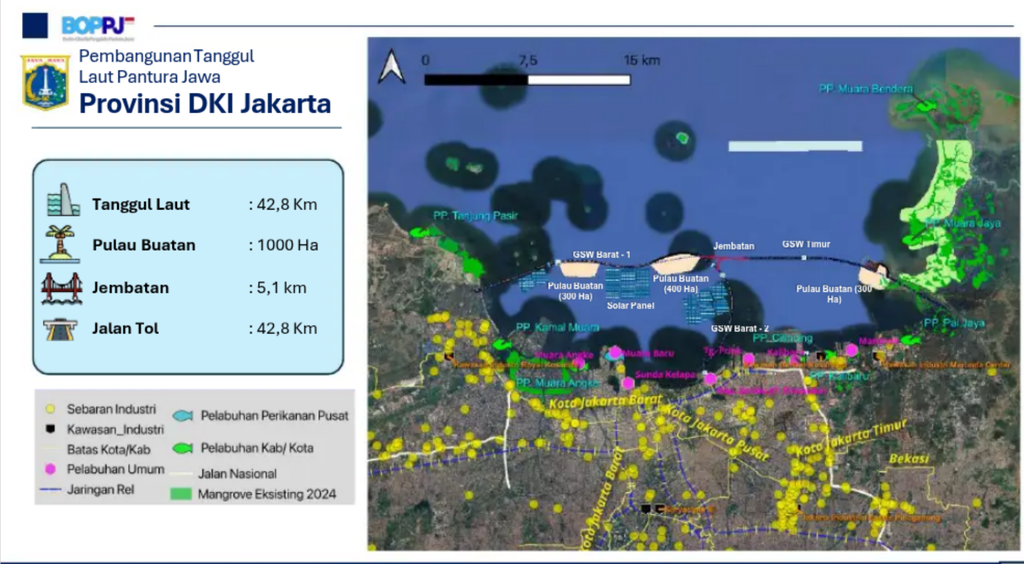
In the AMDAL process, DLH serves as regulator, assessor, supervisor, and facilitator. DLH states that input and agreements from relevant stakeholders can be considered and incorporated into environmental documents.
Nazib then cites access to clean water as an issue he says must not be left behind amid large-scale infrastructure development.
“Don’t let it be that people are protesting, demonstrating, or, forgive me, that they’re just watching from the sidelines, seeing this big building go up, while they’re still buying clean water by the jerry can,” Nazib says.
Read more: Where to Find Traditional Papuan Food? Our Forests Are Destroyed, Women Are Invaded by Cosmopolitan Food
According to Nazib, regional governments in Central Java share a similar view. He describes attention to social and environmental issues as a value judgment that will shape future development.
“Including in the Central Java provincial government, they think the same way. Because it matters, that way of thinking is actually simple, but it determines what comes next. That’s the value in it,” he says.
Claims about this outreach ultimately need to be viewed alongside the fact that the project is still ongoing. The Master Plan is not yet final, GSW’s design can still change, and the government has yet to explain in detail how residents’ input will be translated into decisions on design, sea access, relocation, livelihoods, or the form protection will take in each area.
The debate over this project also reveals another divide between the government and civil society groups: the question of evidence.
Fikerman and Benaya both cite the reclamation of 17 islands during the Ahok era as one experience that has already changed traditional fishers’ fishing grounds. Responding to this, Nazib emphasizes that changes in catch need to be proven through verifiable data and studies.
“So we know about data, right. Sometimes, there’s technology that can determine how many fish there are, that still exists, I’m sure, in this day and age. Whether it’s radar, sonar, all of it,” Nazib asserts.
He also questions relying on individual testimony as a basis for concluding that catch has declined.
Read more: Overcoming Marginalization: Inclusive Pathways to Peace and Cultural Recovery
“Then sometimes the size of the catch is just based on what people say. This needs to be checked. Just going by word of mouth, ‘Is this true or not? Has the catch really declined?’ It needs to be checked. There has to be evidence. It has to be evidence-based. It can’t just be because one person says, ‘My catch has gone down.’ There has to be a study behind it,” he continues.
However, when asked about studies on fishers’ catch and water pollution, particularly around Muara Angke, Nazib says such research is still ongoing and has not yet produced any publication. According to him, the study is still at the design stage and has not yet been incorporated into the GSW master plan.
“It’s still being done, ongoing. Like I said, it’s just at the design stage now, not yet in the master plan.”
Nazib’s demand that fishers’ experiences be proven through evidence-based research runs up against the fact that the studies that could serve as the basis for such proof, by his own account, are still in the design stage even as GSW itself is being prepared.
The demand for data is also, in essence, raised by KIARA and RUJAK. The difference lies in the question of when such studies are conducted and with whom.
According to KIARA and RUJAK, studies on the impact on communities should be openly available and should involve residents before decisions on relocation or construction are made.
Fikerman notes that changes to fishing grounds caused by reclamation have been felt by fishers for some time. Damage to coral reefs, he says, has forced fishers to go increasingly far out to sea, as far as the waters off Banten and Bekasi.
Read more: How Should You be a Young Person in A Time of 26USD Buns and Palace Family of Nepotism?
From an economic standpoint for fishers, Nazib himself, as a government representative, emphasizes that eviction shouldn’t simply mean relocating a house. What needs to be calculated is whether residents can still maintain their income after moving.
“So the fishing business process has to be clear. If they’re relocated here, where do they fish, roughly what’s the estimated drop in their catch. It can’t just be, sir, moving them. That’s easy, sir, moving people. Doesn’t cost money. ‘Here, you move.’ That’s not how it works. It can’t just be like that.”
He gives a simple example of how income should be calculated before an eviction.
“But it has to be checked, ‘How much is your income? Sir, you make 5 million a month.’ Okay. Our fisher friends, they used to make 5 million a month. Now we relocate them, what does the simulation look like? Do they still get 5 million a month or not?”
However, there has so far been no detailed explanation of the mechanism for this kind of measurement, or how the results would be binding on eviction decisions.
At the same time, Nazib also has his own reading of the Jakarta Bay reclamation. He says the project originally included a plan to relocate fishing communities, but it stalled after a change in political leadership.
Read more: ‘Black September’, Diva Suukyi’s Story and the Victims of Human Rights Violation Cases
“Those 17 islands, actually, if I look at it, there was supposed to be relocation first, right. There was actually supposed to be relocation of the fishing communities. But things got noisy too quickly, the governor changed, and in the end the permits for 13 islands were revoked, right. If you look more closely, and I’m not saying I’m pro-government, I’m not trying to be neutral here either. That plan actually existed. Reclamation to benefit the community, that existed. It just got revoked too soon,” he explains.
The differing ways of reading the reclamation experience show why evidence, studies, and community involvement matter. For the government, impact needs to be proven through data before it becomes the basis for policy. For residents, changes to fishing grounds and livelihoods are an experience that has already occurred and, in their view, should itself count as valid data.
Hotmauli Sidabalok and coastal activists have previously flagged this gap: an unfinished project can create new risks for residents living around the construction area, while full protection is not yet in place.
That threat has already knocked on Kalil, Ipah, and their children’s door, and it isn’t waiting until 2045. The tidal flooding comes now. The heat is felt without end. Income from the sea keeps shifting unpredictably. Their home has already faced uncertainty since the climate became a crisis.
This report was produced as part of the Media Fellowship under the Cities on Fire initiative in Bangkok, Colombo, Jakarta, and Manila and ‘Cooler Cities. Healthier Children. Brighter Futures.’ Initiative in India.