



The 81st session of the United Nations General Assembly (UNGA) in 2026 once again brought the issue of Papua to the international stage.
Several Pacific nations, including the Solomon Islands and Vanuatu, called on the United Nations to send the UN High Commissioner for Human Rights to Papua to verify allegations of human rights violations. Indonesia’s Permanent Representative to the UN, Nona Gae Luna, promptly exercised her right of reply to respond to these calls.
Indonesia rejected the allegations, emphasizing that it takes credible allegations of human rights violations seriously and addresses them through national institutions and legal mechanisms, including the independent National Commission on Human Rights (Komnas HAM). The government also maintained that a visit by the UN High Commissioner for Human Rights must be agreed upon between the host country and the Office of the High Commissioner, rather than dictated by other countries or regional organizations.
In its right of reply, Indonesia also argued that discussions about Papua must take a holistic view of the situation. Nona highlighted the murders of three civil servants, the death of a driver transporting essential supplies, and the abduction of nine women and children, all of which were attributed to armed groups in Papua. The Indonesian government further stressed that human rights issues should not be used to justify violence or support separatism.
Read more: Why “I am Jane Doe” Matters: the Cornell University Case is an Urgent Alarm to Take Sexual Violence Seriously
Violence against civilians by armed groups is indeed a serious concern and must be investigated. However, taking a holistic view of Papua also means examining allegations of human rights violations by security forces against Indigenous Papuans (Orang Asli Papua, or OAP), the displacement of communities resulting from armed conflict, and restrictions on journalists seeking to report from the region. A comprehensive account of the conflict cannot focus exclusively on violence attributed to non-state armed groups while overlooking allegations involving state actors.
Unfortunately, the Indonesian delegation did not address the mass displacement in Maybrat. Nor did it discuss allegations of security forces’ involvement in shootings of civilians in Maybrat, which have been monitored by Komnas HAM and the Regional Representative Council (DPD). The delegation also did not mention the series of civilian deaths in Intan Jaya throughout July.
The Indonesian delegation also made no reference to Human Rights Watch’s 2025 report, which warned that escalating conflict between Indonesian security forces and Papuan armed groups threatens civilian safety, particularly that of Indigenous communities. The report also highlighted the risks of human rights violations, restrictions on civil liberties, and repression targeting human rights defenders and nonviolent political activists.
Beyond the armed conflict, the government’s national strategic food estate project in Merauke, Boven Digoel, and Mappi has also drawn criticism over its implications for Indigenous peoples’ rights and environmental protection. These concerns, discussed in analyses such as CELIOS’s examination of food estate policies, illustrate how the Papua question extends beyond security and territorial integrity to encompass land rights, environmental justice, and the future of Indigenous communities.
Pacific Nations’ Continued Pressure on Indonesia over Papua
Indonesia’s defensive response at the UN in September 2026 was not the first time Pacific nations had raised Papua in international forums. Their calls for international scrutiny have a long history, repeatedly bringing Indonesia into diplomatic confrontations over human rights, self-determination, and access for international observers.
On September 28, 2013, during the 68th UN General Assembly, Vanuatu’s then-prime minister, Moana Carcasses Kalosil, raised the issue of Papua within the framework of decolonization and the right to self-determination. A similar pattern emerged in 2016, when several Pacific nations expressed concern about human rights conditions in Papua during the UNGA. Indonesia’s delegation accused them of misusing the UN forum, arguing that their criticism was politically motivated and supported separatist groups.
Diplomatic pressure continued in March 2017, when seven Pacific nations called for a UN investigation into alleged human rights violations in Papua, including extrajudicial killings and violence against activists. Indonesia once again rejected the allegations of widespread and ongoing violations.
The debate has extended beyond statements and diplomatic rebuttals. In February 2018, President Joko Widodo received the then-UN High Commissioner for Human Rights, Zeid Ra’ad Al Hussein, and the Indonesian government extended an invitation for his office to visit Papua. However, the Office of the High Commissioner subsequently indicated that the invitation had not yet been followed up on.
Read more: Mothers and Children Trapped in Heat Along the Rail Tracks: How Kampung Muka Adapts, Rebuilds, and Cools
This unresolved issue resurfaced at the 81st UNGA in September 2026. Solomon Islands Prime Minister Matthew Wale renewed his call for a UN human rights visit to Papua, while Marshall Islands President Hilda Heine expressed support for Indonesia facilitating such a visit.
Pressure has also continued through the Melanesian Spearhead Group (MSG). In September 2026, several member states indicated that Indonesia’s status as an associate member could be reviewed if Jakarta failed to facilitate a visit by the UN High Commissioner for Human Rights in time for a report to be produced before the group’s next meeting in 2027.
Taken together, these developments reveal a recurring pattern. Whenever Pacific nations call for international investigations into alleged human rights violations in Papua, Indonesia’s response tends to center on sovereignty, territorial integrity, and accusations of support for separatism. Meanwhile, the demand for independent access remains unresolved.
Beyond the Diplomatic Standoff: The Consequences of Securitization
Behind the diplomatic exchanges lies a reality that cannot be reduced to competing national narratives: recurring allegations of human rights violations, the appropriation of Indigenous communities’ customary forests, and the government’s reliance on a security-centered approach to the conflict in Papua.
In Securitization of a Political Conflict in Southeast Asia: Disengaging the Indigenous Audience in West Papua, Hipolitus Ringgi Wangge argues that a securitization approach, which frames a conflict primarily as a security threat, tends to measure policy success through the state’s ability to control armed groups and maintain territorial integrity.
In international forums, this approach can become a way of reinforcing the state’s preferred explanation of the conflict. When Pacific nations call for investigations or access for the Office of the High Commissioner for Human Rights (OHCHR), Indonesia can respond by emphasizing armed groups, separatism, stability, national sovereignty, and the capacity of domestic institutions. As a result, attention may shift away from allegations involving state officials and toward the state’s legitimacy in maintaining security.
However, this does not mean that every reference to armed groups is inherently problematic. In an interview with BBC News Indonesia, Heribertus Jaka Triyana, a professor at the Faculty of Law at Gadjah Mada University (UGM), pointed out that armed groups can indeed commit violence against civilians. The central question is whether the security framework is applied proportionately and whether it leaves sufficient room to investigate alleged violations by all parties.
Read more: Enduring Heat and Tides: A Fisher Family in Muara Angke Faces the Giant Sea Wall and Eviction
This distinction matters because the protection of civilians must remain central regardless of who commits the violence. Are civilians adequately protected? Can displacement be brought to an end? Can allegations against security forces be investigated independently? And do Indigenous communities have meaningful opportunities to express their demands and participate in decisions affecting their lives?
When a conflict is primarily framed as a threat to the state, these questions risk being sidelined. Civilian casualties, accountability for security forces, forced displacement, and the political demands of Papuans can become secondary to discussions about national stability and territorial integrity. The consequences are not merely diplomatic; they affect the daily lives, safety, and rights of people living in conflict-affected communities.
Indonesia’s permanent representative to the UN has emphasized that national institutions and legal mechanisms, including Komnas HAM, are capable of addressing alleged human rights violations in Papua. Yet this raises a fundamental question: how willing is the government to facilitate independent access so that allegations can be examined and verified?
Indonesia does not need to choose between sovereignty and human rights. Independent scrutiny does not automatically threaten territorial integrity. Rather, it can help establish the facts, strengthen accountability, and build public and international confidence in the government’s commitment to protecting civilians.
The Pacific nations that have repeatedly raised concerns about Papua are calling for international access and verification. Their demands should not simply be dismissed as political interference or support for separatism without addressing the substance of the concerns being raised.
Read more: “Where’s Your Headscarf?”: Misogynistic Rules Run Rampant, Women’s Bodies Continue to Be Regulated
Ultimately, Indonesia’s response to the Papua question will be judged not only by its ability to defend its position in international forums but also by its willingness to confront allegations of human rights violations and protect the people living in Papua. A credible response requires more than invoking sovereignty or pointing to domestic mechanisms; it requires transparency, accountability, and meaningful opportunities for independent verification.
As long as Indonesia continues to prioritize securitization over dialogue and accountability, it risks remaining trapped in a defensive diplomatic cycle. This approach may reinforce Indonesia’s position in the short term, but it does little to resolve the underlying concerns raised by Pacific nations or address the suffering of Papuans, whom the Indonesian state is obligated to protect as its citizens.
Defensive diplomacy built around sovereignty and security is not necessarily a demonstration of strength. When it repeatedly substitutes rebuttals for independent verification, it risks undermining the credibility Indonesia seeks to defend. The challenge is not simply to persuade the international community that Indonesia’s position is legitimate, but to demonstrate that the rights, safety, and voices of Indigenous Papuans are being taken seriously.
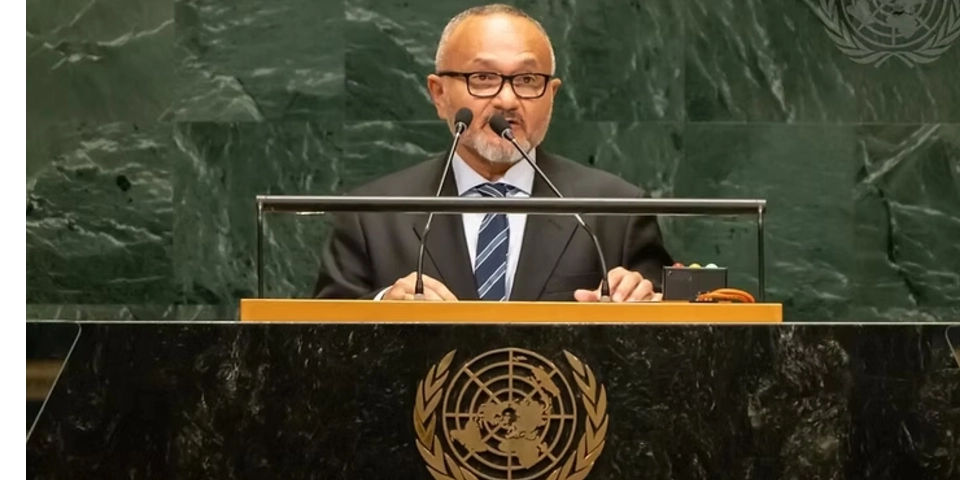
Photo: Solomon Islands Prime Minister Matthew Wale made an emotional plea to Indonesia at UN General Assembly in New York. 25 September 2026. Source: UN Photo
(Editor: Salsabila Putri Pertiwi)