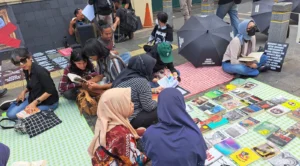





A special edition from Konde.co to provide an article about women’s legislative candidate campaigns during failing politics.
Yuniyanti Chuzaifah looked frustrated while setting the women’s legislative candidate billboards because it was like she wanted to “sell” them.
There was woman candidate who made her face looked younger or over make-up. It seemed being young was a must, while being older would end everything.
Next, Yuniyanti questioned whether it was the party’s requirement or the success team’s request to make women look beautiful and sexy.
Read More: The Portrait Of Waria Religious: They Are Not Immoral
Konde.co did observation in Palmerah, Menteng, and Depok. They found Partai Solidaritas Indonesia (PSI) – Indonesia Solidarity Party used slogan “mamah semok” for Desi Dwi Jayanti candidate and “mamah muda” for Lydia Octavia candidate. The other part of Jakarta also installed posters prioritizing beautiful and handsome faces. Some activists saw this as the use of women’s sensuality as a tool to collect votes.
Did the party request women candidates to use this way to gain 30% votes in parliament? How was about men candidate? How were the party’s responses, whether they ignored or did endorsement to gain more votes?
Konde.co teams explored the motivation of using bodies and sensuality in election campaigns.
Women’s stigmatization in elections
In December 2023, Yuniyanti Chuzaifaih indicated the stigma of women in campaign billboard in her speech during one of women’s organization event. This was another form of cultural stigma toward women when community could accept women who were beautiful, sexy, and young. Next, it was embodied with election campaign. Another example was public would label women candidate as non-Muslim if they didn’t use hijab. The terms sexy or young mother-mamah muda to explain a mother who flirtatiously became popular. Furthermore, it became strategy in advertisement.
Yuniyanti added that the party should take responsibility for this campaign method. They seemed to sacrifice women in the middle of a failing political era.
On January, 22nd 2024, Konde.co interviewed Yuniyanti and she said that this condition was political and party problems in Indonesia. They used patriarchy to frame women as a victim, including women candidate in parliament.
Read More: From Stereotypes to Struggles: How Age Discrimination Hits Women Harder
The party usually avoided competent women because they didn’t really choose women as candidate. So, women who joined parliament usually came from crazy rich types, while the party was too lazy to give political training to women. The rapid election process supported this idea by only looking into the appearance of young, good-looking, or handsome with money for men candidates.
“In Sulawesi, they will suggest you to vote for beautiful and young women candidate”
Another pattern was the candidate was biological/ in-law from previous official or influenced person.
“This is a dilemma in masculine and patriarchal political systems. It is not always bad because women are unable to compete in a male system.”
Nevertheless, Yuniyanti suggested to more critical to look into this matter. Was it women candidates’ willingness, or was it only sexism so intellectual sanity was unimportant?
“Second, this makes sexism stronger in politics. It looks like politics is peddling women as in entertainment despite the fact they will become leaders.”
Yuniyanti started questioning again about where/ how it began. Was it requested by the party or success teams?
“So, it seems women should fight again in the middle of failing politics”
Patriarchy culture behind sensational board of women candidates
Konde.co interviewed two women candidates, Desi Dwi Jayanti and Lydia Octavia. They used term “mamah muda” and “mamah semok” on their billboard. Konde.co team wanted to understand their motif to use those terms. Was it their wish or the party?
Desi Dwi Jayanti said that using the term mamah muda as a branding was a term to describe her identity. She was 35 years old mother with a child. She married at 22, so the term mamah muda was identic for her.
“The term mamah muda is describe me well. It comes from friends, family, and best friends. In addition, the term is more suitable for me because I come from young people party, PSI. Their branding is youth” she said (Monday, 29/01/24).
She discussed her idea with her success team until it became a campaign strategy.
“It used reverse psychology or marketing approach” she said.
Read More: HRW: Protect Newly Arrived Rohingya Refugees, Prevent Anti-Rohingya Violence in Aceh
In reverse psychology or marketing approach, the buyer would search for the seller, it was not like the usual marketing strategy. The persuasive tactic was essential on this approach.
In political campaigns, this approach used campaign tools to gain the public through mainstream promotion or maybe it was potential to become controversial. For female candidates, this approach allows the perpetuation of patriarchy within masculine standards by objectifying women for their sensuality.
Nevertheless, Desi admitted that there were debates between her and her success team. She suggested putting a barcode to explain the meaning of mamah muda, but it was declined.
“I already put the explanation in the billboard using barcode. But the success team think too much about the design. They said it should simple, compact, clean, and consistent” she said.
Ultimately, the billboard strategy went to attractive branding with name and number. So, the public could remember it more quickly than billboards with too much information.
“The previous design has barcode with further information but it is unacceptable then we stick to current design” said a woman who was born in Kediri.
Read More: My Story Visiting Kampongs In Jakarta: Masculine Development Makes Women Poor
Her success team only spread the slogan as the first strategy and then continued to explain the word’s meaning after the public showed interest.
“The complete explanation is available on the website, so we can call a billboard a call to action to check the website.” she added
Desi Dwi Jayanti mentioned seven priority issues on her website. It included economy equality, education, health, young people public space, and women equality.
She continued to provide explanation after one influencer, @rreanggara roasted the term mamah muda. She made collabs content through social media and put “Memberi Akses Setara Perempuan di DKI Jakarta” -Give women equality access in DKI Jakarta explanation on her billboard. Desi understand the negative connotation on mamah muda word in public.
“But I don’t use the word to mean anything sensual. It is only for marketing strategy” said Region House of Representative (DPRD) candidate for electorate district (Dapil) DKI I (central Jakarta).
Read More: Annual Report Of Sexual Violence At University: Mostly From Sexist Jokes
Her success team already predicted the effect of the mamah muda term would gain criticism from netizens, women activists, and the media. In addition, Desi admitted that the use of mamah muda term was not to objectify women. It supposed to become discourse for negative meaning of mamah muda term.
“The real meaning of mamah muda is an independent young mom who has promising career but now wants to be politician. She is willing to hear public aspiration by providing her number, so public can follow it up. I want to give this real narration” said the woman who previously worked in media.
It is challenging to become women candidate
Desi admitted that become women candidate was not easy. In her electorate district, she needed to compete with 216 other candidates who dominated by males and wealthy people. They were children from official, celebrity, or from respected family and incumbent. So, she believed the campaign strategy was essential for a person who joined politics for the first time.
“So, I need to create creative strategy and design although it has negative connotation. But I have a chance to explain about it in the end and it effective. So, I made collabs content with influencer and media interview. It is powerful and free” she said
Lydia Octavia, a woman candidate for Depok, used a similar strategy. She narrated how was the term “mamah semok” used for her. It came from her body, which looked curvy and sexually attractive.
“This is the reason they called me semok. I try to have this body through fitness and running” she said to Konde.co on Friday (26/01/24).
Read More: Much Forgotten: Women Farmers as Neglected Dual Workers
She didn’t consider mamah semok term as negative connotation because according to Indonesia dictionary, semok means chubby. “It used for chubby person and I am cubby” she said.
She and her success team used semok for the abbreviation “Siap Melayani Depok” (SMEOK) – Ready to Service Depok. This slogan was different from other candidates.
“Mamah semok becomes something different because Depok is only using mainstream campaign strategy” she added.
The term “semok” has the meaning of sexy women but for Desi, it had a different meaning as “Semangat Depok” – Spirit of Depok.
“They have their opinion toward me, and I cannot decide it for them. I used this concept when I met the public” she said.
Lydia felt the branding made her more famous, mainly came from young generation in social media. They also helped to endorse her to their circle and family members. On the contrary, she admitted that some people harassed and blasphemous her. She responded it with love emoticon or joking phrases.
Read More: Restorative Justice Should Have The Victim’s Perspective, But Reality Shows Otherwise
She wanted to improve human resources in Depok if she became a legislative member. It was in accordance with her master’s degree as a psychologist. In addition, she wanted to increase job opportunities and skills for young people. It was a reason she put #PSIBerkarir as her initial to become young people spaces.
Desi and Lydia confessed that the whole campaign strategy came from them and their success team; the party was never involved.
“All ideas come from the candidate and their success team as long as they don’t harm the party or violate the law.” said Desi.
Imelda Berwanty Purba, PSI advisory board of Women, Children, and Health, said the political party opened for all creative ideas and expression for female candidates.
“The narration of “mamah muda” or “mamah semok” comes from candidates to show their locality so their community can accept them. Furthermore, the strategy can gain the most significant votes from their areas” said Imelda to Konde.co, Friday (2/2/2024).
Read More: Forgotten in Translation: How Women Contribute in Knowledge?
Also, she believed that the candidates’ campaign strategy reflected their community characteristics. It was not only a gimmick but a creative approach using local wisdom.
On the other hand, Imelda, candidate for DKI Jakarta II (South Jakarta, Central Jakarta, and foreign) used narration “Stop Women and Children Violence” as her mission and target. According to her, it was essential to not only use narration as a jargon but also as an approach. She stated that it was important to protect women and children from all forms of violence.
“This has always been my perspective to voice and fight since I was a domestic violence survivor in 2015” she said.
Konde.co asked about PSI’s effort to support their candidate in 2024, and Imelda said PSI had an equality principle as their value to meet 30% of women representatives in parliament. She expected that the existence of females in PSI was not only for representatives in parliament and public aspirators or the second choice after male candidates.
“For me, politics is not about gender. As a female candidate, I hope the public can accept me as an individual, capable, and brave public representative based on righteousness, fairness, and democracy.” she said
Demand political parties’ responsibility: ideology strengthening and bias dismiss
Usep Hasan Sadikin, researcher in Election and Democracy Organization – Perkumpulan untuk Pemilu dan Demokrasi(Perludem) considered current quality of Indonesia’ democracy was poor. The state was still not protecting political rights like freedom of speech. In addition, there were many biases in politics.
He gave an example of a stereotype of candidates that should be “beautiful”, “handsome”, “young”, and “religious”. Female also considered incompetent.
“We cannot deny the poor quality of Indonesia’s democracy, so, the narration of biases and inequalities become campaign’s narration. It becomes a consequence of government and election (politics) systems that center on individual figures.” said Usep to Konde.co, Thursday (1/2/2024)
He thought the election system drove us to be trapped in individual sentiments to gain votes, for example the candidate from respectful families, celebrity, or influencer.
Read More: A Distant Dream: A Feeling of Safety for Women in Palestine
“So, it drives us not to use our rationality to vote because the public is more likely to see individual sentiments that are more suitable to talk about in private areas.” he said
According to Usep Hasan, political parties were responsible for this. First, they should strengthen their ideology and cadre formation not based on individual background. If political parties perpetuated this idea, it would create biases.
“As long as they are famous or come from respectful families, they will become a priority in political parties rather than worthy candidates according to their education and cadre formation” he added
Nevertheless, Usep admitted this was not easy. The system never allowed parties to play their role as a fair requirement for their candidates and train them. It made political parties choose shortcuts by using controversial and sensational approaches to cadre formation because it would get fast public attention.
Next, Usep opinioned that the current political system made women become a vulnerable group. Females would experience inequality in the public sector, not only in domestic areas; for example, they should think about how to gain votes from the public.
“Women should compete between and within parties. It prejudices women’s solidarity because they cannot support each other. They should compete.
The struggle for ideas’ campaign
Konde.co interviewed Eva Sundari (23/01/24), a women activist and Nasdem party legislative candidate who had been in parliament. She also highlighted “mamah muda” and “mamah semok” term. She admitted she felt sad about this phenomenon because it campaign was directed to sensuality and harmed the female candidates.
“I feel sad because it creates contradictive. That female candidate aims to be selected but uses a domestic symbol that has meaning toward sensuality, whereas joining the politics is for equality purposes. If they are using political “domestic,” it will create more stigma.” Eva explained.
Eva also highlighted the poor ideas in campaigns by using sexual terms. She saw this as the failure of political education to give the right direction to the public and candidates.
Read More: Farmers are expelled, Activists are silenced; Where is the “Independent”?
“She will perpetuate gender domestic roles which is only kitchen, bed, and cosmetic. So, she is condescending woman. In addition, the strategy proves she doesn’t have an idea; she cannot fight. It means she sold herself. I apologize said in this way. It is also proof that our political education failed. The political parties should reflect on themselves and not wait for others to comment. I protest as women activist not as candidates” Eva continued.
Eva also commented on campaign tools when Konde.co asked about the responsibility holder. It should become commitment between parties and candidates as stated in law. Candidates should put their ideas in campaign tools to capture public interest, but it was not for condescending women.
“As stated in law, it should become a joint commitment to bring candidates to become rational, not emotional. Politics is not a joke, but we present democratic qualities that educate and realize ideas. Politicians are a platform to show their ideas in parliament, so candidates must display them in their campaign tools. Ideas are basic in politics, so if they are ex-convicts or sex workers, they can become candidates. They can fight for sex worker victims for example. So, they bring their ideas to lead the votes” Eva answered.
Read More: ‘Open Mic’ Women in Election: Politicians Only Focused on the President’s Candidacy, Where are the Action Plans for Women?
Eva emphasized that the ideas was not only come from general issues. Many techniques could be used to deliver the ideas; for example, sex worker had their way of expressing the idea, although it was still difficult to apply in Indonesia.
“One of the sex workers from Italy enters parliament topless because she wants to fight for sex worker rights and formal work. This is her original idea. If they don’t have original idea, they can talk about party’s program,” said Eva.
Next, Eva felt that body sexualization in campaign was not a joke but dreadful. How did legislators deliver public aspiration if they made it as a joke? The action was disturbing.
“This is not funny but dreadful. What if Senayan transforms into a comedy house? They talked about public’s concern. They couldn’t make funny’s photos and humiliated young people. They are only embarrassing themselves” said Eva Kusuma Sundari.
This article is a part of #BukanCumaSimbol (#MoreThanSymbol) series, urging substantive women representation in politics.
(photo: doc. Konde.co)
[1] Sensual mother
[2] Young mother