




This Special Edition of Konde.co presents how feminism sees the wave of arrests of female students by the authorities during demonstrations.
Trigger warning: the content of this article contains verbal violence and may trigger trauma, especially for victims/survivors of sexual violence.
One of the arrested female students, J, was shouted at.
“Prostitute!” “hustler!” “slut!”
“Strip her naked, strip her naked”
Sexism occurred in the arrest, because they were women.
At that time, the clock showed 16.02 WIB, when J arrived at the medical post under the Senayan Park flyover, Jakarta.
A banner reading ‘Medical Post’ was clearly displayed, making it easy for anyone passing by to read. The area had also been used as a medical post several times in previous protests.
That day Thursday, May 1, 2025 was World Labor Day or May Day. Since noon, thousands of protesters who are members of the Alliance of Labor Movement Together with the People (Gebrak) have held a demonstration in front of the DPR / MPR Building in Jakarta.
Previously, in the morning the masses of action who were members of the Indonesian Women’s Alliance (API) first held an action and then they joined Gebrak.
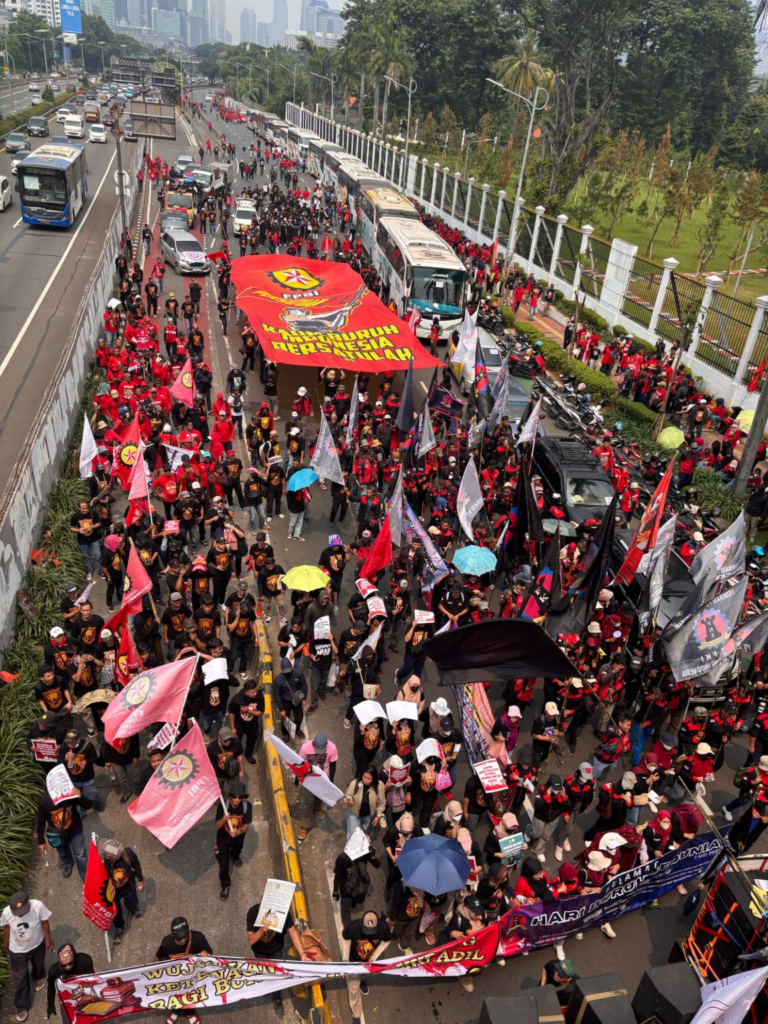
J participated in the May Day action as a paralegal for the medical team because she is a student of the UGM Graduate School of Law. The paralegal for the medical team is in charge of negotiating if necessary with law enforcement officials or other parties.
Read More: Is Our Public Transportation Gender Responsive and Inclusive? Konde.co Research Results (1)
After half an hour at the post, J decided to walk towards the DPR/MPR Building to coordinate with the field medical team. At that time, in front of the DPR/MPR Building, the police had dispersed the protester by spraying water cannons. The atmosphere became chaotic, some of the protesters dispersed and retreated. The Chief of Police Regulation (Perkap) Number 9 of 2008 states that the dispersal of protesters must be done carefully and following the correct procedures.
Together with the field medical team, J then conducted a sweep, walking along the sidewalk in case there were protesters who needed medical assistance.
When they arrived at the medical post, they were shocked to find that it had become a place for the police to arrest protesters. One of the medical team, K, arrived first at the post. At that moment, K was suddenly pulled and beaten. J tried to stop the actions of the authorities.
“Sir, sir, sir, this is a medic, don’t be beaten,” she shouted.
Her efforts to dampen the actions of the police and engage in dialog were ignored. People were shouting and using their hands faster than their ears. She tried to protect K by hugging her to create a fortress for each other. At that time there was a female medical team who was also trying to protect and create a fortress, but was also subjected to violence. She was kicked in the chest and had to be taken to the emergency room.
In a position to protect K, J was also hit and knocked down, until they both fell and were dragged. K’s position at the time was on top, so she was hit a lot, until she fell and replaced by J who was on top.
Read More: Introducing Mary Wollstonecraft, the ‘Mother’ of First-Wave Feminism
At that time she saw someone with a large stature, strongly suspected to be a police officer, in a standing position trying to hit K’s neck with his knee. Suddenly J parried until the officer fell to the ground. She did not know where she got her strength from, all she understood was that she was in a fight or flight position.
After that, K vomited, and yellow liquid came out. One of the officers who hit her told his colleagues to end it.
“Stop, stop, stop,” said the officer.
J then used the opportunity to reiterate their position as paramedics.
“This is medical! This is medical! What’s wrong with you guys, for God’s sake. This is medical!” she shouted.
She also told the officers that she was a paralegal and showed them her letter of assignment. The people around them immediately tried to take photos. J did not accept the letter being photographed without her consent, so she took it back.
There was an argument with the officers, but J insisted that she would give the letter, as long as it was not photographed. Finally, the officer agreed and the people who had wanted to take pictures left.
“Where’s your ID card?” the officer asked after receiving the letter and wanting to match the data.
Read More: Period Pain for Women is Real, How to Deal With It?
J showed her ID card to the officer. After that the situation softened. K was able to stand up and sit down after being tortured.
J looked around and found another medical friend, who she immediately approached and asked about her condition. Her condition was the same as her, broken after being beaten. She did not know what happened to her friend because at that time her position was also defending himself.
It turned out that the friend had been searched by the authorities. Her clothes had been removed and her bag had been searched. But the authorities only found portable oxygen, paracetamol, bandage, gauze, and etc.
‘What is the reason for this search?” J said.
She showed the contents of her sling bag, which contained lipstick and two lip tints, a mirror holder, and stylish glasses. When the search was over, the officers did not find anything dangerous.
Suddenly an officer said, “Transport everyone!”
J was confused as to why they had to be transported when the officers did not find anything dangerous during the search. Therefore, when they were about to be transported, they stayed where they were. J hugged her two friends so that they would not be arrested by the authorities.
As a paralegal, J felt responsible for her fellow paramedics not being arrested by the police. At that time her hands and feet were being pulled. J tried to resist.
“Stop, don’t grab me! I’m a woman,” she shouted.
Read More: ‘What I Inherited, What I Refused’ Reflections About Overcoming Misogyny
At that moment, she heard people swearing at her with various curses.
“Slut!” ” Prostitute!” “Hustler!”
“Strip, strip.”
Quickly, J was transported to a police car by male policemen. There was not a single policewoman. Among the officers who pulling and carrying her, one man gripped her hand so hard that it left a bruise. They were put into a detention car and taken to Polda Metro Jaya.
While in the detention car, K vomited again.
Arriving at Polda Metro Jaya, they were gathered in the lobby. There were 11 people arrested, namely 4 medical teams and 7 protesters.
J and her medical colleagues then moved quickly to treat the protesters who were both detained and injured. Some had leaks on their heads, some had bleeding lips. They were quick to provide first aid, including K, whose condition was actually battered, as well as the other medical team. But they seemed to forget that at that time they also needed to be treated.
An officer then distributed forms and forced the eleven detainees to fill them in. J looked at the form and read the title at the top which read, ‘Identity of Criminal Offender’.
Read More: From Obligation to Right: Rethinking “Sex as Duty” for Muslimah
“Sir, how come it says perpetrator? What are we?” he asked.
“This is just for data collection,” said the officer.
But J persisted in asking, and there was an argument. She did not want to fill in the form because the intention of the authorities was not good, because it could be a kind of confession from the form filler that she was a perpetrator. J then told her fellow detained friends not to fill in the form.
The officer eventually withdrew the forms that had been distributed. But there were 2 or 3 people who still filled it out. J did not deny that they might be under pressure.
In the end, J felt the need to remain observant and aware so as not to get caught up in the maneuvers of the authorities. These 11 people then underwent examination by investigators.
Their case was handled by the State Security Sub directorate (Subdit Kamneg) of Polda Metro Jaya. Because J was a woman, she was examined at the Renakta (Youth, Children and Women) Unit of Polda Metro Jaya by two female investigators. She underwent the interview report (BAI) at around 10 p.m. accompanied by legal counsel from the Advocacy Team for Democracy (TAUD).
Previously they had been forced to undergo an examination immediately.
“Come on, where is her legal counsel?” said the officer.
Read More: “Long Live Indonesian Women!” Gazing into the Realities of Women Workers’ Rights
Meanwhile, the legal team had been at Polda from around 8pm because J had contacted them since they were in the detention car. But the legal team was detained to enter and provide assistance. When she entered the examination room at the Renakta unit, one policeman suddenly yelled at her.
“What are you looking at? What are those eyes looking at!” he snapped.
J felt her actions were normal, there was no attempt to mock or anything like that towards the officers. So she responded by remaining calm and unprovoked. During BAI there was a request to conduct a urine test, but J refused because there was no urgency.
At that time, investigators had not yet determined the charges against her. The investigator only wrote ‘alleged criminal offense of association to commit a crime’. When her legal counsel asked, the investigator did not even know which article the charges fell under.
“Which article is it?” asked the legal assistant.
“I don’t know, because we got it from above,” replied the investigator.
Read More: International Women’s Day 2025: A Call to Action to Accelerate Progress towards Gender Equality
The investigation process lasted until 1am on May 2, 2025. At around 02.00 WIB, J met with her mother who had come a few hours earlier. J then went back into the room to rest, but only lay there.
Inside the room, she was accompanied by a female police officer and a male police officer. At around 6am J was able to close her eyes. Even that was only for a short time, because at around 9:00 a.m., J was awakened by the noisy voices of several police officers, as well as by the cold. At that time, there was a police officer who seemed to be friendly, buying coffee, accompanying her while smoking, and inviting her to chat. However, J felt that this was an attempt by the investigators to obtain information. The policeman also praised her and patted her shoulders, knee and thighs. But J resisted because he was uncomfortable with people touching his body.
After that, J returned to the BAI accompanied by a legal representative. She did not know exactly what time the process took place because there was no clock in the room. There were about 5 to 7 additional questions from the previous BAI.
After the BAI process was completed, the BAI immediately moved on to the BAP (Investigation Report) stage. That afternoon, investigators from the Kamneg Sub-Directorate conducted a seizure. Initially, the cell phone, power bank belonging to a friend that she had borrowed, and a lighter were to be seized. However, her cigarettes and lipstick were not seized. This process was difficult and was carried out without legal counsel present.
Read More: From Obligation to Right: Rethinking “Sex as Duty” for Muslimah
“I have to confiscate these now,” said the investigator.
“I don’t want it if there is no legal representation,” said J.
J was adamant and argued. The investigator said her friends had already left and her detention process could take longer if she delayed. But J insisted that she would wait for a legal representative. Finally, the investigator left the room. He came back once more and still tried to confiscate, but J persisted with her position to wait for a legal representative.
Finally the legal assistant came and tried to prevent her cellphone from being confiscated because she was still studying and finishing her thesis so she needed a cellphone. The confiscated items were a paralegal certificate and a sling bag.
After BAI continued, J was still detained at Polda and was only released at 21.00 on Friday (2/5/25). Although she is no longer detained, the legal process is still ongoing.
On May 2, 2025, investigators issued a Notice of Commencement of Investigation (SPDP), which she only received on Tuesday (6/5/25).Two days later on Thursday (8/5/25), investigators issued J’s designation as a suspect.
J then questioned all of this because there was no clear mechanism for officers equipped with various weapons when making arrests. On the other hand, demonstrations are guaranteed by law and protected by the constitution. There are civil rights to express opinions that are protected by the constitution. In addition, the location is a public space. It could be that people who did not participate in the action but wore black clothes and happened to pass by were also beaten and arrested. This situation shows an imbalance of power between civilians and state apparatus.
Read More: Femicide Crisis in Iran: Unveiling the Shadows of Gender-Based Violence
“If we look at it from the perspective of gender justice, what is the mechanism when there are violations of sexual violence during security?” J asked.
S, Made a Satirical Meme and Was Arrested
Apart from J, in May 2025 there were also other women who experienced repressive actions from state apparatus because they were vocal in voicing criticism.
This student was S, an ITB student who created and shared a satirical meme featuring Joko Widodo and Prabowo Subianto kissing. The meme was modified using artificial intelligence (AI).
The police then arrested S on charges of violating Article 45 paragraph (1) in conjunction with Article 27 paragraph (1) and Article 51 paragraph (1) of the Electronic Information and Transactions Law (ITE Law) concerning decency. Currently, S is on bail. However, his full identity and photo have been widely shared on social media (doxing).
Criticism by women is often met with sexist attacks, body shaming, and even doxing that targets their privacy, family, or gender identity. For women, who often utilize digital space as a channel to voice criticism, the threat of the ITE Law is a form of structural violence and gender-based silencing.
Sexism in Women’s Arrests
Judith Butler in her book Bodies That Matter borrows Althusser’s concept of interpellation, explaining the use of certain terms or calls used to create and reinforce gender norms over the body.
Interpellation is the process of calling or naming individuals and shaping them into subjects who are subject to the existing order.
Butler pointed out that when a citizen is called by the police, “Hey, you!”, this automatically has legal effects.
It is the same when J is called a “prostitute! Look at me! Get naked!” by the police.
Through interpellation, the police make individuals feel as if they choose to be like that. In fact, the individual has been put into the position desired by the system of power. Interpellation not only oppresses or controls the subject, but forms an important part of the juridical and social formation of the subject. The call constitutes, as it initiates the individual into the repressed status of the subject. This process makes J a subject who is already in an inferior position, punished, humiliated, positioned as the ‘wrong’ one.
Usually we think of reprimands or summons from the police, authorities, or institutions only to control or frighten. But according to Butler (and Althusser), the reprimand not only controls, but also shapes one’s identity as a subject within the social and legal order.
Read More: Femicide Crisis in Iran: Unveiling the Shadows of Gender-Based Violence
When the police sexually humiliated J (a woman), they were also intimidating all women into submission.
The cases of S and J show a similar pattern. Women who speak out critically become targets of state repression. In fact, in the public space there are many criticisms made by men, but they are not responded to with reporting or similar violence.
This fact shows how women’s bodies and voices are often seen as more “disturbing” when challenging power, so they are silenced in repressive ways. Criticism coming from women is not only considered resistance, but also a violation of gender conformity norms.
Maria Eriksson Baaz and Maria Stern in the book Sexual Violence as a Weapon of War? Explain why women are more often the targets of sexual violence and arrest. Women are often considered the guardians of morals, honour, and national identity (Yuval-Davis). When women resist or become political activists, the state considers them to be violating the ideal role as the “mother of the nation”.
As a result, the state uses sexual violence to “punish” women who challenge these gender constructions. By targeting women, the state simultaneously controls women as symbols of biological bodies associated with reproduction, honour, and social stability.
Read More: The Orgasm Gap: Why Do Women Climax Less Than Men? Calling Out Unrealistic Images of Women’s Pleasure
The repression of women often contains sexual, moral and symbolic dimensions that men do not experience in the same way. It is not experienced by men because men’s bodies do not carry the symbolic burdens of nationalism, morality, and community honour that are attached to women.
The resulting deterrent effect on women tends to be stronger, as social pressure and the threat of gender-based violence in digital spaces exacerbate women’s fear of speaking out again.
Women activists become more brutal targets because they challenge two orders at once: state power and patriarchy. Women’s repressed bodies become a political and gendered battleground. Sexual violence becomes the language used by the state to assert power while shaming women who refuse to submit.
The SAFEnet organization also highlights the multiple risks women face when speaking out in public and digital spaces. Women are often not only criticized for their opinions, but also personally attacked with sexist standards of morality.
“Multiple risks to women who are vocal in public spaces are common. That women’s opinions are often side lined, and instead attacked with demands for society’s standards of morality towards women. The goal is to attack female critics of themselves, for example that women should not be like this, like that,” explained Wida, a SAFEnet board member.
Read More: Why Are Men So Obsessed with Sex? The Urgency of Getting Out of Toxic Masculinity
Criticism of women in public or digital spaces and the attacks that arise usually do not just refute their opinions. Instead, they objectify, humiliate, or threaten her body.
“Like the Sukatani case, it is the female personnel who are more highlighted, seen their personal lives and so on. This vulnerability does not happen to men,” added Wida.
Maternal Activism, Mother Activism as a Defender of Children’s Struggle
Herlina, the mother of J, then revealed the deep wounds of the apparatus violence experienced by her daughter, J, through discussions spread on social media.
Quoting the X account @barengwarga, Herlina strongly condemned the actions of the authorities who not only violated the law, but also trampled on the dignity of a woman who was struggling.
“I want to teach my child to love Indonesia. Perhaps people think that since I am a mother of a daughter, it is acceptable for her to be treated this way. My child was called a slut, a whore, and told to strip naked. How do you think I feel as a mother? I taught my child to fight, not to be abused like that.”
Herlina also showed her support and closeness to J. “I know my child, I know my child’s friends, because I am open.” She also expressed disappointment at the treatment her son received as a result of her struggle to love this country. “It’s not this country that doesn’t love us, but the people who are appointed as rulers who are like this.”
Herlina’s “I want my child to love Indonesia” is not just an emotional defense. It’s a counterattack to conservative narratives that limit women’s space, such as people saying to her, “How come a girl can be this?”
Herlina is not the only mother who speaks out loudly in defense of her children who are victims of state violence. In many spaces of resistance, the presence of mothers is another face of courage. Indah Ariani is one of the mothers whose her daughter, Ananta Aulia Althaaf, was also arrested during the demonstration.
Read More: Love Languages Are Hugely Popular. Are They Real?
On the morning of May 21, 20205, Ananta said goodbye to join the action to commemorate the Trisakti tragedy, where she was studying. She and other students who are members of the student movement at Trisakti University will submit a petition to the Governor of Jakarta, Pramono Anung, demanding that the four victims of the Trisakti shooting during the reform era be named heroes. This action also aims to protest the proposal to designate former President Soeharto as a national hero, as it was Soeharto who caused the deaths of many Trisakti students. However, after the action, Indah was suddenly informed that her child had been arrested.
At that moment, Indah immediately went to the Metro Jaya Regional Police Headquarters after receiving information from Trisakti alumni that all students, more than 90 people, had been taken there. Indah only found out later that the demonstration in front of the Jakarta City Hall had turned chaotic with the police, even though from the videos circulating online, Ananta was actually trying to prevent the police from beating the students.
“She was trying to break up the fight, but ended up getting arrested instead,” said Indah choking up.
Indah slept at Polda Metro Jaya for several days waiting for Ananta. She could only meet Ananta and her friends when they were going to the toilet, because the toilet was located outside where they were locked up. At that moment Indah immediately gave Ananta a change of clothes and brought her food.
“Be strong, you are not wrong, be strong, be cooperative when asked by the police.”
Read more: Four Fundamental Critics of the Inadequate Implementation of Law on Sexual Violence Crimes
That was the only sentence Indah said while hugging Ananta. For a week, Indah continued to wait for her daughter in the lobby of Polda Metro Jaya, occasionally closing her eyes trying to sleep on the chairs of the police station lobby. Indah felt relieved when human rights activists Usman Hamid from Amnesty International and the Advocacy Team for Democracy (TAUD) came and accompanied Ananta and her friends.
On May 27, 2025, Indah and other mothers who are members of Suara Ibu Indonesia (Voice of Indonesian Mothers) went to the Metro Jaya Regional Police Headquarters to deliver a letter to the Metro Jaya Police Chief requesting the release of the Trisakti students who had been arrested. They came carrying signs of support. The letter read, among other things:
“We are here today, standing in front of the office whose its members have the spirit of “protecting and nurturing”, because we believe in the motto of Rastra Sewakottama. The motto of the Indonesian National Police means “the nation’s foremost servant.” For this nation, land, and water, we have pledged our loyalty, dedication, and our very lives. That is why we are deeply concerned to learn that the Rastra Sewakottama has arrested and detained our children, the children of the nation. We are saddened and hurt to know that students—in Semarang, Central Java, and Jakarta—are now in police custody and have been labelled as suspects. This label cuts deep into our hearts. They are young people who, in every speech, are always referred to as the nation’s hope. We entrust the future to our young people. Among them are the young people within the police force. We are mothers, women, who cannot remain silent while the future of our children is silenced by fear.
Read more: Four Fundamental Critics of the Inadequate Implementation of Law on Sexual Violence Crimes
Other mothers also stood firmly in the Kamisan Action, who for more than 18 years have faithfully stood in front of the State Palace with all black clothes and black umbrellas as a symbol of grief. There is Maria Catarina Sumarsih, the mother of Bernardus Realino Norma Irawan (Wawan), a student at Atma Jaya University who was shot dead by the authorities in the Semanggi Tragedy in 1998. Sumarsih not only took care of the grief of losing her son, but also turned it into a long struggle to hold the state accountable. This is what is called maternal activism.
Feminists introduced the concept of maternal activism as a framework for understanding the activities of women or groups of women who use their identity as mothers to demand justice and encourage social and political change.
Some of these feminists are Adrienne Rich, Danielle Poe, and Kathleen Gallagher. Adrienne Rich in Of Woman Born, Motherhood as Experience and Institution explains maternal activism as a process of reinterpreting the role of mothers from the private sphere towards political mobilization and participation in the public sphere.
The role of mother has historically been associated with the private and exclusive role of “housewife”. This role limited women to childbearing responsibilities and meant that they were often controlled by male figures (whether husbands, religious leaders, or the state). This has led to motherhood being seen as an oppressive institution.
Read More: ‘Divorce Because of Different Political Points of View Until Sexual Violence’: Women Violence in Election
In contrast, Rich emphasizes the transformative experience of motherhood, highlighting the potential of bonds with children as a source of empowerment. These bonds can propel mothers into the public sphere, where their personal pain catalyzes political engagement and collective advocacy.
This transition from personal to political roles transforms the oppressive nature of traditional motherhood into a powerful tool for justice and societal transformation. As such, maternal activism represents a profound shift in the way motherhood is understood.
Meanwhile, Kathleen Gallagher explains that the concept of maternal activism can be used to understand maternal mobilization in the context of authoritarian regimes that use conservative narratives about the role of mothers for social control. Gallagher presents this idea in Mary, Mother of Martyrs: How Motherhood Became Self-Sacrifice in Early Christianity.
She cited the case of Argentina under the military junta from 1976 to 1983. At that time, Argentina under the leadership of Jorge Rafael Videla implemented policies that limited women to their traditional roles as wives and mothers.
Women were tasked with protecting their children from communist ideology and subversion while promoting Christian values and Western ideals. Gallagher argues that contemporary expressions of women’s activism often use this traditional role as a strategic essentialism to gain support and protect themselves.
Read More: Rape Survivor From Cilacap Drop Out Of School, But The Rapists Are Free
She analyzes representations of the Virgin Mary in Christian society as an archetype of motherhood for various political purposes. In the Christian tradition, Mary is idealized as the archetype of self-sacrificing motherhood, who endures suffering to bring the Messiah into the world. And at the same time witnessed his violent death.
This depiction of motherhood as self-sacrifice, loss and martyrdom is in line with traditional conceptions of motherhood in Latin America. It is a social construct that has been historically shaped since the Spanish and Portuguese colonial period to oppress women. Simultaneously, it resonates with reactive activism, which arises from personal suffering, such as the loss of a child.
The activism of the Plaza de Mayo mothers can therefore be seen as a prominent example of maternal activism. The mothers began gathering at Plaza de Mayo, a square in the centre of Buenos Aires, Argentina in April 1977. They demanded an explanation from the then ruling military regime for the enforced disappearances of their children. The mothers, who had no previous political experience, did not initially realize that their actions were essentially political.
When the authorities forced them to “turn around”, forbidding them to stand still in groups of more than three, they inadvertently organized a political march. In October 1977, the mothers decided to make their presence visible during a religious procession held by the Catholic church.
Read More: The Story of Ria, Tiko, and Erni: The Challenge of Transgender to Have Social Security
They took the initiative to wear their children’s cloth diapers as veils, this action evoked the symbol of Catholicism while subverting it as a form of their protest. This action was chosen to make them stand out among the large crowd of the religious event while reinforcing their demand for the lives of their missing children.
By using artifacts of their personal lives in public spaces as symbols of political resistance, they subverted the passive role imposed on women by the regime.
The mothers in the Plaza de Mayo are proof that even in an environment with limited opportunities for action, women can resist gross human rights violations by a patriarchal regime. They have changed their country’s history while contributing to the creation and development of an international framework for the protection of human dignity. The actions of the Plaza de Mayo women also offer a legacy of resilience that transcends generations.
While Danielle Poe in Maternal Activism: Mothers Confronting Injustice exposes the maternal activism of four American women who fight injustice. They are Molly Rush, Michele Naar-Obed, Cindy Sheehan and Diane Wilson, each of whom has a different background.
Read More: ‘My Dream To Be A Football Player To Get Citizenship’: Stories Of Immigrant Children In Malaysia
Molly Rush, a mother of six, who was active in the civil rights movement in 1963 and marched against the Vietnam war. Rush was convicted when she struck the tip of a nuclear warhead to draw public attention to the dangers of nuclear weapons. Michele Naar-Obed, was active in acts of civil disobedience and like Rush, she also destroyed a nuclear warhead a decade later.
Both women acted as part of a community that opposed nuclear war. But they both had very different support systems for their children. Their situations show the different circumstances mothers face when they decide to oppose militarism.
Cindy Sheehan became an activist after losing her son Casey who was killed in the second Iraq War. After her son’s death, Sheehan held the president accountable for the purpose of the Iraq War and the purpose of her son’s death.
Sheehan’s transformation into a peace activist raises important questions about the role mothers play in shaping their children to become soldiers and support military ideology. As well as how being an activist mother ostracized her from some communities and brought her into solidarity with others.
Finally Diane Wilson, a lone fisherwoman in Calhoun Bay, Texas who tirelessly fights against war and environmental destruction. The mother of four’s activism began as a response to corporate pollution of Calhoun Bay.
Read More: Rape Survivor From Cilacap Drop Out Of School, But The Rapists Are Free
Poe explains that dissecting the focus of each of these women, their context, and their actions allows us to better understand how specific individuals can respond to widespread injustice and systemic militarization in society. Each of the mothers in the book employs essentialist rhetorical strategies, drawing attention to their children and using emotivism.
However, they also undermine essentialism at every turn. They break the law without violence, willingly serve time in prison, and challenge social standards of acceptance.
By understanding the experiences of these four women and the relationships they formed to support their activism, it is clear that maternal activism does not necessarily lead to essentialist understandings of mothers and women. The four of them managed to attract media attention, provoke conversations about structural injustices, and spark change and challenge prejudices about motherhood.
The Wave of Mass Arrests
Throughout the period February to May 2025, there have indeed been a series of waves of mass arrests of citizens involved in protests in various parts of Indonesia. Konde.co noted from various sources that at least 373 people experienced arrests, both in the form of temporary detention and determination as suspects.
This wave of arrests targeted various groups of people, ranging from students, laborers, indigenous people, to foreign nationals who documented the action.
The “Dark Indonesia” rally in February 2025 marked the beginning with the arrest of 16 people, including one foreigner who was detained simply for filming the demonstration.
Entering March, the wave of rejection of the TNI Law was met with an increase in arrests. Between March 15-28 alone, at least 168 people were arrested, with actions spread across at least four cities/districts. Many of them were arrested without proper legal procedures, signalling a form of arbitrary detention by security forces.
The peak of arrests was seen during the May protests, particularly on Labor Day and Reformation Day. Workers and students were arrested simultaneously in major cities such as Jakarta, Bandung, Semarang, and Lhokseumawe. A total of 58 people were arrested on May 1 alone, while in the middle of the month, harsh measures against students from the Student Association for Social Concern (IMPAS) and Trisakti University exacerbated the situation, with more than 100 students arrested and 21 of them charged as suspects.
Read More: From Stereotypes to Struggles: How Age Discrimination Hits Women Harder
Meanwhile, in East Halmahera, residents of Maba Sangaji who opposed mining activities were also targeted, with 27 arrests and 11 suspects named.
The arrest of S who made this meme was strongly criticized by the Indonesian Legal Aid Foundation (YLBHI).
Meila Nurul Fajriah, a YLBHI board member, told Konde.co on Sunday (18/5/25) that public officials often use ITE to report citizens who criticize them, so the police will act quickly. Meanwhile, in S’s case, there was no summoning process, suddenly she was arrested and immediately processed.
“If the person reporting is an official, the police will quickly summon and examine without the application of a good Criminal Procedure Code in accordance with existing rules. Our question is how dangerous is the criticism made by this student that the process is so fast? Because whoever reports and is reported, the police should carry out the processes in the Criminal Procedure Code,” she explained.
YLBHI also noted that public officials are the ones who most often criminalize citizens, especially those who voice criticism or defend their rights.
“There are signs of authoritarianism, because they have a certain social position. Moreover, the president and ministers have state apparatus at their disposal. So we see this as an authoritarian regime that is gradually imposing criminal penalties. Especially with the ITE Law, which is a very vague article. If our friends at SAFEnet say this is a digital authoritarian regime,” she added.
Read More: The Portrait Of Waria Religious: They Are Not Immoral
Christine Constanta, a legal assistant from LBH APIK Jakarta who is a member of the Advocacy Team for Democracy (TAUD) stated that J’s arrest was a general atmosphere of oppression against women in demonstration spaces.
“Women in public spaces, wanting to express their opinions, have the right to freedom of speech, but instead are repressed and criminalized,” Christine said.
More than just arrests, Christine said that the authorities’ actions contained many procedural violations. The arrests were made without sufficient preliminary evidence and the evidence was not transparent to the companion, which allegedly violated Article 17 of the Criminal Procedure Code. The arrest also lasted more than 24 hours, which according to Christine could be considered a violation of Article 19 paragraph (1) of the Criminal Procedure Code.
Christine also mentioned that the examination was carried out until two in the morning, exceeding the humane time limit, without any consideration of the victim’s vulnerability. The series of actions also violate the International Covenant on Civil and Political Rights (ICCPR) which has been ratified through Law Number 12 of 2005.
Read More: My Story Visiting Kampongs In Jakarta: Masculine Development Makes Women Poor
Not to mention the forced searches and urine tests, which were later objected to by the legal team.
“The examination until two o’clock at night should not have been done. That includes psychological torture according to the Convention Against Torture,” Christine added.
Paralegal J’s assignment letter was even torn when she tried to show her identity as a legal assistant. Paralegals are legal aid providers regulated by Law No. 16 of 2011 on legal aid and derivative regulations in the form of Regulation of the Minister of Law and Human Rights (Kemenkumham) No. 3 of 2021 on Paralegals in the Provision of Legal Aid.
In addition, her position as a medical personnel is also not seen. In fact, in international law such as the 1977 Geneva Convention, paramedics must be protected, not arrested.
“Maybe because there was a violent tug of war when she showed her paralegal certificate, so it was immediately torn by the authorities,” said Christine.
Read More: Annual Report Of Sexual Violence At University: Mostly From Sexist Jokes
When the suspect status was finally confirmed, the process was full of irregularities. The initial investigation or Interview/Interrogation Report (BAI) did not mention any articles. Even when asked, the investigators vaguely stated, “conspiracy to commit a criminal act.”
Only after the BAI was printed, articles 216 and 218 of the Criminal Code were added. That night, Christine as legal counsel asked about the basis for J’s arrest.
“Which article is being charged?” Christine asked the two investigators in the Renakta Unit.
“It’s conspiracy to commit a criminal offense,” one of them replied.
Christine continued to ask, “Which article is this?” but there was no answer from the two investigators.
Then the examination proceeded, J was bombarded with questions about her background, who was the leader of the action, and her motivation for participating in the action.
“After completing the BAI, they coordinated with the Kanit section and 13 other people, and only then did they include the article. But until then, there was no certainty as to when J could be released. We have already stated that J is the victim, so we should be the ones reporting, not the ones being reported, but they did not respond at all.”
Read More: Two Fish and a Plate of Rice: Wagini’s Story
“There is no transparency at all,” Christine continued.
Christine also shared that even after J declared herself a victim of sexual violence, there was not a single procedure or access to recovery provided by the authorities.
“J should have been examined considering her vulnerability as a victim of sexual violence, but there was no information about recovery, no access to services,” Christine said.
After the arrest, the process of assisting J was carried out by TAUD. Christine revealed that when she arrived at eight in the evening, J was already tired, scared, and had not eaten.
“J was already exhausted because the arrest took place from 5pm to 8pm. At eight in the evening, she was examined for BAI,” she said.
The repatriation was eventually carried out, but that did not mean that the detention was valid. Not only was it illegitimate, the repatriation was carried out without compensation or acknowledgment of the apparatus’ procedural errors.
“The arrest took more than 24 hours. They were arrested at five in the afternoon, BAI until two in the morning, did not go home, slept there, continued directly to the BAP. The process of going up to the BAP was not legal,” said Christine.
Read More: Two Fish and a Plate of Rice: Wagini’s Story
After the suspect status was issued, advocacy efforts are now focused on two things, namely the termination of the investigation and counter-reporting of sexual violence and ethical issues. The Notice of Commencement of Investigation (SPDP) has been received, and the first summons in early May has been responded to with a request for postponement due to J’s unstable psychological condition.
“The psychological capacity of the victims is also not good. So we submitted a postponement for this first summons on the grounds that the victim must first recover psychologically,” explained Christine.
These efforts were carried out independently by the assistance team, including cooperation with the Pulih Foundation to provide counseling to the fourteen people who were arrested. Unfortunately, the insensitivity of the authorities continued in the public sphere.
“If we look at the news about the Regional Police Public Relations Office, they are creating public opinion that they were summoned but failed to appear. In fact, the summons was issued before we received the summons letter,” said Christine.
As of the publication of this article, TAUD has sent a letter requesting confirmation of the investigation and a Letter of Termination of Investigation (SP3) to the Metro Jaya Regional Police regarding the naming of suspects. This request is based on the assumption that the police do not have sufficient evidence to prove that TAUD’s clients are guilty.
Read More: Introducing Mary Wollstonecraft, the ‘Mother’ of First-Wave Feminism
Unfortunately, immediately after TAUD sent the letter, Christine delivered the bad news that the letter had been responded to with a second summons for the suspect.
Going forward, TAUD plans to report the case as a crime of sexual violence under the Sexual Violence Crimes Act (UU TPKS). Although power relations are a challenge, this step is important to emphasize that victims should not be silenced.
“Of course, we can definitely report it under the TPKS Law,” said Christine.
The Importance of Gender Perspective in Law Enforcement
This whole series of events shows that law enforcement institutions do not have adequate guidance or awareness in dealing with women in conflict with the law.
“Law enforcement officials actually do not have guidelines for what kind of examination of women,” said Christine.
Even when questioned by female investigators at the Renakta Unit, J did not receive appropriate treatment or protection. In a legal narrative that is often masculine and repressive, J’s experience reveals the importance of profound reform in institutional approaches to women. It is not enough to simply transfer women to a special unit if the procedures and substance continue to perpetuate violence.
“Even though she is a female investigator, she still has to provide information about access to assistance for victims,” she said.
A Pattern of Criminalization in Bandung
Similar to J and the 12 Jakarta May Day protesters and dozens of Trisakti students who were named suspects by the police, the same patterns were used in Bandung.
According to LBH Bandung Director Heri Pramono, one of the protesters was suddenly arrested while conducting student activities. The arrest was even carried out without any arrest warrant or official notification. Worse still, the arrests appeared to have been carried out by unknown persons (OTK) because those who made the arrests did not wear uniforms or use police vehicles.
“Actually, the arrest was more like kidnapping, judging from what one of the victims experienced. He suddenly thrown into a car. That also hindered us because his friends were confused as to whether it was the police or someone else who arrested him,” said Heri.
The same thing was experienced by a mass protester against the TNI Bill who was arrested at his boarding house a few days after the action took place. LBH Bandung suspects that the identity and location of the protesters were tracked by the police through the OSINT (Open Source Intelligence) method, which is data-based tracking and information that is openly available on the internet.
There are allegations that the police used video footage of the protesters that was widely spread on social media and CCTV footage as material to track the identity of the protesters.
“If we can say so, this is the OSINT method. The video and CCTV footage can be used as evidence for the police to summon suspects. Perhaps through face recognition or something else, what is clear is that they were caught on camera and analyzed by the police. That way, we can find out their names, where they live, and where they go to college,” added Heri.
Read More: Is Our Public Transportation Gender Responsive and Inclusive? Konde.co Research Results (1)
This practice indicates an increasingly massive digital surveillance of civilians. This pattern certainly has the potential to violate the right to privacy and freedom of expression as citizens. This strategy shows that the state does not only use physical violence to silence its citizens, but also digital violence in suppressing critical voices in the social media space.
Procedural violations do not only occur during the arrest process, often these procedural flaws are found in the investigation process. One of the protesters in Bandung who had been named a suspect experienced actions from the authorities that were considered to exceed their authority. During the investigation process, the police checked the contents of the victim’s personal cell phone to see how he used social media – including videos, photos, and contacts stored on the cell phone.
In fact, the actions taken were not directly related to the allegations against the victim. Heri assessed that the police should carry out the investigation process in accordance with procedures, without the need to pry into the victim’s personal life just to find justification. This kind of investigation shows that power is easily abused by ignoring the rights and legal protection of the suspect.
“For us, it is inappropriate because the investigation process is not related to the allegations. The investigation process is just an investigation process. Be professional and follow the procedures, and do not go beyond that. As long as he is a suspect, he also has the right to maintain his dignity as a human being,” explained Heri.
Read More: Period Pain for Women is Real, How to Deal With It?
Based on his observations of the pattern of arrests in Bandung, Heri believes that the arrests made by the police are only intended to spread fear and create a negative image in the community. The police are not really focusing on the crimes alleged against the suspects.
“The police are no longer focused on the crime itself; instead, they’re spreading their efforts in all directions. This is because the media has framed the issue as an anarchist movement, especially during May Day, which was seen as synonymous with the leftist movement. As a result, the actual criminal acts are being avoided, and the focus is not on that,” Heri explained.
Pattern Defects in the Criminal Law System
The arrest practices carried out by law enforcement officials are considered procedurally flawed, violate the criminal procedure law, and show the weak accountability of the apparatus in the Indonesian justice system.
Maidina Rachmawati, Acting Director of the Institute for Criminal Justice Reform (ICJR) explained that there is no term “security” in criminal law that can be used as a basis for detaining someone.
“Actually, the security mechanism in the context of criminal law does not exist. So there is no security, there is only arrest,” she said.
Arrest also has strict conditions according to the Criminal Procedure Code (KUHAP). There are only two conditions that legalize an arrest, namely if a person is or has just been caught red handed committing a criminal act, or if a person has been properly summoned twice as a suspect but does not fulfil the summons.
“An arrest is only legal in two conditions, caught red-handed or having been properly summoned twice but failed to appear,” she said.
In the case of actions carried out by elements of civil society, laborers, and students, the action participants and even medical personnel, according to Maidina, did not meet the element of being caught red-handed committing a criminal act, nor was there a summons that had been ignored before.
“If it happens like that (recent arrests), it means that it is not security to save lives, but it is a form of arrest. Because it is mandatory, obligatory, forceful, it is coercive,” Maidina explained.
Read More: From Obligation to Right: Rethinking “Sex as Duty” for Muslimah
She also criticized the actions of the authorities who confiscated the personal belongings of protesters, conducted forced urine tests, and detained them for more than 24 hours without clear legal status.
“If it’s more than 24 hours, either she is detained—but you can’t detain someone who isn’t a suspect, right? That’s why she was eventually released, because it wasn’t clear who the suspect was.”
“Or secondly, they should be sent home immediately after 24 hours. But in this case, they weren’t sent home. Even after 24 hours, their status was still unclear when they were sent home. Procedurally, that shouldn’t be allowed,” she added.
The lack of legal protection for women has also been highlighted. According to Maidina, KUHAP only briefly mentions that arrests of women must be carried out by female police officers. There are no comprehensive rules governing examination procedures for women, especially in the context of gender-based violence.
“So indeed our KUHAP rules that recognize gender-based vulnerability are only in the context of arrest and detention. Even then, it only mentions that if in the condition of arresting a woman, then she is carried out by a policewoman. Just like that,” she said.
Read More: “Long Live Indonesian Women!” Gazing into the Realities of Women Workers’ Rights
The investigation of the protesters was also deemed legally flawed because it was not transparent and was conducted arbitrarily. Maidina highlighted the use of “interview/interrogation reports” (BAI) which have no equivalent in the Criminal Procedure Code.
“In the Criminal Procedure Code, it is examined, meaning as a witness or as a suspect. Well, that has already entered the law enforcement process. So BAI has no equivalent in procedural law. So the police have to create their own procedural law mechanism.”
Konde.co noted that there were at least nine articles used by the authorities to charge the suspect. Maidina considered these articles problematic because they seemed to have been imposed.
“The problem is that from the outset, the police did not have sufficient knowledge of the criminal offense that had been committed. They simply arrested the suspect, and only then did they consider which articles to use and gather evidence,” said Maidina.
Read More: International Women’s Day 2025: A Call to Action to Accelerate Progress towards Gender Equality
| Articles and Laws | Short description | Criticism of the use of mass action |
| Article 2 Paragraph (1) of the Emergency Law No.12 of 1951 | Anyone who unlawfully possesses, carries, or conceals firearms, ammunition, or explosives shall be punished with a severe penalty. | This article is often used speculatively. Protesters can be charged simply for carrying objects that are considered “dangerous” even though they are not weapons. There is no adequate preliminary evidence. |
| Article 160 of the Criminal Code | Inciting others to commit crimes, violence against public authorities, or disobeying regulations. | Prone to abuse to silence expression. Demonstrations or speeches can be criminalized simply because they are deemed “incendiary,” even though they are part of freedom of expression. |
| Article 170 of the Criminal Code | Violence against persons/property committed jointly is punishable by imprisonment. | Often charged with mass action simply for being at the scene of the riot, without specific evidence of active involvement. The principle of individualization of punishment is often ignored. |
| Article 351 of the Criminal Code | Intentional mistreatment of another person. | Strong evidence of direct action and intent to cause harm is required. However, it is often used in one-sided reports by officials without medical examination or independent witnesses. |
| Article 212 of the Criminal Code | Resisting officers performing their lawful duties with violence or threats of violence. | The category of “resistance” is very flexible. Gestures of refusal, resistance, or panic are often interpreted as active resistance, even though the element of violence may not necessarily be present. |
| Article 216 of the Criminal Code | Failure to comply with lawful orders from officials performing their duties. | The command to “disperse” or “be quiet” during protests is often used as grounds for prosecution. However, it is not always clear whether such commands are lawful or proportionate. |
| Article 218 of the Criminal Code | Did not immediately leave after being ordered to disperse from a crowd that was disturbing public order. | A vague article that is prone to ensnaring peaceful protesters. The police can define a crowd as a “disturbance” at any time, even though the protest is guaranteed by law. |
| Article 214 of the Criminal Code | If resistance (Article 212) is carried out by two or more people in an organized manner, the punishment is increased. | Often combined with Article 212 and used to aggravate charges. However, collective intent or specific coordination is not always proven. |
| Article 333 of the Criminal Code | Illegally depriving others of their freedom. | Ironically, this article is sometimes used by victims of mob violence to report the perpetrators to the authorities. However, in practice, it is very rare for investigators to accommodate such reports against the police. |
General Notes:
1. These articles are often used overlappingly, without strong individualized evidence against each action participant.
2. The principles of non-retroactivity and criminal proportionality are often ignored, especially in situations of mass arrests.
3. The rights to self-defense, access to a lawyer, and due process are often violated in the practice of summary detention.
4. The use of these articles without a strong basis has the potential to become a form of criminalization of protest, which is contrary to the rights to freedom of assembly, expression, and opinion guaranteed by the 1945 Constitution and the ICCPR.
Meanwhile, regarding forced urine tests, Maidina said it was a form of violation of the right to the body which is protected by the principle of non-self-incrimination. Urine testing should only be carried out if there is preliminary evidence in the form of narcotics findings. Without that, mandatory urine tests are voluntary, and cannot be forced.
“A urine test is a bodily sample test. Our bodily samples cannot be used against us in criminal proceedings. Currently, the only cases in which bodily samples can be taken are narcotics-related crimes,” she explained.
Dangerous Signals of the RKUHAP that Move Away from Reformation
According to Maidina, efforts to report back by legal counsel, including through the Sexual Violence Crime Law (TPKS Law), can also face structural obstacles.
She highlighted the absence of an independent oversight institution that specifically oversees the police, as exists in other countries.
Complaining to the police is the same as reporting to the perpetrator. Maidina considers this logic to be unreasonable, and it persists because there is no independent institution that investigates violations committed by officials.
“There is no judiciary to test the illegality of an arrest on the basis of harassment. Well, that’s the most problematic. Apart from the fact that the rules are very minimal, secondly, in an incident like this we don’t know where to complain.”
This condition could have been prevented and corrected by the existence of the habeas corpus mechanism, a universal legal principle that guarantees the right of every detained person to be immediately brought before an independent judge to test the legality of their detention.
“In other countries, if you are arbitrarily detained, you can immediately take it to a judge. The judge will decide, ‘is this detention legal or not’, in a short time. In Indonesia, that doesn’t exist. We don’t have a habeas corpus mechanism,” says Maidina.
Read More: From Obligation to Right: Rethinking “Sex as Duty” for Muslimah
In the absence of this mechanism, citizens who are arbitrarily arrested have no quick access to demand their release or question the legality of police actions. Even oversight of the apparatus is carried out internally by the institution itself, such as through the Propam Division or ethics complaints in the police, which are prone to conflicts of interest.
“We don’t have a truly independent police oversight institution. Kompolnas? It can only make recommendations to the president. It’s not a corrective mechanism,” she said.
“That means we make allegations of new criminal offenses, then yes, it can be processed according to their wishes, whether they want to process criminally or not, and whether they want to process ethics or not. Indonesia has never had an institution that is actually a police watch. We have Kompolnas, but Kompolnas is only tasked with providing police policy recommendations to the president.”
Furthermore, Maidina also expressed concern about the direction of the revision of the Criminal Procedure Code that is currently being discussed. According to her, instead of the revision being able to become a turning point for criminal procedure law reform, the process now has the potential to legitimize the practice of arbitrary arrests by the authorities.
Read More: Femicide Crisis in Iran: Unveiling the Shadows of Gender-Based Violence
“Unlawful arrests are lasting, because the police can just arrest without clear accountability. The concept of a preliminary examination judge is important to test the actions of the authorities, but that is precisely what is most rejected by the police,” she concluded.
J’s case and the wave of arrests that followed are not just records of civilians being criminalized. It is a complete portrait of how the law can fail to protect, and even become a tool of violence against those who are most vulnerable.
This bad precedent is a call to reform law enforcement institutions from upstream to downstream, from arrest protocols, examinations that consider gender, to recovery mechanisms for victims.
“This means that it’s not just J who can then…” Christine paused mid-sentence during the interview. But the audience listening had to continue, that it’s not just J and those currently accused who can become victims, but anyone from the civilian population, if legal reform remains far from being realized.