




How exactly do we conceptualize failure in women? A quick Google search may be the start of a more critical dive in answering this rhetorical question. The SERP (search engine result page) for the query “failure women” showed a range of articles from A-list media – Oprah, Elle, Forbes – with various types of content.
Some results aimed to explain why women fear failure, especially in comparison to men, while some others provided tips on overcoming failure and claiming back one’s worth as a femme fatale. Yet, almost all articles share something in common: they equate failure with the inability to fulfill a target at an office job or to generate revenue and maintain entrepreneurship. The notion of failure, in the feminine world, seems to have been narrowed down into a corporatist context.
Dismantling society’s construction on the nature of “failure” is the first step in comprehending why women fear it. Despite its power and potential, the very notion of “women empowerment” sometimes may lead to further inequalities and unnecessary stress as women fail to meet the standards set for them by society. In a fast-paced society – one that prioritizes competitiveness over collaboration – a woman’s worth tends to be judged based on how much she can make in numbers, not by how much she feels comfortable with herself in her femininity, or how she can give back to the community around her through concrete actions. Therefore, a thorough look on the way society’s perception on feminism and women empowerment has changed paves the path in understanding why some women feel on top, while some others feel stuck at rock bottom – and how instilling courage to self-actualize in marginalized women starts from the mind.
Feminism Then and Now
The word “feminist” tends to spark an unpleasant image in the minds of those who hear it: blue-haired far-left girls, shouting at street rallies with nose piercings, tattoos, and unshaved armpit hair. Yet, the “real” definition of feminism – or rather, what the term originally aimed to represent – is far from this stereotype, further proving the point that the way feminism is perceived has changed over time. “Feminism” was coined by male philosopher Charles Fourier in 1837 to refer to feminine qualities or character. The term experienced a change of meaning throughout the course of history, referring to the emancipation of women and equality between genders. The first wave of the modern feminist movement began in the 1848 Seneca Convention, where feminists – mostly white, upper-class women and abolitionists – gathered to propose the right to vote for women, kick-starting the widespread women’s suffrage movement, mainly in the United States.
The intended definition of feminism, therefore, can be seen in the Declaration of Sentiments, which was the result of the Convention, as follows:
“We hold these truths to be self-evident: that all men and women are created equal; that they are endowed by their Creator with certain inalienable rights; that among these are life, liberty, and the pursuit of happiness.” [1]
The vast development of feminism occurred mostly due to the idea that the right to vote was not sufficient in realizing equality for women. The second wave of feminism, often associated with the term “women’s liberation movement”, began in the 1960s along with the “sexual revolution”, in which the vast usage of the birth control pill prompted heated debates on female sexuality, procreation, and the relevance of the nuclear family as the basic unit of modern society. By the 1970s, due to the enormous development of the feminist social movement, the term “women’s liberation” was no longer exclusively used by certain groups. Numerous groups appropriated the term, even those who had little or no connection to its originators (Evans, 2015, p.139).
Read more: 2025 Year-End Edition: Women’s Resistance in the Season of Arrests and the Year of #DemocracyApocalypse
This was supported by the theoretical emergence of intersectional feminism – the notion that privilege and marginalization are experienced differently by women because of race, gender, sexual orientation, social class, language, culture, ethnicity, and many other factors – in the 1980s, as famously initiated by Kimberlé Crenshaw. The vast development of supplementary theories to feminism brought positive effects: they opened the doors to a more critical and engaging discussion about the whole discourse. However, at the same time, these developments marked a total rupture with earlier feminist movements, cutting them off from their fundamental roots of the first wave (Evans, 2015, p. 142).
Extensive social progress separated contemporary feminism from its intended definition, which is the creation of equality between genders, as proposed by the Seneca Convention. Surely, theoretical developments are inevitable, and may even be favorable, as they add to the richness of feminism as a discourse and social movement. However, without a strong and clear theoretical base on what feminism is – and is not – it is prone to being affected by other forces. People who claim to be feminists often appropriate the term “feminism” to justify hate and judgment towards women who do not fulfill the standards regarding what it means to be a free, modern woman and live as one.
Capitalism and Empowerment: Setting Impossible Standards, Failing the Marginalized
A notorious example is how “feminists” tend to hate on women who choose to be stay-at-home wives and mothers because “women now have equal opportunities with men in working outside of the house and they should be able to seize them” and that “home-making is oppressive”. Real feminism, which is supposed to emphasize equality between genders and letting women choose the paths they want, has become “corrupt” because of the over-arching misunderstanding “feminists” have failed to dismantle. The terms “ultra-feminism” or “radical feminism” (abbreviated “radfem”) are synonymous with these connotations.
The capitalist notion of “women empowerment” is a clear proof and byproduct of this. A woman’s worth is determined by how much she can make. The very notions of “empowerment” and feminism now are biased towards rich, middle-to-upper class women living in industrial urban areas, enforcing the fear of failure in marginalized women because they do not have enough money or cannot fulfill the capitalistic standards of being an “empowered woman”. This results in a highly elitist perception of feminism. Often, the way feminism is implemented does not side with women who are marginalized because of their social class and access to economic opportunities.
Even in the international level, gender-themed forums and institutions tend to equate empowerment with businesswomen, female CEOs, and not women who run small businesses or participate in their local economic activities. Most forms of currently existing international cooperation surrounding the issue of women empowerment also tend to focus solely on the economic aspect, completely omitting other aspects of life. An example of this is the W20 (Women 20; the G20’s official engagement group dedicated to gender equality), which clearly states that its main focus is women’s economic empowerment in issues including financial inclusion, women’s participation in entrepreneurship and SMMEs (small, medium, and micro enterprises), and women’s access to the workforce (W20, 2025). Even the WEI (Women Empowerment Index) from UN Women still considers employment – whether a woman is in paid employment throughout the year – as the main indicator of women empowerment (KNBS, 2020).
Read more: Stop Tech Misogyny: The Long Chain of Gender-Based Cyber Attacks and Disinformation
Most discussions about women empowerment – such as the articles written by business media aforementioned in the Introduction of this essay – focus on what women can do to achieve more business profit. In reality, many women, who are members of marginalized groups, have their own ways in empowering themselves, such as through indigenous cultural practices. In cultures with women-centered practices, women can become tribe leaders, historians, doctors, and farmers, playing a pivotal role in maintaining social stability, interacting with neighboring tribes, and even protecting nature.
For example, in many Papuan tribes, where women or mama-mama are known to implement a shifting cultivation method known as igya ser hanjop, utilizing no chemical fertilizer to maintain soil health and crop growth(Chamim et al., 2024). Yet, despite the cultural significance of these practices, they are hardly talked about at all. Popular media also do not focus much on traditions outside of urban areas, further marginalizing these women despite their standing as leaders in the spotlight of their own societies.
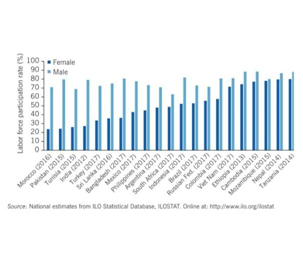
Furthermore, not all women have the same opportunities. Simply put, the educational requirements and certifications needed to land a nice, well-paying corporate job or establish one’s own business are highly expensive and take time to complete. This is proven by the high disparity between genders in the workforce, especially in developing countries (as shown in Figure 1), where educational attainment is low and jobs are scarce. To add to that concern, in certain areas, such as rural villages or third world countries with patriarchic traditions still intact, women are viewed as domestic creatures who have no right in pursuing higher education or even stepping outside of the house. Child marriage, sexual abuse, domestic violence, and conflict also place women in a more vulnerable position than men when it comes to access to higher education and better-paying jobs.
Figure 1 Gender disparities in labor force participation rates in selected developing countries, 2012—2017
Furthermore, no matter how much the discourse of feminism has progressed, the social truth that women still face the “double burden” because of gender roles and societal expectations as domestic caretakers, even more so than men, is still prevalent. A businesswoman with a high-paying job may still struggle to juggle her responsibilities in the office and at home as a wife and mother. Standards of performativity leads us to believe that women’s success is not only determined by how many KPIs she can fill, but also how successful her children are – because intelligent children imply that said woman is responsible enough to balance her time at the workplace and at home.
Yet, rarely any talk about empowerment focuses on how women deal with postpartum depression, or how to assist women who feel like they have failed as mothers, simply because the capitalist standards of feminism merely focus on how women are empowered outside their homes. While women who work outside may be seen as “heroes”, they are also prone to being judged as “failing, selfish mothers” who make no time for their families, which is rarely the case for the men, who society tends to view as the default breadwinner of the household.
Are the “Empowered” Truly Empowered?
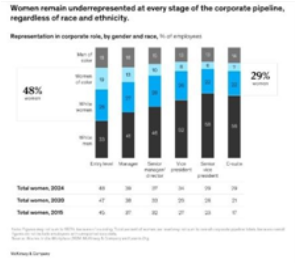
This is not to say that women who are involved in the “widely-accepted” standard of “empowerment” (i.e. business and corporate jobs) all have it nice, either. The main problem of the way feminism is perceived is that even women who seem to have the idyllic life, meeting the standards of “empowerment”, also have tough times. A female student who takes up gender theory as her main focus of study during her college years may not land a job as the issue is deemed too abstract and not lucrative for business and company development. A fresh graduate may feel pressured because she did not build on her personal branding on LinkedIn or social media because she did not have access to information about online profile optimization. Generally speaking, women are still underrepresented in the corporate pipeline, as shown by Figure 2 below.
Figure 2 Representation of women in corporate roles
Surely, the economic aspect of life is important – as no individual can fulfill their other needs without guaranteeing their welfare first and foremost – but not the only one to consider. Self-actualization often comes from other aspects of life, which capitalist standards of feminism have failed to consider. A woman cannot feel empowered simply by having the opportunity to work or earn her own wages: something deeper is needed to fill in the void in her journey towards self-actualization, after generations of oppression through structural capitalism, inequality, and misogyny. The current discourse of women empowerment tends to simply stop at giving women the space to work without letting their gender become an obstacle without addressing the power relations that run deeper in the social contexts of the workplace.
Such failure reveals a paradox: the notion of empowerment claims to empower women in the workplace, but even then, not all women in the workplace are truly empowered. Problems like the gender wage gap are still prevalent despite the prevalence of the women empowerment discourse. Findings from the PwC Global Empowerment Index (2023) even revealed that there is a gap of 34 percent points between women who say that being fairly rewarded financially for their work is important and the proportion who actually experience it, making it the biggest gap for women in the survey. Structural discrimination against women of color or women who are members of the LGBTQIA+ community also frequently occurs in the workplace, hindering their opportunity to progress in their career ladders.
Inclusivity Begins in the Mind
The notion of women empowerment, infused with capitalism after years of social progressivism, burdens marginalized women and proves to be in contradiction with its own nature. Perhaps this is the reason why women fear failure so much: we have strayed too far from the true definition of feminism as the Seneca Convention intended, and have made the supposedly simple nature of feminism – equality between genders – more complicated than it actually is. The capitalist notion of empowerment shows that despite the jargons that women are equal to men, in practice, sometimes there is still a long way to go. It appears that women are equal to men, under certain terms and conditions. Hence, feminism becomes a conditional movement, not a holistic approach to true inclusivity.
This dent in the way feminism is perceived is then internalized in the minds of women – who are marginalized and cannot fulfill modern capitalist standards simply because they are a woman – aggravating the fear of failure inherently there. It may even be stated that current perceptions of feminism, in a subconscious way, may tend to favor men because of its strong capitalist undertones. Ironically, women fear failure – the failure of never being enough – while participating fully in the system because there is hardly any way out. Women criticize the current system, yet at the end of the day, participate in internships and business training camps, simply because these routes are the fastest in achieving what society requires of them – as if being a woman requires an explanation.
Equal wages in the workplace, easier access for maternal leave, and training programs for women who live in poor, rural areas are necessary steps, but they all begin in the mind. Only after inclusivity is instilled in the mind and accepted as easily as common sense, concrete actions can be taken to reform the way women empowerment is perceived. Starting from abolishing gender roles in the family and treating our sisters more fairly, we can continue to progress in advocating for systemic changes and inclusive policies.
Just as it takes a whole village to raise a child, many stakeholders and many years are required to shape radical changes in the current system – and even then, the implemented results may not even be totally perfect. Yet, though we are still far from coming up with concrete policies and solutions, a theoretical, comprehensive approach in re-defining feminism and gender empowerment is required – because inclusivity begins in the mind and education system before anywhere else.
This does not mean that the current perceptions of “empowerment” are incorrect and thus should be abolished. If anything, these standards are good proofs of how far the feminist movement has come in ensuring that the livelihoods of women reach the standards of modernity. Yet, the voices of marginalized women, and all women in general, should be listened to more. Without listening to the voices of women, the fear of failure because of existing negative perceptions surrounding feminism and gender empowerment tend to be internalized, creating a conflict between dreams and idealism: “should I be what I want, or what society expects of me?”
True empowerment should mean that no woman has to choose either. An empowered woman is one who has the freedom to make her own choices, based on her own free will, and actualize herself with the goals of self-actualization and genuine happiness. Gender shouldn’t be an obstacle to chasing dream careers, but also in living as a human being in general. Only when the notions of feminism and gender empowerment are re-defined, challenges can be turned into success, and women can be more courageous in taking risks, knowing full well the feminist movement shields and secures them from anything hindering them in achieving their true potential.
Bibliography
Chamim, Mardiyah, Hendrika Tiarma Wulandari Samosir, Martha Triasih Karafir, Elisabeth L. Pasapan, Julia Kalmirah, Hendrietta Retno Putri (2024, May 16). Ibu Bumi Papua: Relasi Perempuan Adat dengan Alam di Tanah Papua. WRI Indonesia. https://wriindonesia.org/id/wawasan/ibu-bumi-papua-relasi-perempuan-adat-dengan-alam-di-tanahpapua.
Dictionary.com (2024, March 1). From Suffrage to Sisterhood: What Is Feminism and What Does It Mean? Dictionary.com. https://www.dictionary.com/e/womens-movement-what-doesfeminism-actually-mean/.
Evans, Sara M. (2015). Women’s Liberation: Seeing the Revolution Clearly. Feminist Studies, 41(1), 138—149. https://doi.org/10.15767/feministstudies.41.1.138.
Kenya National Bureau of Statistics (2020). Measuring Women’s Empowerment: Key Indicators. UN Women.
McKinsey & Company (2024, September 17). Women in the Workplace 2024: The 10th-anniversary report. McKinsey & Company. https://www.mckinsey.com/featured-insights/diversity-andinclusion/women-in-the-workplace.
PwC (2023). Despite some gains in the workplace, indicators show considerable progress still needed; at current rates it will take over half-a-century to close gender pay gap across OECD: PwC analysis. PwC. https://www.pwc.com/id/en/media-centre/press-release/2023/english/despitesome-gains-in-the-workplace-indicators-show-considerable-progress-still-needed.html.
Verick, Sher (2018). Female labor participation and development. IZA World of Labor. http://dx.doi.org/10.15185/izawol.87.v2.
W20 (2025, June 17). Economic Empowerment of Women and Girls. W20. https://women20.org/.
[1] Definition from Dictionary.com.