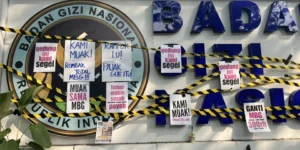





Trigger warning: the content of this article may trigger trauma due to explicit accounts of violence committed by authorities
Two days after the death of Affan Kurniawan (21), who was run over by a Brimob vehicle, Jakarta remained tense, including in Tanjung Priok.
Fathurrosi (41), a man who works as a fish transporter in Muara Angke, Jakarta, that night, as usual, asked permission from his wife, Sri Utami (32), and their three children to go to work as a fish transporter driver in the Muara Angke area, Penjaringan, North Jakarta.
It was already very late at night, but Fathurrosi had not yet returned home.
Sri grew anxious as she waited for Fathurrosi, who still hadn’t returned home even after the clock had struck midnight. Accompanied by the sound of her neighbor’s television still on, the smell of leftover rice in the kitchen, and the loud ticking of the wall clock as the house grew quiet from the cries of their two-month-old baby.
Dawn was approaching, and Sri’s head was spinning. She never imagined that night would be the beginning of something that could not be undone.
Sri went out to look for her husband, but she was not alone. That night until morning, in all the small houses on the outskirts of town, the women were still waiting. Waiting for their husbands to return, waiting for their children who usually came home late from work, waiting for the sound of a motorcycle that never reached the doorstep.
Sri had just given birth. Her body and mind were still recovering. While caring for her two children, who were now both older siblings, she nursed her baby, who was still completely dependent on her breast milk.
However, the authorities did not wait for Sri Utami’s body to be ready. Sri had to wait two days to find out that her husband had been arrested by the authorities on charges of rioting.
Read more: Stop Tech Misogyny: When AI Becomes a Tool for Manipulating Women’s Bodies
She never imagined that the long night spent awake in uncertainty would be the beginning of something that would drag her into further uncertainty.
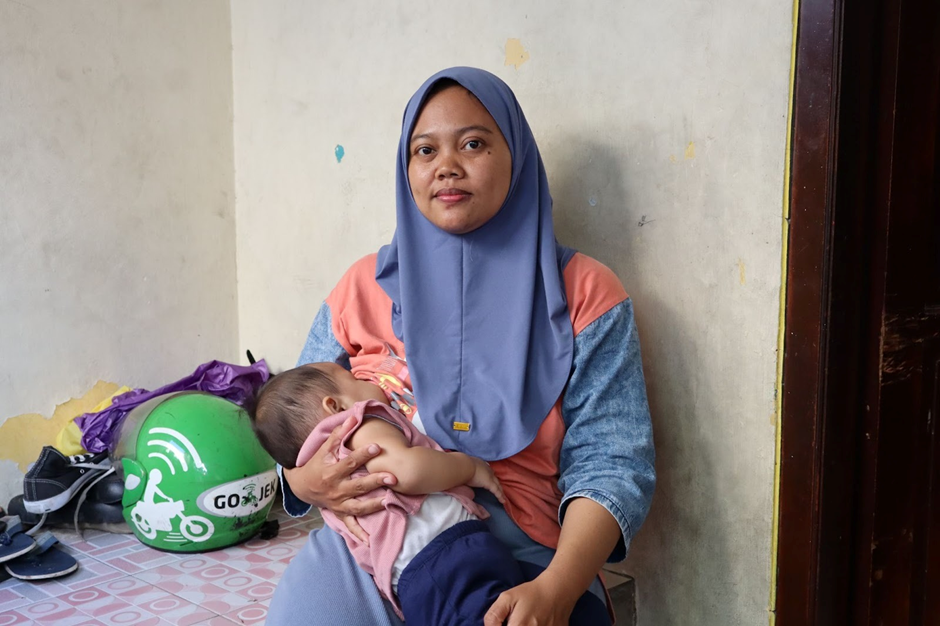
Sri is breastfeeding her baby, who was left behind by her husband, Rosi, who was arrested during the August demonstrations. (Photo: Luthfi Maulana Adhari/Konde.co).
The woman recounted the moments leading up to the arrest of Fathurossi, or Rosi, as Sri calls her husband. Rosi was beaten by the authorities and became a victim of wrongful arrest while he was watching the demonstration in the early hours of the morning after work at the end of August 2025.
Rosi was not an activist. He was not an eloquent orator. Nor was he a “dangerous” figure, as alleged to have incited riots during the demonstration that night. He was simply a father of three children who wanted to return home after work.
At 2:00 a.m., while Rosi was on his way home carrying fish, he saw a crowd of people. Curious, Rosi decided to stop and watch the situation for a moment. Suddenly, officers in Brimob (Mobile Brigade Corps) uniforms beat him until he lost consciousness. While he was unconscious, Rosi was arrested by the officers.
“They just started beating him without asking what was going on or who he was. They just beat him (my husband). Anyway, he was wearing a Brimob uniform and a face mask (buff). You couldn’t see his face,” Sri told Konde.co when met at her residence in North Jakarta on Wednesday (12/24).
Read more: Stop Tech Misogyny: The Long Chain of Gender-Based Cyber Attacks and Disinformation
In addition to the bump on his head, Sri said her husband continued to bleed from his mouth while being carried away by the authorities. His clothes, which smelled of fish after work, had disappeared. With his body limp, Rosi was dragged hundreds of meters along the asphalt road.
Sri couldn’t imagine how, on that night, the pain in her husband’s body, which was on the verge of unconsciousness, was mixed with blood and road dust.
“Dragged from BRI to the North Jakarta Police Station. That’s quite a distance, isn’t it? I still can’t imagine it,” she said bitterly.
Rosi was taken to the Police Hospital because she was unconscious. He was discharged with injuries that were far from healed. After a short break, Rosi had to leave the hospital and go to the detention center.
“It seems that the police were also afraid. He (Rosi) was unconscious, so he was taken to the hospital, but once he regained consciousness, he was taken back (to the North Jakarta Police Station),” said Sri.
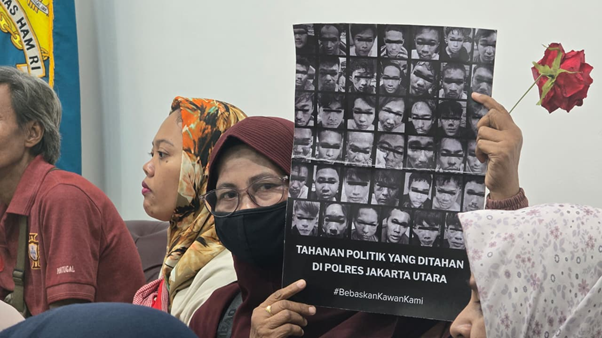
A woman held up a poster featuring photos of detainees with injuries during a report and hearing at the National Commission on Human Rights (Komnas HAM). (Photo: Luthfi Maulana Adhari/Konde.co).
Read more: Prabowo-Gibran’s One-Year Report Card From A Gender Perspective
Since then, Rosi has disappeared from her family’s reach. He did not come home that night. There was no news to go on. And there was no official notification explaining where he had been taken or on what grounds he had been detained. There was no explanation, and it was this absence that Sri found most cruel.
Time passed, hour by hour, day by day, without certainty, while the family was left to live between hope and fear.
What Rosi experienced was not an exception. He was part of a recurring pattern, experienced by many other families during the wave of arrests at the August 2025 demonstrations in various locations, with similar wounds.
Rohimah (56), Sri’s neighbor, also did not immediately know that her son had been arrested that night. Rohimah also had to start everything from scratch: guessing, searching, asking questions, and leaving her fate to hope.
“The police didn’t tell the family that our son had been arrested,” Rohimah said with a bitter expression to Konde.co, along with Sri, on December 24.
Her son, Sofian (30), still seemed normal until late at night in late August 2025. There were no signs that that night would be the turning point of his arrest by the authorities.
“At 2:00 a.m., he was still at home. Then he left, either to get something to eat or something else. We don’t know. After that, there was no news.”
Read more: Arrests at the End of the Day: Arrested While Hanging Out, Allegations of Sexual Harassment
When the call to dawn prayer sounded, Sofian was not at home. The quiet dawn turned into a suffocating anxiety. Rohimah began to panic. She searched everywhere, going to places where he might be, asking people about her son, but no one had any answers.
That day, Rohimah lost more than one child. While searching for her son, she nearly lost two other loved ones: Amar, her eldest son, and Rizky. Although not her biological child, Rohimah treated Rizky like her own and had become his guardian after he had lived apart from his biological family for a long time.
Amar and Rizky left the house at dawn with the intention of looking for their younger brother who had not yet returned home amid the August 2025 demonstrations. They carried nothing but the hope that their brother could still be found. They had no plans to fight back, no idea that they would face violence. Like their mother, Amar and Rizki just wanted to know where Sofian was.
However, that intention was never fully expressed. Before they even reached the North Jakarta Police Station, the police quickly intercepted them.
“They were immediately arrested. Their motorcycles were taken, their phones were taken. Rizky was taken away, along with the others, while being beaten.”
“My son (Amar) argued: Why me? I just want to find my brother. But instead, he was beaten and kicked with shoes,” said Rohimah.
Read More: Indonesian Academics, Do We Stop Taking Accountability on Research Papers?
That defense fell on deaf ears. Amar’s body became the next target. Right before his eyes, Rizky was beaten. The violence did not take place in an open space, near a shopping center.
“He said, ‘Wait a minute, if anything happens to me, I’ll sue.’ He also saw Rizky being beaten in front of him. (And) he said, ‘Watch out, if anything happens to my brother, I’ll sue!'”
That threat was Amar’s last cry to remind the police of their limits. But those limits were instead used as a source of ridicule.
“The police said (in a mocking tone), ‘Sue us!’ while jumping up and down.”
On the street, the violence did not stop. It flowed, moving from hand to foot, from one body to another, as if it needed no reason to continue.
“On the street, they were also beaten. My son said they were interrogated on the street. He said, ‘If you want to interrogate us, do it at the office. There are no CCTV cameras here.'”
Amar understood one thing very quickly: that the road was a space without witnesses. There, blows did not need to be accounted for. He tried to survive by using the logic of saving his own body first.
“I want to ride a motorcycle, not walk. If I walk there, I’ll get beaten up!” said Amar, as recounted by Rohimah.
Read More: Arrests at the End of the Day: Arrested While Hanging Out, Allegations of Sexual Harassment
That request didn’t stop anything. On the contrary, the violence seemed to find its own space. The violence was then brought into the police station, moving from place to place without ever losing its form.
“Even when he arrived at the police station, he was still questioned. His cell phone was confiscated and checked.”
Inside the room, the search turned into an interrogation. Amar’s identity was slowly uncovered through the screen of a cell phone that was no longer his.
“Coincidentally, my son is an active SAR volunteer. He often participates in flood relief activities and training sessions. He was in Bekasi during the floods, and also in Bogor,” he explained.
The humanitarian work he had been doing all along now became a source of suspicion.
“Then they also asked, ‘Why are you in this group?’ So he was suspected.”
Amar tried to remain cooperative, hoping that openness would lead to a solution.
The police’s attitude softened when they saw the name of a general who had been in contact with Amar when he was a volunteer.
“My son said, ‘If you want to check, please call the person.'”
Read More: Prabowo-Gibran’s One-Year Report Card From A Gender Perspective
The clock ticked away without certainty. Eventually, the decision to release Amar was made, though without explanation.
“After hours of questioning, he was finally released. His cell phone was not returned. It still hasn’t been returned. His motorcycle could only be retrieved two days later.”
“The only one who got away. Sofian and Rizky were arrested,” said Rohimah, her eyes glistening.
Rohimah recalls that moment as the thin line between survival and loss.
“Perhaps because God is still watching over me. Otherwise, all three of us could have been detained. This child is the one I rely on. His father is already sickly.”
But the day wasn’t over yet. Amar kept going back and forth to the police station, bringing home stories that only prolonged the fear.
“That day, my son kept going back and forth to the police station. He said, ‘Mom, I was beaten. What about Sofian?’”
That day, Amar truly saw violence become an almost ordinary sight.
In front of him, people were being beaten. Some were bleeding profusely in front of him. He didn’t dare to fight back, but he kept saying, “Sir, please don’t hit them.”
Read More: Arrests at the End of the Day: Arrested While Hanging Out, Allegations of Sexual Harassment
Among them were people who were even working and did not escape the police’s target.
“There was also an ojol driver who was stopped. His app was still running, he was carrying a passenger. Another ojol driver who reportedly refused to stop was thrown off his bike, fell, and was dragged away.”
Everything Amar witnessed piled up into one question that never stopped spinning in his head.
“‘How and where is my younger brother?’ Others were beaten that badly,” Rohimah repeated her son’s question.
When the arrested individuals arrived at the police station, the process took place without any layer of protection. There were no procedures to guarantee safety, let alone justice.
There were no legal representatives. And there was no clarity regarding their status. There was no clear line between interrogation and intimidation. Everything took place in a gray area that benefited the authorities and paralyzed the victims.
“Even the investigation process didn’t have legal counsel,” said Sri.
After the arrest of 70 people that day, 60 of those arrested were named as suspects under Article 170 of the Criminal Code concerning assault and Article 212 of the Criminal Code in conjunction with Article 214 of the Criminal Code concerning resisting officers.
Read More: MBG Must Be Stopped: Poisoning Scandals, Gender Bias, And The Shadow Of The Military
The year 2025 has indeed turned into a wave of arrests that continues without pause, without respite. There has been no transition from repression to recovery. Konde.co recorded that throughout 2025, at least 7,677 people were arrested and 42 people forcibly disappeared in one year. The data was compiled from documentation monitoring collected by KontraS, YLBHI, Polri, AMAN, Satya Bumi, Amnesty International, Human Rights Monitor, and records through analysis of news reports and civil movement reports by Konde.co.
The largest cluster came from demonstrations and civil actions. Throughout 2025, 7,148 people were arrested and 34 others forcibly disappeared in the context of protests. In this wave of arrests, mothers never knew when their children would return home, or if it was even possible for them to return. Activists and civilian women were also targeted in cyber persecution.
Sri and Rohimah, Portraits of Women’s Resistance Far from the Spotlight
Despite being far from the hustle and bustle, Sri and Rohimah are undaunted in demanding justice for the arbitrary arrest of their husbands and children. They also show solidarity with each other in carrying out collective care work.

Rohimah (right) and Sri (left) are two mothers who work together to visit and fight for the release of their children and husbands. (Photo: Luthfi Maulana Adhari/Konde.co)
Despite all her limitations, Sri refuses to give in. She continues to fight for justice for her husband and the father of her children who was taken away. However, in the process, she has encountered numerous obstacles, many of which come from law enforcement officials.
Read More: Leftist Books Are Not Dangerous; What Is Dangerous Is A State That Confiscates Books
After reporting the loss to the police, Sri found out that her husband had been arrested and detained.
“Well, it’s been 24 hours, and then I saw his name on the list,” said Sri.
The name was neatly recorded in the system, but it was never announced. No officers came to the house, no letter arrived at the doorstep, and there were no calls whatsoever.
From Sri and Rohimah’s experience, the authorities knew where Rosi and Sofian were but chose to remain silent. The family was forced to search for information amid closed institutions, layered procedures, and indifference to a mother’s conscience.
The discovery did not bring relief. Instead, it opened the door to further violence. Short-term disappearances work precisely because they are temporary, because they can be denied, because they are allowed to float in the gray area of procedure.
At the police station, Rohimah and Sri witnessed firsthand the traces of violence that had not been hidden. The building, filled with symbols and slogans promoting law enforcement and “protecting the people,” showed the opposite.
“On the fourth floor, when I went to check my husband’s name, there was blood all over the walls. The elevator was also covered in blood. Almost everything,” said Sri, who was met with a sad nod from Rohimah.
Read More: Arrests at the End of the Day: Arrested While Hanging Out, Allegations of Sexual Harassment
That blood wasn’t just a stain. That blood was evidence that the torture wasn’t an incident carried out by one or two people, but rather a practice by a system that operated without any correction whatsoever.
And even when the injuries were visible, the detention was not stopped. This was the case with Rosi and other detainees.
“The most severe cases involve permanent disabilities, but they are still detained, not in the hospital.”
“When the police get a minor injury from a firecracker, they immediately get medical attention,” she complained.
Damaged bodies are not considered a reason to stop punishment. Instead, the body itself becomes part of the punishment. They are kept in a state of pain, stripped of their right to treatment, as if physical suffering is a legitimate consequence.
The wounds on Rosi’s back, which were captured on camera, were shown by Sri. (Photo: Luthfi Maulana Adhari/ Konde/co).
The discovery of blood and the name became a threshold. The mothers were not allowed to meet their husbands or children. It was at this point that Rohimah and Sri were forced to understand that the state not only hurt their bodies, but also regulated their time, distance, and access to their loved ones.
Read More: MBG Must Be Stopped: Poisoning Scandals, Gender Bias, And The Shadow Of The Military
As a mother, Rohimah had no choice but to continue questioning and fighting. Every name on a police uniform became a possibility. Every corridor of the institution became a space of hope and anxiety. At this point, they showed that motherhood is political work to refuse to accept ignorance as a normal situation.
“I went back and forth to the police station, but I was never allowed to meet him. It took me 22 days before I was finally allowed to see him,” said Rohimah.
When the meeting finally took place, her son’s body became a living archive of what was never recorded in police files.
“His hands were like this (demonstrating the dislocated bones in his wrist) because they were stepped on.”

Rohimah showed a leaked photo of Sofian with other detainees, his wounds still wet and bruises visible on his face. (Photo: Luthfi Maulana Adhari/Konde.co).
What Rohimah experienced was intertwined with Sri’s experience. She was forced to wait, and waiting is never a neutral word. For weeks, family access was completely closed off, and there was no certainty as to when they would be allowed to meet.
“The family was also not allowed to visit for three weeks. No visits at all for three weeks. I had to wait until the wounds dried before I could see my husband,” said Sri.
Read More: The Banality Of State Violence, We Urgently Need Police Reform
Those words came out of Sri’s mouth without any drama. Sri tried to ask questions, tried to find a reason. But the state did not feel the need to explain.
“The reason for the three weeks was simply answered: it’s not allowed yet.”
After three weeks without any news and two months of detention at the police station, the prisoner was transferred unilaterally without a letter, without explanation, without any opportunity for the family to prepare or even to know where the person was being taken.
“Two months later, he was immediately transferred to Cipinang. There was no prior notification,” said Sri.
“When a nice bus suddenly arrived, like a tourist bus, and a woman saw that they (the prisoners) were about to be taken out, I immediately ran. I approached the bus and waved my hand. I didn’t know if my child was inside or not, but I could see that all the parents outside and the people on the bus were crying,” Rohimah continued.
During her detention at the Cipinang Correctional Institution (LP), Rohimah tried to break through the restrictions with acts of kindness by giving gifts, but violence returned in a form that was almost trivial, yet at the same time heartbreaking.
These items were not intended as luxuries. They were symbols of care. Rohimah provided sarongs, prayer mats, underwear, towels, things that connected the prisoners’ bodies to life outside their cells and even to their spirituality.
Rohimah brought these items with the simple hope that her son could at least pray, dry himself off, and maintain what dignity he had left. But even that hope was shattered.
Read More: From Obligation to Right: Rethinking “Sex as Duty” for Muslimah
“Sir, I brought a prayer mat, sarong, underwear, T-shirt, and towel, but only the underwear and T-shirt arrived. Where are the rest, sir? Where are the sarong and the other items?” asked Rohimah.
“They were probably thrown away, ma’am,” replied the officer.
“Try looking in the trash bin on Monday,” the officer continued.
“Really, sir? The prayer mat and sarong were thrown away?” Rohimah asked in shock.
Rohimah then reported it to another investigator. She said, “Sir, if they’re not allowed in, they should be returned. They’re more useful that way.”
“Weren’t they returned, ma’am?” the investigator asked.
“No, sir.”
“How long has it been?”
“Just recently, sir.”
“It’s impossible to throw it away.”
“Huh? No, sir. I remember it very well. I protested. It’s for worship, sir. It’s your responsibility, sir. If it’s not allowed, how can we pray, sir?”
“Just continue, ma’am. You can wear shorts inside too.”
“How do you continue? Oh my God,” Rohimah complained.
Read More: Indonesia’s Deadly Protests: Economic Chaos and Political Frustration
“Yesterday my child asked for it again. I tried to bring it. But it still didn’t pass. They said it’s not allowed, afraid it might be used for suicide, they said,” Rohimah explained.
Rohimah looked at the photo of her son, Sofian, who remains the icon of her family’s WhatsApp group. (Photo: Luthfi Maulana Adhari/Konde.co).
In all these experiences, Rohimah saw how the role of mothers continued to be reduced to disrupting procedures. Questions were considered nagging. Tears were considered weakness. Yet it was precisely from this maternal position that state violence was most clearly visible. These mothers did not speak in legal terms, but in body language, time, and loss. The mothers read the system not from legal texts, but from pauses, prohibitions, and discarded items.
“What do they think we are, anyway? They have mothers, they have children, don’t they?” Rohimah asks bitterly.
Restricting family access served as a form of disappearance that was never officially recorded. There were no reports about days without news. There were no documents about prolonged visitation bans. And there were no records about discarded belongings. All of that was left to live only in the memories of the mothers, and precisely because of that, it was considered invalid.
But it is these memories that become a counter-archive. Women fight back with memories that are not merely personal recollections, but political tools. The mothers refuse to let the violence vanish without a trace.
Women Who Refuse to Believe Forced Confessions
After that, the violence was no longer vague or imaginable; it took on a more structured, colder form, and precisely because of that, it was even more devastating.
If in the early stages mothers were forced to deal with silence and a lack of news, then once that door opened, they were forced to witness how the state actively worked to construct crimes that their husbands and children had never committed.
For Sri, the next step was not simply to wait for the legal process to run its course. She entered a realm that she had previously only known as terms on television news: case files, investigation reports, witnesses, trials. But what she encountered was far from the image of orderly legal proceedings. She found a stage set to ensure that her husband was a criminal, regardless of the facts.
The violence first appeared in an almost absurd form. Sri recounted how her husband was forced to reenact the scene of throwing a bottle, even though Rosi had never done such a thing. The crime scene, which should have been a place for clarification, turned into a tool of coercion with threats.
“During the crime scene investigation, my husband was told to throw a bottle. The reason was so that there would be no trial in court,” said Sri.
To Sri, those words sounded like a threat wrapped in persuasion. The authorities did not explicitly say that this was an obligation but offered it as a “shortcut.” No trial was necessary, no lengthy proceedings, just follow the script.
Read More: Sexism in Student Arrests and Maternal Activism Mothers Defend Their Children’s Struggles
She knew her husband’s heart refused. She knew her husband didn’t throw the bottle. But that refusal had no room to exist in the presence of armed officials with full authority over the prisoner’s body.
“I was told to do it, even though I didn’t want to. My husband said, ‘Because I didn’t throw it, because I was just watching,’ but then he persuaded me that it was okay, so that you wouldn’t be guilty and it wouldn’t take long in court. That’s it.”
In this offer, legal logic is turned on its head. Admitting to an act that was not committed is positioned to be “not guilty.” State officials are no longer seeking the truth, but compliance. The defendant’s body is used as a tool to fill the void of evidence, while a wife watches as reality is forced to submit to the needs of the law.
The violence continued in the courtroom. Sri hoped that the court would at least be a place where lies could be tested. But what she found was a repetition of false narratives in a legitimized format.
As a wife and mother, Sri realized that something was amiss; the people testifying were not those who had been at the scene. The testimony became a formality divorced from direct experience. The chain of lies was validated by the court, while the voices of the family—who knew the chronology from the beginning—were deemed irrelevant.
“The police witnesses also did not match up with the arrest witnesses, who said that the defendant threw something, which was all wrong. The arresting officer was not him, even though it was the Mobile Brigade who made the arrest. But most of those who came were like other officers. Even those who made the arrest did not recognize the defendant. Most of them were not the original witnesses who were presented,” said Sri.
Read More: Sexism in Student Arrests and Maternal Activism Mothers Defend Their Children’s Struggles
At this point, Sri and the other women were not only facing the authorities, but the entire system that failed to recognize their vulnerability.
The North Jakarta District Court held a follow-up hearing for the late August 2025 demonstration case in the main courtroom on Thursday, December 4, 2025. The agenda for the hearing was to examine witnesses. The public prosecutor presented 25 witnesses, all of whom were members of the North Jakarta Police, for the 33 defendants who are currently on trial.
Of the 25 witnesses, two were presented as victim witnesses, while the rest were arresting officers from the North Jakarta Police Criminal Investigation Unit. The case was constructed entirely without presenting any civilian witnesses who were present at the scene of the incident.
Chief Judge Eka Prasetya Budi Dharma began the hearing by asking the victim witness, First Inspector Dodi Pandapotan Siagian, about the chronology of events referred to as the riots at the end of August 2025.
“Does the witness know what the problem is?” asked Eka.
“I know about the attack on the North Jakarta Police Headquarters at the end of August 2025,” replied Dodi.
The judge then requested a more specific explanation of the timing of the incident.
“Can you be more specific about the date?”
“As far as I recall, it was Saturday night into Sunday,” said Dodi.
Read More: Period Pain for Women is Real, How to Deal With It?
In his statement, Dodi said that the situation began when police officers were on high alert. According to him, the attack came suddenly when the crowd threw Molotov cocktails at the North Jakarta Police Headquarters. At around 10 p.m., Dodi said, the crowd was already across from the police station.
“At around 10:30 p.m., the crowd used motorcycles to throw Molotov cocktails in front of the North Jakarta Metro Police headquarters,” said Dodi.
“Then what happened?” the judge asked.
“We exited the headquarters to establish a perimeter as the crowd continued to grow,” he replied.
Dodi stated that the attack came from various directions, including from the port area and Plumpang. According to him, the crowd threw various objects at the police station, ranging from rocks, wood, zinc, iron, to fireworks. He said that the situation remained tense for seven hours afterwards.
“When did everything become conducive?” asked the judge.
“Sunday at 6 a.m.,” Dodi replied.
He also mentioned that he suffered minor injuries from being hit by fireworks during the incident.
Read More: The Banality Of State Violence, We Urgently Need Police Reform
In the indictment, the prosecutor stated that on Sunday, August 31, 2025, at around 12:05 a.m. Western Indonesian Time, the defendants “committed violence against an official who was carrying out his lawful duties or a person who, according to the law or at the request of an official, was providing assistance to him, committed by two or more persons.”
This trial placed police officers as both victim witnesses and arresting officers, while the events involving dozens of residents were processed entirely through the narrative of law enforcement. This context is important because it will determine how the boundaries between mass action, violence, and criminalization are interpreted and decided in the courtroom.
The police previously stated that the attack on the North Jakarta Police Headquarters was part of a series of organized “anarchist” actions, which began on the night of August 30 and continued until the early hours of August 31. According to an official police statement, the crowd gathered and stormed the North Jakarta Police Headquarters on Jalan Yos Sudarso, attempting to break in and damage the police facilities. The officers on duty claimed they were forced to repel the crowd because the situation was considered threatening.
The police reported that firecrackers and stones were thrown, and Molotov cocktails were even found near the location. These findings were used from the outset to confirm that the crowd did not simply gather spontaneously but rather had violent intentions.
As of September 1, the North Jakarta Metro Police announced that they had detained 70 people suspected of involvement. Most of them are said to be teenagers.
“Most of those detained are teenagers,” said North Jakarta Metro Police Chief Kombes Pol Erick Frendriz in Jakarta on September 1.
Read More: From Obligation to Right: Rethinking “Sex as Duty” for Muslimah
On September 4, the investigation entered an advanced stage. The North Jakarta Metro Police Criminal Investigation Unit named 60 people as suspects. The police said that many of them admitted to coming because of invitations or calls circulating on social media.
“Their role was to cause destruction and throw objects, with evidence including Molotov cocktails, fireworks, and various other items,” Erick told the press in Jakarta, as quoted by Tribun Jakarta on YouTube (September 5).
Erick emphasized in his statement that the police did not arrest demonstrators, but rather “rioters” with evidence including Molotov cocktail shards, CCTV footage, and stones.
“What is certain is that those we arrested are the perpetrators who carried out the throwing and destruction at the North Jakarta Police Station.”
“The evidence includes broken glass from Molotov cocktails, CCTV footage, used fireworks, rocks, and so on,” said Erick.
If Sri was forced to witness the fabrication of evidence against her husband, Rohimah faced another form of violence that was just as systematic through the destruction of the victim’s morale by means of accusations that were unrelated to the case being tried.
Read More: Indonesia’s Deadly Protests: Economic Chaos and Political Frustration
In Rizky’s case, the police not only detained him, but also built a criminal image to justify the detention.
Rohimah recalls how the accusations were thrown around casually, as if truth could be created with a few short sentences.
“The police suddenly said, ‘Do you know that Rizky is a drug user?’ I immediately replied, ‘Sir, he doesn’t even have enough to eat. I take care of him, sir. I don’t believe it, sir!'”
As a mother, Rohimah interpreted the accusation as a multi-layered attack. Not only on Rizky, but also on his background: poor, neglected, and living in vulnerability. The state uses stigma as a tool to break down defenses, exploiting class and moral hierarchies to legitimize accusations.
The accusation was then recorded in an official document. In the investigation report, Rizky was accused of throwing stones at the police four times. Rohimah knew that the story did not make sense. She knew what the children had done that day.
“Do you know why Rizky did that, ma’am? He threw stones at the police four times!” said the police officer, as recounted by Rohimah.
“I don’t know, sir! He and Amar were looking for Sofian, not looking for trouble with the police. I don’t believe it!” she replied.
Here, maternal experience is once again a source of knowledge that is rejected. What a mother sees and knows carries no weight in the face of official state texts. Paper trumps memory. Stamps trump living testimony.
Read More: Sexism in Student Arrests and Maternal Activism Mothers Defend Their Children’s Struggles
Violence does not stop at the creation of stories. It manifests itself in the form of forced confessions through the body. Rohimah witnessed how her child was forced to sign an investigation report and a letter of remorse without legal representation and without any real choice.
“There (Sofian and Rizky) were told to sign first. Legal counsel was not yet allowed to enter. So they were told to make a statement saying, ‘I regret my actions and I will not repeat them again and will not hang out anymore, I apologize.'”
For Rohimah, this administrative letter was proof of how confessions were extracted from a situation of helplessness. Her children, who had no knowledge of the law, were forced to apologize for something they did not do, while their mother was removed from the room that was supposed to protect them.
Efforts to seek legal assistance were also subject to structural violence. The right to legal representation was treated as a privilege, not a state obligation.
“There has been no (legal counsel). Even during the investigation process, there was no legal counsel,” said Sri, emphasizing how vulnerable the defendant’s position has been from the start.
Rohimah experienced something similar. When her family tried to bring in a legal aid organization, the door was slammed shut. The family was also given false hope about a suspension of detention, which evaporated into thin air.
“At that time, LBH came first and was also kicked out. LBH was not allowed to enter either. They were ignored. At first, we were given false hope, told that we would be given a letter of suspension of detention. We were told to take care of it at the neighborhood association, but after 20 days there was no news, and we were told that it had been extended again. The documents were incomplete, or something like that,” said Rohimah.
Read More: Sexism in Student Arrests and Maternal Activism Mothers Defend Their Children’s Struggles
In that situation, the authorities played on fear and confusion. As a mother, Rohimah was positioned as someone who was easily swayed. The narrative that LBH would “complicate” the process was repeated. The pressure was repeated until it seemed like advice.
“These women are confused, given false hope.“Don’t use LBH, it will only make things more difficult.” “Why bother with this (looking for a lawyer)?” “We’re already confused, and then the police say that, so now we’re here, our minds are in turmoil, we want to move forward but we’re confused, we want this but we’re confused, we want that but we’re confused, what will happen next, it turns out that the police are just stringing us along.”
“So they said to just use the police. Don’t use the Legal Aid Institute, it will only make things more difficult. It’s better to get help (from the police), right?” continued Rohimah.
During the visit on Friday, Rohimah requested permission to visit in a restrained tone, as if she knew that a right could turn into a request. The response was brief, flat, and left no room for negotiation.
“Well, ma’am, how about Monday?” the officer said to Rohimah.
She tried to understand. Looking for a loophole.
“Can’t it be done? Why wait until Monday?”
“Yes, because tomorrow is a holiday.”
Read More: ‘What I Inherited, What I Refused’ Reflections About Overcoming Misogyny
That reason sounded unreasonable to Rohimah. She was then forced to go home, wait, and hold on to the promise of Monday as if it were a certainty.
Monday finally arrived with a shared sense of certainty. The family gathered, belongings were neatly arranged, food was packed, clothes were folded, and friends entrusted their hopes in the form of small gifts.
“This is for Ian,” said a friend.
Rohimah arrived at the prison. Unfortunately, the procedures had become stricter again.
“Try calling the investigator, Ma’am.”
The problem was that Rohimah had tried to contact him via WhatsApp, but her messages were sent but never read, let alone replied to. Finally, the guard called him. The answer came from the other end, short and cold, like a hammer dropped without a trial.
“There are a lot of inspections going on. Can’t. Can’t meet.”
Rohimah could no longer hold back the tone of her voice.
“This is about meeting my child—why is it so difficult?”
The response wasn’t denied, but it wasn’t answered either.
She moved to the food storage area. Trying another route. Trying to hold on in the narrow space that remained.
“Sir, what’s going on? I was given permission on Friday, I already brought it with me, so why can’t I do it now?”
Read More: Period Pain for Women is Real, How to Deal With It?
The officer hesitated, then repeated the same sentence, like a mantra that closed all doors.
“Oh, well, maybe… this, ma’am… there are a lot of inspections.”
“Why is it like this, sir?”
“Well, you have to understand too.”
“Understand” was the word that stung Rohimah, as if demanding her to accept it. At that point, the accusation followed.
“Your child is defiant, wants to bomb the officer, wants to burn down my office!”
Rohimah only responded with the simplest words, and precisely because of that, they were the most straightforward.
“I just want to visit!”
Hearing this story, Sri also admitted that she was often teased in the same way. She was often labeled “This is the one who burned down my office” and “This is the one who destroyed my office.” Sri was annoyed and often responded with a cynical stare.
“They said the bus stop was destroyed, the shop was looted, and many police stations were damaged and burned down, but the police station wasn’t damaged. The only thing we saw damaged was a billboard when we were looking for our husband and child,” Sri said angrily.
Read More: Indonesia’s Deadly Protests: Economic Chaos and Political Frustration
First Inspector Maryati Jonggi, Head of Public Relations for the North Jakarta Police, stated that last night’s riots did not cause damage to the police headquarters building. However, she acknowledged that there was damage to several public facilities around the North Jakarta Police headquarters.
“We managed to restore order with the help of religious leaders, community leaders, and residents in the North Jakarta area. We at the North Jakarta Metro Police would like to express our gratitude for their assistance during last night’s incident,” she said on August 31, as reported by Kumparan.
This is in line with the statement made by North Jakarta Police Chief Senior Commissioner Erick Frendriz, who said that his headquarters was safe and had not suffered any damage.
“The police headquarters itself is generally in good condition,” he told the press on September 5.
It is at this point that these mothers are present, refusing to stop asking questions, refusing to fully believe, and continuing to hold onto their memories as the state attempts to erase them.
Legal advisor Sofian, Jericho Mandahari, views the wrongful arrest and arbitrary detention as unlawful actions with clear consequences.
“If, for example, the police make an arrest in error, they have committed a legal error and misapplied the law. Violating this article, we can seek compensation in accordance with Article 96 of the Criminal Procedure Code. If there is an arrest in error, a misapplication of the law, then the defendant can file a claim for compensation and rehabilitation, in accordance with Article 96 of the Criminal Procedure Code,” said Jericho.
Read More: Sexism in Student Arrests and Maternal Activism Mothers Defend Their Children’s Struggles
The legal framework that allows for compensation and rehabilitation should be a tool for correcting the power of the authorities. However, in practice, it often becomes a dead letter. Victims of criminalization are faced with a system that from the outset closes the door to the admission of wrongdoing.
According to Jericho, violations did not occur at just one point but were layered from the initial arrest process to the examination at the trial.
“Actually, during the trial there were many procedural errors, if I look at the facts of the trial, up to this examination,” he said.
The arrest was carried out based on target logic, not evidence logic. The sting operation, which should have been based on strong evidence, was carried out haphazardly, without scientific investigation standards. Jericho emphasized that the authorities ignored the basic principles of investigation.
“First, the quality of evidence seized or obtained through sting operations is not optimal. For example, are there fingerprints on the stones? Conduct a forensic examination. The police must conduct scientific crime investigations, so they must be thorough,” explained Jericho.
Instead of tracing the causal relationship between the suspect and the evidence, the authorities took a shortcut by naming anyone at the location as the perpetrator. In fact, evidence technology is available and should be used.
“If there is CCTV footage showing his face, then it’s clear that he threw the object. This proves that he can be immediately arrested. He was arrested immediately without considering the circumstances and was immediately named a suspect,” he added.
Read More: ‘What I Inherited, What I Refused’ Reflections About Overcoming Misogyny
It was at this point that Sofian, Rizky, and Rosi, along with dozens of other detainees, were dragged into a legal system that had already reached a conclusion. The status of suspect was attached to them not through fair evidence, but through the assumptions of officials working in a repressive situation.
The most obvious inequality confirmed by Jericho was seen in the matter of legal assistance. The state often claims that the right to legal counsel has been fulfilled administratively. However, this claim collapses when confronted with the concrete experiences of the defendants.
“During the trial, we also saw that they were not accompanied by lawyers. The lawyers were only there to sign and take photos,” he said.
Legal representation is reduced to a formality, a signature on paper, documentation for the archives, without any substantive presence in the examination process. Jericho explained how difficult it is to uncover the truth because of this problem.
“So it is difficult to prove that they were not accompanied because of the administration.”
The bureaucratic system protects itself, creating an illusion of procedural compliance. However, in the courtroom, the defendants speak from their own bodies and experiences, and they speak under oath.
Read More: Indonesia’s Deadly Protests: Economic Chaos and Political Frustration
“But the factual testimony in court said they were not represented, they were also sworn in for that,” explained Jericho.
This testimony is also a valid legal statement. In their testimony, Sofian and other prisoners also revealed the intimidation and violence they experienced during the investigation process.
“They reported intimidation and violence during the investigation (BAP),” Jericho continued.
This violence is often normalized in a masculine and hierarchical police culture, which views the suspect’s body as an object of discipline. Jericho firmly rejects this normalization.
“If there is violence, then it is a crime, even if it is committed by the authorities,” he said.
Systematic Impoverishment of Women
In her efforts to fight back, Sri had to endure hardship. She still had to breastfeed, and her body felt the impact.
“At first, I couldn’t even eat rice, and I was still breastfeeding, so my milk didn’t come out. I hardly ever left the house.”
Time passes, but wounds do not heal immediately. Babies who should get to know their fathers through touch, sound, and daily presence instead grow up in a state of distance and absence produced by the state.
In the courtroom, behind bars, the father-child relationship is reduced to brief, unfamiliar, and tense encounters. Sri witnesses this change with an irreplaceable sense of loss; her child no longer wants to be held by his father.
“The baby no longer wants to be with his father; every time he is held during the trial, he cries, as if he has forgotten his father’s face,” Sri said sadly.
But amid all that, there was also a fragile hope, expressed by his father before everything took a turn for the worse. That hope now sounds like a bitter prophecy, but also like a small act of resistance against a system that wants to break him.
“From the moment he was born, his father said he would grow up to be a strong child. And indeed, at this age he’s already been back and forth to the JPO, riding the busway, getting caught in the rain, playing in Cipinang, going to court, yes, dear,” Sri said to the baby she was holding.
The strong children referred to are not an ideal choice, but rather the result of forced adaptation to unsafe conditions and early exposure to repressive spaces. Sri, as a mother, became a facilitator of all this because the system forced her to.
Read More: Is Our Public Transportation Gender Responsive and Inclusive? Konde.co Research Results (1)
Sri feels overwhelmed by female impoverishment. In Sri’s house, time does not flow smoothly; it spins around, stuck on the hours when someone does not come home. The detention of the family’s backbone is an earthquake that has destroyed the economic structure of Sri’s household, shaken parenting relationships, and forced mothers to take over roles that were previously shared or at least imagined to be shareable.
Sri never refers to herself as an activist. She calls herself a mother. Yet it is precisely from that position that she carries out the most concrete political work by keeping life going amid sudden destruction.
When her daily income disappeared, she was forced to rack her brains. Life turned into a series of emergency decisions, with every rupiah having to be fought for from queues, social assistance, and debts that were never truly paid off.
At Sri’s house, the economy is not a graph or a table showing an eight percent increase, but a list of necessities that must be met so that her children can survive another day.
“That’s right. I still must rack my brains sometimes to take on jobs such as picking up and dropping off my neighbors’ children from school. Then sometimes there is direct KJP assistance, such as picking up basic food supplies, and sometimes I am asked to queue up and pick up goods there. Whatever I must do. The important thing is that the children can buy snacks, pay for school fees, and eat. Especially the baby, who needs diapers, groceries, not to mention electricity and water,” she confided.
Sri was forced to become a logistics manager, a substitute breadwinner, and an emotional caregiver all at once. The double burden then became a physical sensation that weighed heavily on her chest. Sri not only worked more; she worked in extreme uncertainty, with no guarantee that tomorrow would be any easier.
Read More: Introducing Mary Wollstonecraft, the ‘Mother’ of First-Wave Feminism
Loss of income went hand in hand with loss of assets. The authorities not only took people, but also the things that supported daily life. Cell phones, identity documents, even daily wages all disappeared in the vortex of opaque detention.
“Never mind cell phones, sir, even motorcycles are stolen, lots of them. I also lost my vehicle registration and driver’s license. I didn’t even have the 500 thousand rupiah I earned from work,” explained Sri.
Women are forced to patch up the holes that keep being made
Rohimah’s own body became a record of that suffering. She shrunk, weakened, and was on the verge of giving up. Dealing with bureaucracy, finding money, keeping the children emotionally intact—it all piled up without pause.
“This is my body; I was originally overweight. I was originally overweight. This is almost a drastic change. Yes, it also affected my child. I almost gave up; I wanted to go back to my hometown. Now my parents finally told me to come here. Because I felt like I couldn’t take it anymore,” she complained.
Her anxiety multiplied when Sri thought about her child sitting in elementary school. Social stigma haunted her thoughts, overshadowing her child’s unexplained tears.
She imagined the questions her friends might ask, the possible teasing, and the small wounds that could grow into long-term trauma.
“She often bursts into tears since her father didn’t come home. I asked her why she was crying. Did someone hit her or say something mean? I was afraid that was the case. I kept thinking that she was being teased, ‘Your father is in jail,’ and I was afraid that was the case. I kept thinking about that. But she never answered why she was crying. It affected everyone,” explained Sri, holding back her tears.
In Sri’s concern, it is evident how the detention of one person creates a domino effect that spreads throughout the family. The children are forced to bear the social burden, while the mother must become the last line of defense, trying to protect them from stigma and further violence.
Caring is Fighting
At first, no one called it a movement. There were no banners, no slogans, no stage. All there were mothers standing for too long in the waiting rooms of police stations and courthouses, their eyes swollen, their backs stiff, their hands busy clutching plastic folders containing photocopies of ID cards, letters of authorization, and fading hopes.
Rohimah remembers clearly how it all began not out of any intention to form anything, but out of the most basic need: to search. To search for children, to search for husbands, to search for news, to search for certainty that never came from the authorities.
Rohimah (right) and Sri (left—carrying her child) care for each other as they visit and fight for the release of their children and husbands. (Photo: Luthfi Maulana Adhari/Konde.co).
The state operates with masculine logic (arresting, transferring, detaining) and then closes the door under the pretext of procedure. In this hierarchical and repressive system, information becomes a commodity of power. The authorities keep it tightly under wraps, while the mothers are left to go from one counter to another, from one uniformed face to the next, without consistent answers.
It was in the waiting room that they saw each other. The first glance was often awkward, but over time, their shared fate broke down the barriers. The suppressed tears created a shared language that needed no conductor. Rohimah recounted how this chance encounters slowly turned into bonds, aided by the encouragement of young activists, one of whom was an alliance calling itself the “Youth Movement Against Criminalization” (Gemulai/GMLK).
“At that time, there were quite a lot of women. We started helping each other, some looking for food, some looking for drinks. But during that situation, there were still those who were called and questioned continuously, as if their business was not yet finished. Then some young friends arrived, and we promised each other to seek legal assistance. We were advised to go to LBH Jakarta, and two days later I went there with my child,”
Read More: From Obligation to Right: Rethinking “Sex as Duty” for Muslimah
The situation in the room at Komnas HAM after the solidarity meeting between the families of Tanjung Priok political prisoners and the Youth Movement Against Criminalization with the Chair of Komnas HAM, Anis Hidayah (11/22). (Photo: Salsabila Putri Pertiwi/Konde.co).
In this excerpt, it is clear how care work is intertwined with political work. What is often dismissed as domestic activity becomes the foundation for consolidation. These women did not start with strategic discussions, but rather by ensuring that no one fainted from hunger, that no one was left alone to bear their anxiety. From there, information began to flow who was detained where, who had been transferred, who needed to be accompanied.
The decision to go together to LBH Jakarta was not an easy one. It stemmed from the realization that facing the state alone would only make them more vulnerable.
However, solidarity did not stop at seeking legal assistance. It grew into the courage to knock on the doors of the highest authorities, even though experience had shown time and again that those doors were rarely truly open.
Rohimah, Sri, and other women approached state institutions with the fragile belief that there was still room for justice within them. So far, they have encountered layers of bureaucracy, long waiting times, and formalities with no certainty as to the fate of their reports. This also happened when they reported to the Vice President of Indonesia, Gibran Rakabuming Raka.
“We have reported to the Vice President. We were told to wait, and we went there twice. So we waited a month, went there again, and finally met with the staff. They asked us about the chronology of events. After that, we went to Kompolnas. Someone advised us that it would be better to go to Kompolnas because the issue involved violence. They said it was a complaint against the police. Finally, yesterday we went to Komnas HAM and had a hearing with the chairperson of Komnas HAM directly,” said Rohimah.
Read More: “Long Live Indonesian Women!” Gazing into the Realities of Women Workers’ Rights
Sri Utami carried her 6-month-old baby in front of Komnas HAM after the meeting with the chairperson of Komnas HAM, Anis Hidayah (November 22). (Photo: Luthfi Maulana Adhari/Konde.co).
Solidarity also takes other forms through food. Behind bars, many prisoners have no family who can visit them. Prisons provide minimal rations, which may not even be enough. The women who come to bring food do so not only for their own families, but also for strangers.
“So, it feels like if we don’t bring food, there’s a buzz. It feels uncomfortable. Like yesterday, ‘you’re not coming here?’. So if someone brings food, everyone comes over. They come over and share it, so when I bring a lot of food, it’s gone in no time. Yes, because that’s how it is.”
Rohimah admits that she shares not because she has too much, but because she knows exactly what it feels like to be in need.
“Sometimes I want to bring a lot, but what can I do, there are limits. I feel sorry for them (the prisoners) because they must feel limited too, just like me,” said Rohimah.
The waiting rooms at police stations and courthouses have taken on a new meaning. They are no longer just transit areas on the way to a legal decision, but spaces for consolidating an unrecognized movement. There, the women exchange phone numbers, arrange visitation schedules, and remind each other of court dates.
Rohimah and Sri understand that this solidarity does not promise a quick victory. There is no neat ending, no certainty that the country will suddenly change into a just one. But there is something that cannot be taken away, namely these mothers’ ability to support each other and continue to demand change. Now, both are waiting to fight at the trial on January 6, 2026.
Read More: International Women’s Day 2025: A Call to Action to Accelerate Progress towards Gender Equality
In feminism, this struggle for motherhood/maternal activism is known as the concept of maternal activism. It is a framework for understanding the activities of women or groups of women who use their identity as mothers to demand justice and encourage social and political change. In this case, demanding justice for arbitrary arrests along with the restriction of civil rights.
Some of these feminists include Adrienne Rich, Danielle Poe, and Kathleen Gallagher. In Of Woman Born, Motherhood as Experience and Institution, Adrienne Rich explains maternal activism as a process of reinterpreting the role of mothers from the private sphere to mobilization and political participation in the public sphere.
Women who engage in maternal activism include Maria Catarina Sumarsih, mother of Bernardus Realino Norma Irawan (Wawan), a student at Atma Jaya University who was shot dead by the authorities during the Semanggi Tragedy in 1998. For more than 18 years, Sumarsih has stood faithfully in front of the State Palace dressed in black and carrying a black umbrella as a symbol of mourning. She not only mourns the loss of her child but also turns it into a long struggle demanding that the state take responsibility. This is what is called maternal activism.
Laras to Rifa: Women Who Were Detained and Fought Back
In addition to the mothers who fought for their children and husbands, there were Laras and Rifa who persevered in their struggle in prison.
“I am a citizen and a woman who sees (and feels) injustice.”
“Shouldn’t my criticism be used as a reflection for improving the system, rather than for imprisoning people?”
“It feels so unfair. Just because I am a woman who voices my disappointment, anger, and sadness at the tragic death of Affan Kurniawan at the hands of the police, who are supposed to protect us. Instead, I am being prosecuted and must serve a much longer prison sentence than the individuals who ran him over and killed him. I did not kill anyone, I did not commit a crime, I have been in prison for four months, as if they are afraid of a woman’s voice.” (Laras Faizati Khairunnisa)
Laras Faizati hugged her mother during the postponed sentencing hearing at the South Jakarta District Court (December 22). (Photo: Salsabila Putri Pertiwi).
Laras Faizati was arrested after posting on social media that investigators believed contained elements of incitement to riot in the context of the August 2025 demonstrations.
The arrest was swift and suddenly made Laras a suspect. This was followed by detention and the confiscation of her devices. Several institutions and observers stated that the steps taken to arrest Laras in the name of law enforcement showed a pattern in which women’s speech was easily reinterpreted as a threat to their security.
“In fact, Laras’ expression was not a criminal act, but a form of criticism of state institutions,” wrote LBH Jakarta in its amicus curiae brief.
Read More: From Obligation to Right: Rethinking “Sex as Duty” for Muslimah
The National Commission on Violence Against Women even submitted an amicus curiae brief with written statements considering the serious implications for freedom of expression and gender vulnerability in citizen-state relations.
In the indictment, the prosecutor cited a number of norms that could be used to convict the defendant, namely provisions in the Electronic Information and Transactions Law (ITE Law), specifically Article 28 paragraph (2) in conjunction with Article 45A paragraph (2), which refers to the dissemination of information to incite hatred, as well as provisions in the Criminal Code related to incitement (Articles 160 and 161). In practice, the combination of electronic articles and incitement articles provides room for double prosecution of controversial expressions that are vulnerable to undermining civil liberties.
“The format is the same, even though the fourth element of the article is different,” said Said Niam, Laras’ lawyer from the Jakarta Legal Aid Institute (LBH) APIK, after the hearing (5/11).
In a series of hearings that have taken place, the panel of judges rejected the exception filed by Laras Faizati’s legal counsel in the case of alleged incitement to demonstrate in August 2025, and with one short sentence moved all objections to the area referred to as the “main case.” Thus, the court decided to proceed without first answering the fundamental question of whether the indictment, which had been questioned from the outset, was valid or not.
In its deliberations, the panel of judges stated that the objections raised by the defendant had entered material requirements, so they could not be examined in an interim decision.
Read More: The Orgasm Gap: Why Do Women Climax Less Than Men? Calling Out Unrealistic Images of Women’s Pleasure
Said Niam, Laras’ lawyer from LBH APIK Jakarta, did not hide his disappointment. In his statement after the hearing, he said that the interlocutory decision did not give any weight to the arguments presented in the objection. He highlighted that although the panel of judges acknowledged the prosecutor’s lack of precision in formulating the articles, this acknowledgment was not considered important enough to accept the objection or at least change the direction of the case.
For Said, the rigid separation between formal and material requirements shows how the law works with logic that is disconnected from reality. He questions how it is possible for the court to assess the formal requirements of an indictment, whether it is clear, accurate, and valid, without touching on the material requirements that form its foundation.
“It is impossible to look at formal requirements without touching on the material requirements,” Said said.
Criminal law regarding incitement is not static. The Constitutional Court’s ruling itself emphasizes that incitement should be a material offense, which means that there must be tangible consequences that must be proven, not merely statements that are considered dangerous in the abstract.
The Constitutional Court’s ruling on Articles 160, 161, 162, 163, and 163 indicates that incitement can only be criminalized if it causes consequences. Without evidence of such consequences, labeling expressions as criminal acts risks becoming an abuse of the law.
In Laras’s case, her legal team repeatedly asked, “Is there concrete evidence that her posts caused or triggered criminal acts, or is the potential danger sufficient to convict her?”
Read More: When a Bear is More ‘Bearable’ than a Man: on Collective Experience of Feeling Unsafe Around Men
Said also reminded that in the prosecutor’s response to the exception at the previous hearing, the public prosecutor had acknowledged a clerical error in the indictment. This error was not a minor detail. The article that should have been referred to was Article 28 paragraph (2), but it was written as Article 28 paragraph (1). According to the legal counsel, this error had a direct impact on the direction of the defense and on the defendant’s right to fully understand the charges against him.
However, admitting the mistake was not enough to stop the case from proceeding. With the exception rejected, Laras was forced to continue the trial with charges that were admittedly incorrect but still considered valid.
After the rejection of the exception, the trial continued into the examination phase. On Thursday (11/27) from 3:00 p.m. until evening in the South Jakarta District Court, not only was Laras Faizati examined, but also the inconsistencies that emerged from the evidence of screen captures, changing memories, and assumptions that were treated as facts. The panel of judges actively confronted discrepancies in statements regarding the origin of the screenshots, the chronology of the report, and the claims of provocation that formed the basis of the police report.
The examination began with the prosecutor’s first witness, Muhammad Lutfi. He was asked to explain how he knew about the demonstration in front of the National Police Headquarters. Lutfi said he only found out about the incident on August 29, 2025, when he was passing by at noon. However, his statement was immediately interrupted by the presiding judge.
“You said 8:00 PM. The evidence is recorded at 5:18 PM. Which is correct?” asked presiding judge I Ketut Darpawan.
Read More: Why Are Men So Obsessed with Sex? The Urgency of Getting Out of Toxic Masculinity
Lutfi was unable to provide a consistent explanation. He remained silent, then cited his limited memory. Tension escalated when the judge asked Lutfi to explain his capacity to assess the causal relationship between Laras’s post and the alleged chaos.
Lutfi referred to the narrative he saw as “facts that occurred” and said there were incitements that could trigger chaos.
At this point, Laras’ defense began to dismantle the fragile foundation of the indictment. Said Niam, a lawyer from LBH APIK Jakarta, held the investigation report and compared it with the digital forensic records submitted by the prosecutor.
“It doesn’t match,” he said.
The judge reread the contents of the investigation report in the courtroom to confirm the discrepancies. Another lawyer, Uli Pangaribuan, then examined each of the screenshots that had been submitted as evidence. He pointed to a photo of Affan Kurniawan that was claimed to be incitement.
“Why do you keep repeating that this content incites hatred? It’s just a condolence caption. The content was not created by the defendant,” said Uli.
Lutfi replied briefly, “That’s what I responded to.”
Read More: Love Languages Are Hugely Popular. Are They Real?
When the judge asked about the number of posts to match the police report, Lutfi said he only saw three story posts and claimed they were all made by Laras. However, his statement changed again when the judge asked about other content.
“That’s all I know,” he said.
The judge emphasized that the witness must be consistent.
In the next session, Lutfi was asked to present the complete chronology. He said that he and his two colleagues, Hendra and Egi, felt like “victims.”
At the time, they were discussing the matter at Kafe Nyai in Jakarta and decided to file a report with the Criminal Investigation Unit. They agreed that Lutfi was the first person to see the post.
However, the location of the meeting was also questioned. Said Niam presented the findings of his team’s investigation.
“The address is not in Petogogan,” he said, explaining that the address was the office of the Muannas Alaidid & Associates Law Firm.
Lutfi claimed he did not know the exact address.
When the judge examined the evidence in the form of a photo of Laras with the words “burn down the police headquarters,” Lutfi admitted to taking the screenshot on the same night as the report.
“There was a pause,” he said.
The judge inquired whether he had reposted or re-uploaded the video.
“I forgot,” Lutfi replied.
Read more: Four Fundamental Critics of the Inadequate Implementation of Law on Sexual Violence Crimes
The second witness, Hendra, raised more inconsistencies. He claimed to have seen Laras’s post on August 29 at 9:00 PM with Lutfi and Egi, and said that Laras’s account was “not private.” However, when the judge asked about the signs of a public account, from access to the home page display, Hendra fell silent.
“I forgot,” he echoed Lutfi.
Said Niam emphasized the chronology of the meeting at Nyai Cafe. Hendra said that Lutfi showed the post at around 8 p.m. and admitted to opening Laras’ account and taking a screenshot.
“Is that evidence yours?” the judge asked.
“Yes,” said Hendra.
However, after hearing Lutfi claim the screenshot as his own, Hendra changed his statement.
“As far as I know, it belongs to the complainant (Lutfi),” he said.
The judge emphasized, “Don’t say ‘to my knowledge.’ This must be clear.”
The statement about the location changed again. In the investigation report, Hendra admitted to passing in front of the National Police Headquarters at 5:30 p.m. and seeing smoke. At the trial, he said he only “saw it on social media.”
“I’m not making this up, I was mistaken,” he said, after being pressed by the judge. The legal team reminded him of the threat of Article 174 of the Criminal Procedure Code regarding false statements.
When asked if he had been provoked, Hendra replied to no. He argued that the public could be provoked “in general.” When the judge pressed him based on his view, Hendra finally said, “Assumption.”
He also admitted that he had never attended training or obtained ITE certification.
Read more: Five Reasons for the Problematic of the Draft Law on the Welfare of Mothers and Children
The third witness, Egi, showed a similar pattern. He said he saw Laras’s post on the evening of August 29 after Lutfi showed it to him. He claimed to have seen it directly from his cell phone and said there were three or four stories with the narration “burn down the police headquarters.”
“In my opinion, this is incitement,” he said.
However, when the judge asked whether he had seen any direct impact, Egi said no. He also corrected the statement in the police report that said he had passed in front of the police headquarters.
“I saw it on social media,” he said.
“Does that mean you were mistaken?” asked the lawyer.
Egi nodded.
“Wrong.”
He admitted to understanding the English phrase because “Lutfi guided him.” Egi also claimed to work at the Office of the Committee for the Eradication of Legal Mafia, and the judge then asked about the connection between that job and the work of conducting “viral research.” Egi denied this.
During the same trial, the LBH APIK Jakarta team revealed that part of the chronology in the investigation report was written as a report of alleged pornography crimes, not the case involving Laras. The three witnesses claimed they were unaware of this. The legal team assessed that they had not read the investigation report or that the report had been written before the examination was conducted.
Read More: Stop Tech Misogyny: The Long Chain of Gender-Based Cyber Attacks and Disinformation
During the defendant’s testimony session, Laras expressed her objections directly. She protested the mispronunciation of her name by the reporting witness and refuted the claim of provocative content.
“Thank you for testifying and reporting me,” said Laras in response to Lutfi’s testimony. “But much of your testimony does not match the investigation report. You also often forget things.”
She also denied the allegations regarding the dancing video.
“I never uploaded a video of myself dancing. It was an outfit check,” she said.
To Hendra, Laras clarified the mechanism of the digital platform’s algorithm.
“Your algorithm won’t show my story unless you’ve opened my profile,” she said.
The panel of judges closed the hearing with lengthy notes regarding the inconsistencies of the witnesses, ranging from differences in time, location, origin of screenshots, content, to claims that Laras’s post triggered the riot. The judge emphasized that the contradictory statements of the would be the main consideration of the panel in assessing the weight of the evidence.
At the final hearing in 2025, these inconsistencies seemed to disappear. The judge, who had previously emphasized that the conflicting statements would be a major consideration for the panel in assessing the weight of the evidence, remained firm. Laras left the courtroom with her head held high and her usual smile, despite the prosecutor’s demand for a one-year prison sentence.
The charges positioned the post as sufficiently fulfilling the elements of incitement under Article 161 of the Criminal Code, so the prosecutor demanded punishment and maintained detention during the proceedings.
The defense submitted to the court, both by Laras’ legal counsel and by civil society organizations, raised several points: first, the emotional and political context of the post; second, the lack of causal evidence that the post actually mobilized criminal action; third, the principles of proportionality and ultimatum remedium in detention; and fourth, proposed alternative resolutions such as restorative justice.
The legal counsel emphasized that the post was a spontaneous reaction to a series of events as an expression of anger and grief, not a planned incitement to violence. They asked the judge to view the expression as part of the freedom of expression protected by the constitution (Article 28E paragraph (3) of the 1945 Constitution and the right to communication in Article 28F), not merely as a criminal offense.
“The state should protect those who speak out for truth and justice, not punish them,” said Said Niam.
At the hearing for the reading of the charges, the Indonesian Legal Aid Institute (PBHI) was scheduled to read an amicus curiae brief. However, the panel of judges rejected the reading without providing an adequate explanation. Instead, the judges requested that the amicus curiae document be submitted directly through the One-Stop Integrated Service (PTSP), rather than being read out in the courtroom.
Laras Faizati’s legal advisor, Lufti Yasiva, revealed that there were several important points to note from the start of the trial. First, the hearing began far later than the scheduled time. Second, the rejection of the amicus curiae brief was made without clear, firm, and legally based reasons.
“When the trial was about to begin, there were several issues. First, the trial started very late. Second, there was a section where our colleagues from the institution were supposed to read the amicus curiae, but for no clear and valid reason, the judge firmly rejected the reading of the amicus curiae from our colleagues from the institution,” said Lufti in a joint statement with PBHI in front of the South Jakarta District Court building.
Read More: Indonesian Academics, Do We Stop Taking Accountability on Research Papers?
According to him, given the delay in the trial, the panel of judges should have allowed the relevant institutions to present their amicus curiae directly in court. The trial, which was supposed to begin at 11:00 a.m., did not start until around 1:30 p.m.
PBHI considers this situation to be a violation of the principle of legal certainty, while also reflecting the lack of public participation in the judicial process, which should be open and accountable.
Public defense from human rights groups to freedom of expression advocacy organizations has revived the narrative that cases like this are not just about one individual, but a broader pattern of criminalizing critical voices, especially those of women. Amnesty International Indonesia and other organizations have condemned the charges as disproportionate and risky, setting a dangerous precedent for civil liberties. They place this case within the broader context of laws that are supposed to protect but instead become instruments for selecting who is allowed to speak.
“Prosecutors are state attorneys. It is as if the state wants to turn spaces for expression into spaces behind bars by criminalizing peaceful expressions in public and digital spaces,” said Haeril Halim, Media Manager for Amnesty International Indonesia, as written in a press release.
What happened to Laras also happened to Rifa Rahnabila. Last August, Rifa expressed collective anger over the death of Affan Kurniawan and the increase in representatives’ allowances with a post on her social media. Before the panel of judges, she simply said, “I was moved by the increase in representatives’ allowances.” Those words became a political confession about where the collective anger came from.
The prosecutor charged Rifa with a criminal offense, accusing her of helping to distribute electronic content that was considered “incendiary” and sparked riots at the West Java Regional Representative Council on August 29, 2025. She was the only woman among seven defendants brought to trial for the same wave of protests, even though her only involvement was recording and uploading footage of the protests from her second Instagram account.
A small note in Rifa’s file raises a big question. Rifa arrived at the location after the chaos had already occurred; it was the authorities who fired tear gas first. The evidence that must be weighed is the chronology, the political motives of the masses, and the role of the recording as documentation, rather than as an order. However, this context has been turned into pieces of text that can easily be read as “incitement.”
Read More: Arrests at the End of the Day: Arrested While Hanging Out, Allegations of Sexual Harassment
What happened to Laras and Rifa was part of a pattern of systematic persecution in cyberspace during the August 2025 protests. The SAFEnet report shows that during the period of, there were dozens of violations of freedom of expression in the digital space. There were 59 cases with a total of 156 victims, 128 of whom experienced politically motivated criminalization, ranging from ordinary citizens to activists. Social media, particularly Instagram and TikTok, were most often used as a basis for reporting and prosecution.
Claims of political criminalization through platforms such as Instagram and TikTok have come under serious scrutiny due to their targeting patterns, namely young activists and ordinary citizens whose voices disrupt the status quo.
Laras and Rifa are just two of many women who have been criminalized for political reasons. Konde.co, in May 2025 special edition ” (Voices) , documented the repressive actions of the police against women during the 2025 Labor Day commemoration.
At the time, J was arrested amid sexual violence, her bra was pulled off while being shouted at with insults like “lonte,” “pukimak,” “perek,” and even “telanjangi.” She was dragged into a police car by male officers. One officer gripped her hand so tightly it left bruises. J, who is a paramedic, was taken to the Metro Jaya Police Headquarters with her friends without any reason.
There, 11 people were arrested, including 4 medical teams and 7 participants in the action. Despite their injuries and exhaustion, J and the medical team provided first aid to their fellow prisoners. The authorities then forced them to fill out a form titled “Identity of Criminal Offenders.” J refused and warned the others; the forms were withdrawn, although some had already filled them out due to pressure.
Legal counsel was initially prevented from entering, and J was yelled at and intimidated. Investigators have not yet determined the charges, only writing “alleged gathering to commit a crime,” without knowing the legal provisions.
The interrogation lasted until the early hours of the morning, without consideration for J’s physical and psychological condition. He also experienced physical contact that made him uncomfortable. The seizure of items was carried out without legal counsel and only stopped after J insisted on refusing. In the end, only paralegal letters and bags were confiscated.
Read More: Prabowo-Gibran’s One-Year Report Card From A Gender Perspective
Although he was released on May 2, 2025, the legal process continued. The SPDP was only received four days later, followed by the designation of suspects.
Legal counsel for LBH APIK, Christine Constanta, considers this arrest to be rife with violations, ranging from insufficient preliminary evidence, detention for more than 24 hours, inhumane interrogation, forced urine tests, to the disregard of reports of sexual violence. The entire process is considered to violate the Criminal Procedure Code (KUHAP) and the ICCPR, as well as to disregard the protection of women, paralegals, and medical personnel.
The charges were also imposed later under Articles 216 and 218 of the Criminal Code without transparency.
The series of events that befell J, followed three months later by Laras, Rifa, and another wave of arrests, cannot be interpreted merely as separate cases of civilians facing the law. They form a comprehensive picture of how the legal system is often absent as a protector and instead functions as an instrument of violence against those who are most vulnerable.
This situation highlights the danger of the precedent that is being set. It serves as a stark warning about the urgent need for comprehensive reform of law enforcement agencies, from the way arrests are carried out, to the investigation process, which should be sensitive to gender-based experiences and vulnerabilities, to the recovery mechanisms that are almost never provided to victims.
“This means that it’s not just J who can then…” said Christine in an interview with Konde.co in May 2025, leaving her sentence hanging.
Now, the outcome is clear: Laras and Rifa are the next targets, currently sitting as defendants. Christine emphasized that without real change in law enforcement practices, anyone from the civilian population, especially women with their vulnerability, could become the next target.
The coordinator of Perempuan Mahardhika, Mutiara Ika Pratiwi, stated that the attacks on civilians arrested on the streets constitute state terror and violence, as well as harassment of marginalized groups who are arbitrarily arrested.
“They are low-wage workers such as parking attendants, market vendors, and drivers who were watching the demonstration. From the court hearings, they are families who belong to marginalized groups. So, the terror is not only directed at activists, but also at marginalized groups,” said Mutiara Ika when contacted by Konde.co on December 30, 2025.
Read More: Arrests at the End of the Day: Arrested While Hanging Out, Allegations of Sexual Harassment
In court, Mutiara Ika always noticed that the questions asked by the prosecutor to this marginalized group were very intimidating, such as already knowing there was a demonstration, why were they there.
“The prosecutor’s questions were very intimidating. They knew there was a demonstration, so why did they still watch? They knew there was tear gas, so why did they still watch the action? This is the right to participate, a form of participation by the people who want to see the situation and are frustrated by the poverty that has befallen them.”
The families of these political prisoners (Tapol) refused to remain silent during this situation. They sought justice, whether at the police station, in the courtroom, or by filing complaints with the National Commission on Human Rights (Komnas HAM).
“How the resilience of families, as well as Laras’ resilience and the determination of those imprisoned, transformed in the face of repression and fought so that women and marginalized groups would not be silenced. This is not only about how they responded to terror, but also about their strength and refusal to remain silent, continuing to speak out in search of justice. There is no other option but to fight for justice,” said Mutiara Ika.
The National Commission on Violence Against Women strongly condemns the police’s violent actions against the demonstrations held on August 25 and 28, 2025.
In its statement, Komnas Perempuan deplores and demands accountability for repressive actions in the form of beatings, mob violence, and the alleged use of expired tear gas, which resulted in injuries and wounds to protesters and residents. These acts of violence clearly violate constitutional guarantees of freedom from violence and torture as stated in Article 28I paragraph (1) of the 1945 Constitution of the Republic of Indonesia and violate National Police Chief Regulation No. 8 of 2009 on the Implementation of Human Rights Principles and Standards in the Performance of Police Duties.
“Komnas Perempuan observes acts of violence by the authorities’ targeting citizens who are active in the vicinity of demonstrations. One incident recorded by the media involved a woman who was injured and had her work equipment damaged by tear gas. Violence by the authorities against demonstrations not only injures citizens but also erodes democracy and public trust in the state,” said Komnas Perempuan Commissioner Yuni Asriyanti.
Read More: MBG Must Be Stopped: Poisoning Scandals, Gender Bias, And The Shadow Of The Military
Amidst public disappointment over the increasingly pressing social, economic, and political conditions in recent times, such as tax increases at the national and regional levels, economic pressures, and statements by some council members that are considered to lack empathy for the economic difficulties of the people, demonstrations have become a legitimate outlet for aspirations. It is important to ensure that citizens’ freedom of expression through demonstrations continues to be respected as part of their constitutional right to express their opinions.
“Therefore, the authorities must return to their primary mandate, which is to protect the people and ensure peace, support and protect citizens who express their aspirations and opinions. Not the other way around, using excessive force that has the potential to be abused and spread fear among the community. Furthermore, this situation must be taken seriously by the Government of Indonesia, the House of Representatives, and local governments by improving the accountability of performance and the behavior of state institutions so that they remain in line with the mandate of the people,” said Yuni Asriyanti.
Amnesty International Indonesia highlights the arrest and criminalization of these activists as an erosion of civil and political rights. This is a violation of human rights (HAM) that every human being, including when expressing criticism and protest, has the right to humane treatment. This is especially true for women who are vulnerable to gender-based discrimination.
Throughout this year, there has been massive violence by the authorities, including waves of arrests and criminalization of activists. The escalation began with protests the ratification of the TNI Law in March 2025, followed by demonstrations demanding better welfare for workers in May 2025, and culminating in protests the increase in allowances for members of the House of Representatives in August 2025. Dozens of people have died, dozens of activists have been detained as suspects, and thousands of arrests have been made without due process.
Read More: Leftist Books Are Not Dangerous; What Is Dangerous Is A State That Confiscates Books
Usman Hamid, Executive Director of Amnesty International Indonesia, said that instead of thoroughly investigating and providing justice, the state authorities have been negligent and indifferent. This is particularly true regarding police reform and the formation of a Joint Fact-Finding Team (TGPF).
“Instead of evaluating policies, including ensuring police accountability, the President has labeled protesters with negative labels such as “anarchists,” “traitors,” “foreigners,” and even “terrorists.” In fact, they are students, schoolchildren, literacy activists, and ordinary citizens,” Usman said in his official statement.
The issuance of National Police Chief Regulation No. 4 of 2025 on the Handling of Attacks against the Police on September 29 has loosened police authority, especially the use of firearms. Meanwhile, cases of violence by the authorities unrelated to demonstrations are also rampant.
As of October 20, 2025, there have been at least 119 victims of violence by the authorities. The details are as follows: arrests (13 people), physical violence (93 people), torture (27 victims), shootings (9 people), extortion (5 people), and extrajudicial killings (42 people). This data does not include cases in Papua, which are currently being verified.
Beyond the handling of protests and state violence, other erosions of civil liberties include continued attacks on human rights defenders, totaling 268 cases. These range from reports to the police (46 victims), arrests (17 victims), criminalization (35 victims), attempted murder (6 victims), physical attacks (153 victims), to attacks on the workplaces of human rights defenders (11 institutions).
Journalists and indigenous activists suffered the most attacks, with 112 and 81 victims respectively. This includes a Molotov cocktail attack on the Jubi media office in Jayapura, Papua, on October 16, 2024, which involved the military but was never resolved. In the digital realm, 14 journalists and media outlets were attacked. This does not include 20 cases of criminalization for alleged violations of the Electronic Information and Transactions Law (26 victims).
Read More: Arrests at the End of the Day: Arrested While Hanging Out, Allegations of Sexual Harassment
Repression continues in Papua. This includes arrests in April 2025 in Sorong and treason trials at the end of August, the use of tear gas that killed residents in the city of Manokwari, and the arrest of five protesters against investment and remilitarization in Jayapura City on October 15, 2025.
“Whatever the reason, humans have the right to be treated humanely. Especially when expressing critical discourse in the civil sphere. If there is silencing of critical opposition voices, then what is created is an atmosphere of fear,” said Usman.
The erosion of freedom was also marked by religious discrimination, with 13 cases. The details are as follows: sealing of houses of worship (7 cases), intimidation/disruption of congregational activities (5 cases), and individuals (1 case). There are three cases where most victims are teenagers and children: Riau (a second-grade elementary school child reportedly died due to SARA bullying), Cidahu (a Christian student retreat was forcibly dispersed), and Padang (intolerance towards children in the GKSI case).
The state should guarantee public participation, especially in terms of freedom of expression. Various policies such as development projects and extractive industries that threaten nature and indigenous communities should be reformed because they exacerbate socioeconomic inequality.
In the face of discontent, the state tends to justify repressive approaches and even accuse protesters of negative labels that further justify repressive policing. In addition to the protests at the end of August, another example is the Indonesia Gelap (Dark Indonesia) protests, which were also accused of being funded by corruptors.
The root cause of the current erosion of human rights is the government’s current pro-elite policies, which emphasize authoritarian practices, the militarization of civil space, and inappropriate budgetary efficiency.
State policies are made without meaningful public participation, including without adequate deliberation by representatives in parliament. This is exacerbated by careless and insensitive statements by officials.
As a result, there has been an erosion of human rights. From the civil rights of citizens who criticize and protest through demonstrations in urban areas to the social rights of indigenous peoples who defend their customary rights in rural areas.
“The government also often silences citizens who criticize its policies through repressive policing. If this trend continues, Indonesia risks falling into a new authoritarianism that continues to oppress citizens’ rights,” he concluded.