



To better understand the building materials and passive cooling concepts discussed in this article, you can explore the interactive dashboard below.
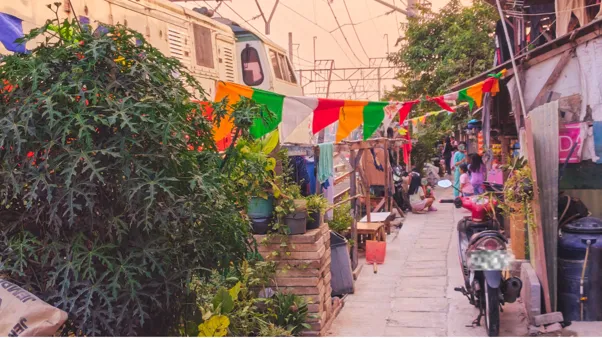
A day on the active rail corridor near Kampung Bandan Station always begins with a din that quickly numbs the ears. A train conductor’s whistle shrieks, locomotive wheels grind against the rails with a sharp metallic screech, while fine dust and hot exhaust swirl into the air.
It is at the very edge of that track that Supriyati (45) lives out her days as a housewife.
Her hands move deftly, wiping down a housedress damp with sweat, then returning to boil water to sort laundry for her family at the threshold of her home. Outside, the scorching sun of Jakarta’s northern coast beats down without mercy, reflecting off the rails onto the tightly packed walls of the houses.
This is how Supriyati has lived, year after year. She has had to contend with heat that penetrates the narrow space within her own home’s walls, trapped in stifling air beneath a low asbestos roof.
“Before my house was rebuilt, it was low, the roof was like asbestos — the heat, even with a fan, oh God, it was still hot,” Supriyati complained when Konde.co visited her residence in Kampung Muka on Saturday afternoon (29/8).
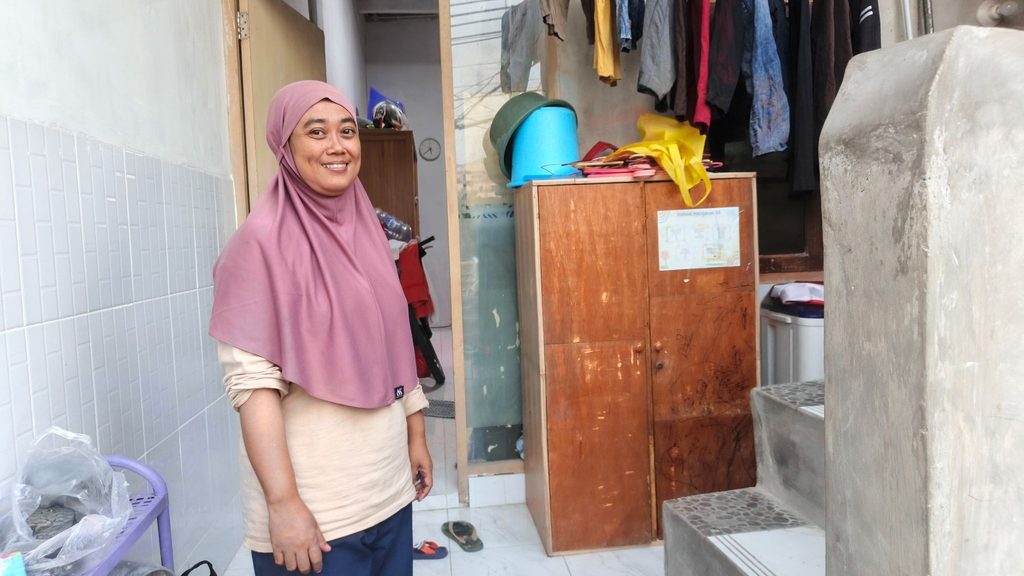
Back then, two electric fans spun continuously all day until their motors hummed hot. But the air they threw off was just as dry and searing as the air outside.
Read more: “Where’s Your Headscarf?”: Misogynistic Rules Run Rampant, Women’s Bodies Continue to Be Regulated
Sweat still streamed down the foreheads and backs of Supriyati and her children. Trapped in that stifling heat, the quickest way for her children to quench their thirst was a chunk of ice.
“They just wanted iced drinks, cold water, ice all the time.”
That momentary, artificial coolness came at no small cost. Supriyati says her children’s bodies are quick to give in to extreme temperature spikes.
Though flavored drinks brought brief relief, the children’s respiratory tracts were irritated by dust from the rail embankment and the yard; the result was recurring coughs and colds, while their pores, inflamed by unrelenting sweat in the humid air, broke out into itchy rashes.
“It’s hot, so they drink ice, flavored ice. If it’s just plain water they don’t want it, they want ice, so they often get coughs, colds, heat rash,” Supriyati said.
When illness struck, it was Supriyati who had to lead or carry her children through Kampung Muka’s narrow alleys to the local health clinic, queuing with their BPJS Kesehatan health insurance card in hand.
Meanwhile her husband, Saripudin (50), had to keep working, sweating it out to make sure the kitchen fire kept burning.
“Her father works,” she said simply.
Senu (21), Supriyati’s daughter, carries her own memories of childhood on the tracks. Back then, once the school bell rang and the heat in Kampung Muka intensified, there was no open space to welcome her home except a narrow corner in front of a fan.
“So, just in front of the fan,” she said, recalling the one way she knew to survive the heat that crept over her skin.
Her memory is still vivid of sharing the fan’s breeze with her mother and younger sibling as part of daily life.
Read more: Feminist Dictionary: A Critique of Choice Feminism—Women’s “Choices” Are Not Merely Personal Consequences
Sweat would run from her forehead, while her younger sibling’s shirt grew damp under the arms and across the back. She calls this condition “gerah yang rungsing” — a restless, suffocating heat. When met by Konde.co, Senu’s younger sibling, now in junior high school, appeared shy and reluctant to be interviewed.
“Gerah yang rungsing, that’s it. Sometimes you’re so sweaty you feel sticky, clammy. Sometimes it looks like the younger ones sweat even more. The younger siblings, especially — because the roof was asbestos back then,” Senu recalled.
When Senu was still in school, there was an enemy she feared more than the scorching heat itself: power outages. Senu, who depended entirely on the spinning plastic blades of a fan to breathe once she got home, saw blackouts as something close to disaster.
Days and nights, humid and hot with no breeze from the fan, forced them to seek refuge, finding brief sanctuary at a relative’s house just to breathe slightly friendlier air.
“It used to happen a lot. We’d just go out. We had no choice but to go out, ride around on the motorbike here and there. To relatives whose houses still had power, whose electricity hadn’t gone out,” Senu recalled.
Now an adult, Senu works in the Sunter area of North Jakarta. Still, the heat and smell of the kitchen from helping her mother cook after school remain vivid in her memory.
“Back then the kitchen was hot, because the air was at the back, and when you cook, obviously you cook at the back, so the heat goes into the whole room,” said Senu, describing how the cramped space where the stove burned, without adequate ventilation, trapped heat and blew it back through the entire house.
Read more: After the Days of Hell in Jakarta: The Death of Ita Martadinata as Recalled by Ita Fatia Nadia
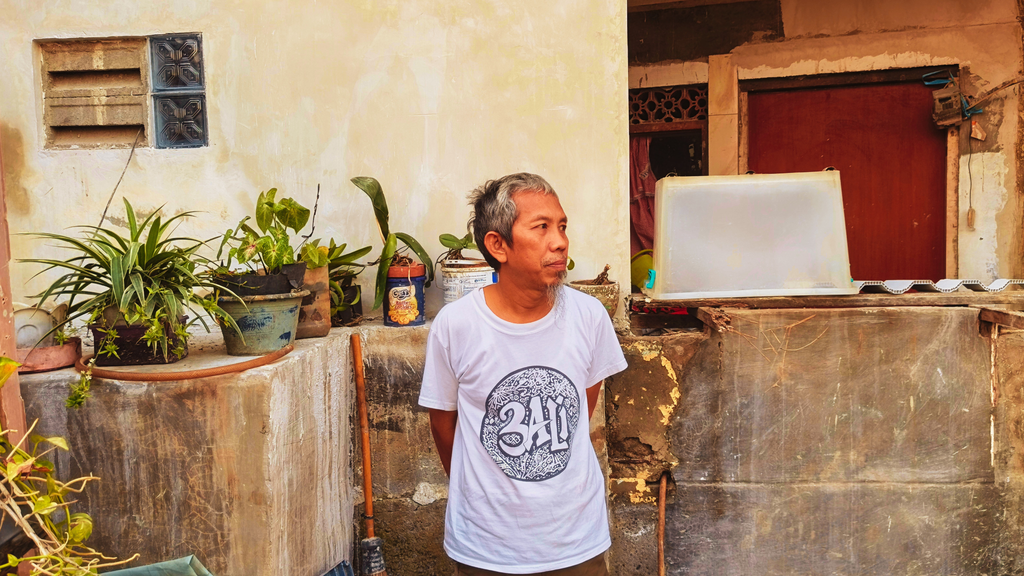
Not far from Supriyati’s home, Haris (57) — a man whose roots run deep in Kampung Muka’s soil — has much to say about the history of the row houses along the tracks.
Haris says that improving the shelter he has called home since childhood is not simply about seeking comfort or escaping the heat. There is a communal dignity at stake in breaking the prejudice that settlements along the rail tracks are slums better off razed by heavy machinery.
He wants the houses along the tracks to become proof that residents on the city’s margins are capable of fixing up their own kampung with their own hands and their own dignity, without needing to be forcibly evicted.
“For our environmental health, for our families. So that families — wives, children, everyone — can live decently, can play,” Haris said firmly to Konde.co in the yard of his home on Saturday afternoon (29/8).
Read more: I’ll Be Back in Jakarta: Stories of Rural Women Who Move to the City
Supriyati and Haris’s families are members of the Kampung Muka Cooperative. Their homes — which for years have soaked up the sweat of mothers and children who spent hours inside them — are now being rebuilt through a collective, community-based effort to reorganize the kampung.
Under the umbrella of the cooperative and with support from a civil society coalition, ten row houses along the tracks in RT 6 are being completely overhauled without displacing their historical footprint. Residents, working with a team of young architects, designed floor plans door by door, tailoring the layout of each space to every family’s actual needs.
The principle of passive cooling has become the animating force behind the physical changes to the buildings. Financing is driven through an interest-free revolving fund scheme managed by the kampung cooperative.
Swampland, Stigma, and Eviction in Kampung Muka’s History
Kampung Muka is not a squatter settlement that suddenly sprang up along Jakarta’s northern rail line. The area has been inhabited since the 1930s, when migrants arrived to cultivate vegetable gardens and work in nearby warehouses. By 1960, around 40 households lived there, most working as factory laborers, farmers, and dockworkers.
In 1974, the area was known for a time as Kampung Kebun Sayur — Vegetable Garden Village, a name still used for a nearby area — because part of its land was used for farming, including training in cultivation techniques for prospective transmigration participants.
Over time, the population continued to grow, particularly due to demand for labor in the warehouses around the Ciliwung tributary and Kampung Muka.
According to Haris, the history of the row settlement along the tracks where he grew up began with railway workers who, decades ago, were permitted to occupy land belonging to PT Duta Anggada — a property and real estate developer — near Kampung Bandan Station.
Haris’s parents were among them.
“Back then my mother was the head of the local religious study group, and that’s eventually how these houses (the row of houses in Kampung Muka) came to be built. But at the time, only active railway employees were allowed to live here,” Haris recalled.
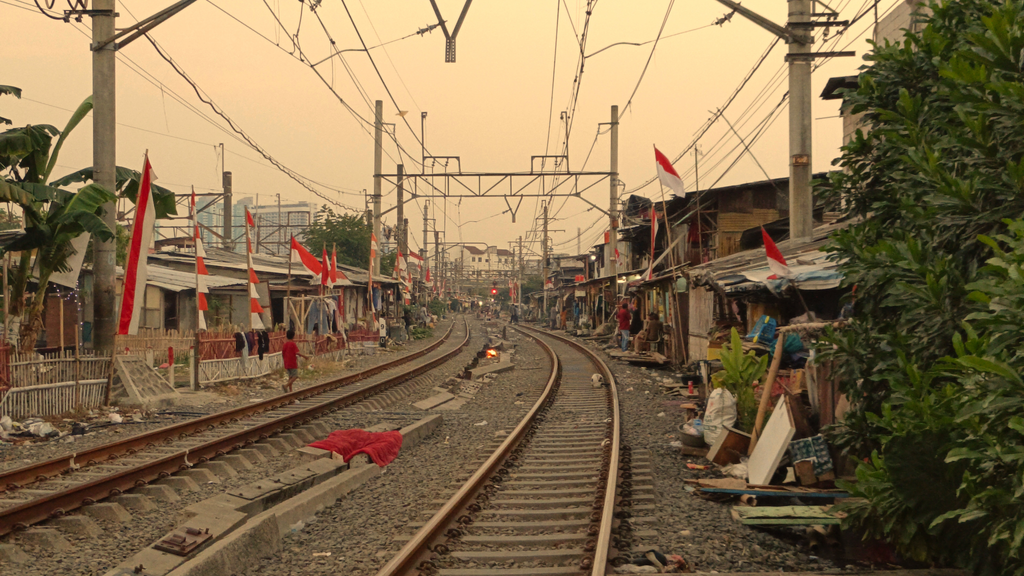
From that official permission, the settlement grew organically through the sweat and collective labor of its residents. The land residents stand on today was originally black-water swampland and abandoned fish ponds that were home to snakes and other creatures.
Read more: Indonesia’s Garbage Emergency: Scavengers Buried Under Mountains of Garbage in Bantar Gebang
Residents reclaimed it bit by bit, filling it in with rubble and soil.
“We just built our houses first. In the beginning we just filled in the land — there were lots of snakes here, it used to be ponds, abandoned fish ponds,” Haris said.
At that time, the footpaths that now wind through the narrow alleys did not yet exist. The only route safe from the danger of an oncoming train ran straight through residents’ homes, who cut holes in shared walls to create passage.
He also recalls the decades before the 1990s when the deadly tracks in front of their homes often claimed lives, as shunting train cars reversed without warning, with no horn sounded.
After decades of residents filling in the abandoned swamp and building their lives atop it, the land beneath their feet remained shadowed by legal uncertainty. A protracted and bitter tug-of-war over land ownership between PT Duta Anggada and PT Kereta Api Indonesia (KAI) played out through multiple rounds of appeals, further complicated by plans for infrastructure development, including a proposed MRT depot that at one point eyed a portion of the area.
“This has gone through the courts, appealed I don’t know how many times,” Haris said.
Although Haris says the plot he and Supriyati live on lies outside the directly disputed area, this uncertainty has deepened a broader stigma — the perception that the settlement along the tracks is an illegal, unruly slum.
It is this structural stigma that Haris, Supriyati, and Saripudin have tried to fight — through the cooperative.
Komarudin, chair of the Kampung Muka Cooperative, said the construction of the ten row houses in RT 6, the area along the rail embankment, was not initiated as a project but grew out of social resistance.
Read more: Indonesia’s Garbage Crisis: The Irony of Women Amid the Stench of Garbage
“All along, houses by the rail tracks have always been seen as shabby, seen as slums, disorderly,” Komarudin told Konde.co plainly at his home, which also serves as the cooperative’s secretariat, on Saturday afternoon (29/8).
Komar also sees the residents’ independent effort to organize their community as a form of political dialogue with the government.
“Residents, even though they live close to the rail tracks, can show they’re able to put their own affairs in order. Later, the authorities can see — oh, it turns out residents can tidy up their own houses independently, without needing to be evicted,” he stressed.
The specter of eviction has never truly left the collective memory of Kampung Muka’s residents. Komarudin recalls two major wounds that once devastated the area: the mass eviction of 2016 under then-Governor Basuki Tjahaja Purnama (Ahok), followed by a 2019 crackdown on homes deemed to violate safety limits along the active rail line.
Some residents who were displaced were relocated to the Marunda public rental housing complex (Rusunawa), with rent waived during the COVID-19 pandemic.
“That was indeed along the rail tracks, so they were moved to Rusun Marunda. And as it happened, because it was during COVID-19, they didn’t pay rent for three years,” said Komar, who helped advocate for residents in the 2019 eviction case.
Gasping for Breath in an Increasingly Hot Jakarta
In 2021, the Asian Development Bank (ADB) identified Indonesia as one of the countries most vulnerable to the impacts of the climate crisis, including heatwaves and rising temperatures. That vulnerability does not stand alone. Deforestation and urbanization have altered land cover, while in large cities like Jakarta, increasingly dense development has reinforced the urban heat island effect.
Building materials such as concrete, glass, and other hard construction materials absorb and retain heat during the day. Heat is further compounded by warm air released from air conditioning units, while dense building clusters restrict air circulation. As a result, heat is not only felt in open spaces but also accumulates and lingers longer inside homes.
These conditions can worsen during an El Niño event. The ocean warming and shifts in atmospheric patterns that accompany El Niño can increase the likelihood of drier, hotter conditions in parts of Indonesia. As a city’s baseline temperature rises due to climate change and urbanization, episodes of extreme heat can feel even more searing for residents.
The situation is especially difficult for vulnerable groups — women, children, and the elderly — particularly those living in dense row settlements along the rail tracks, such as Kampung Muka. Because it builds slowly and its impacts accumulate over time, extreme heat is often described as a slow-onset disaster.
Historical data shows Jakarta is indeed undergoing significant long-term warming. Analysis using the ERA5 climate reanalysis dataset records that Central Jakarta’s average daily temperature has crept up from 26.1°C in 1940 to 27.6°C in 2026 — a rise of 1.5°C over 87 years.
This warming trend is further confirmed by Indonesia’s Meteorology, Climatology, and Geophysics Agency (BMKG), which has recorded a 1.6°C rise in Jakarta’s surface temperature over the past 130 years.
Read more: Stop Tech Misogyny: The Long Chain of Gender-Based Cyber Attacks and Disinformation
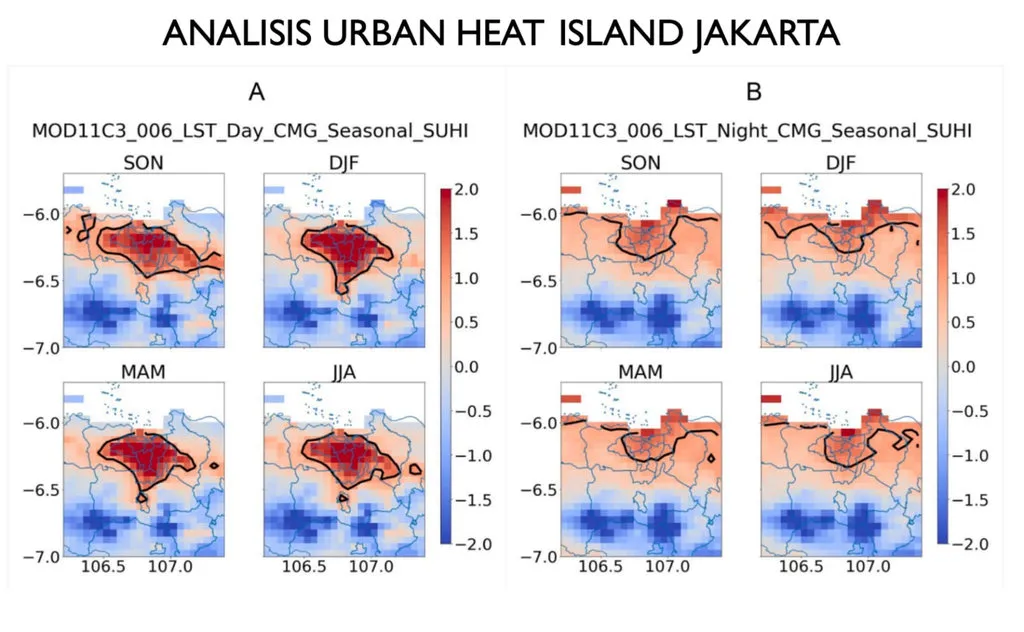
This rate of warming is moving far more aggressively than regional or global averages, driven by diminishing vegetation cover, which is increasingly replaced by housing, roads, concrete, and dense commercial areas.
Jakarta’s hottest recorded temperature was 37.5 degrees Celsius, set in October 2025. In March 2026, BMKG recorded a maximum temperature in Jakarta of 35.6°C, with a UV index reaching the extreme danger category, prompting the agency to advise the public to avoid outdoor activity between 10:00 a.m. and 2:00 p.m. local time.
Over the long term, both minimum and maximum temperatures specifically in North Jakarta show a rising trend. Based on temperature monitoring at the Tanjung Priok Maritime Meteorological Station from 1981 to 2025, minimum temperatures have risen by around 0.026°C per year, while maximum temperatures have risen by 0.014°C per year.
Nationally, BMKG has recorded several of the hottest years in its 40-year observational record (1981–2020), with the highest temperature anomaly recorded in 2016.
Amid a sweltering city, its cooling lungs remain constrained. Data from the Jakarta Parks and Urban Forestry Agency (Dinas Pertamanan dan Hutan Kota) as of June 2026 shows that green open space (RTH) covers just 5.59% of the city. This figure falls far short of the mandate set by Law No. 26 of 2007 on Spatial Planning, which requires a minimum of 30% green open space, with at least 20% of that designated as public green open space.
Read more: Stop Tech Misogyny: When AI Becomes a Tool for Manipulating Women’s Bodies
In terms of the proportion of Jakarta’s total green open space, North Jakarta has the least, with green space scattered across 353 sites. This scarcity of green space is also felt at the neighborhood level.
In Kampung Muka, for instance, children have very few options for play. Komarudin, chair of the Kampung Muka Cooperative, said that of three open spaces once available, only two remain usable today. The other was lost to a toll road construction project.
One of the remaining spaces is even land claimed by PT KAI. That unused plot was later developed independently by residents into an open-air futsal field.
The lack of shaded space in dense kampungs is one of the reasons behind the Beyond Housing Types research project — a cross-country collaboration between Rujak Center for Urban Studies, Kota Kita Foundation, Arkom Indonesia, and Universiti Kebangsaan Malaysia — which surveyed four cities: Jakarta, Semarang, Surabaya, and Selangor.
Researchers went into the field to measure temperatures directly, conducted in-depth interviews, and equipped residents with heat diaries to document their daily experience of the heat.
Dian Tri Irawaty, Program Director at Rujak Center for Urban Studies, said early findings point to a problem common to dense kampungs across Southeast Asia: humid heat — heat combined with high humidity.
“The heat is absorbed and stored during the day, then released at night. With high humidity and poor air circulation, residents — especially in dense settlements along the northern coast — often complain, for instance, of being unable to sleep at night,” Dian said.
Read more: Stop Tech Misogyny: Misinformation on Social Media Used to Trap Victims of Human Trafficking
In a written statement to Konde.co, the Jakarta Environmental Agency (DLH DKI Jakarta) confirmed that the risk of extreme heat in Jakarta falls into the moderate-to-very-high category, with areas of very high risk concentrated in North Jakarta, West Jakarta, and parts of Central Jakarta.
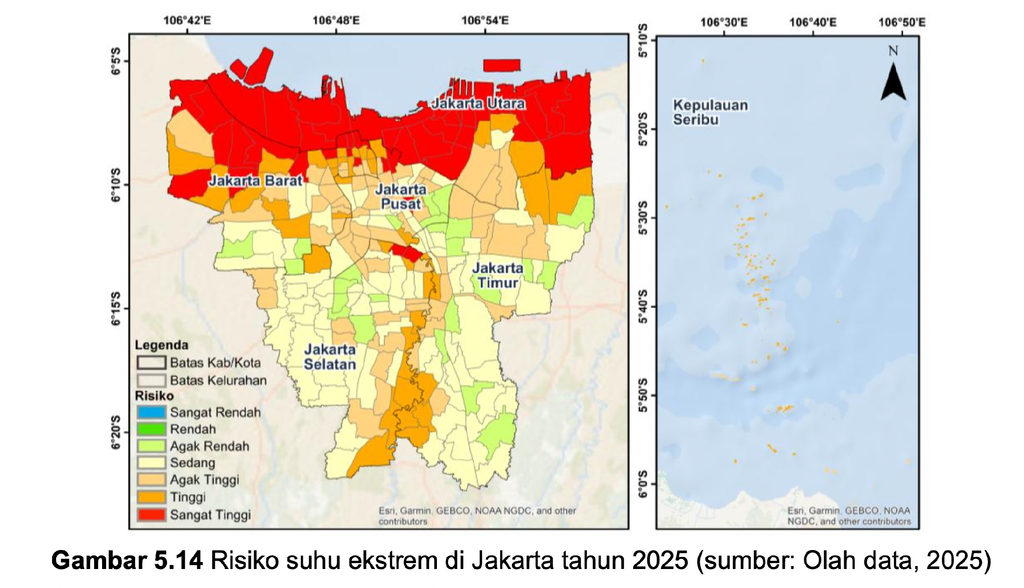
Responding to Konde.co’s question about the development of green open space in dense kampungs, DLH stated in writing that the overall designation of green open space locations across DKI Jakarta Province refers to the Regional Spatial Plan (RTRW).
DLH said that, technically, the authority for designating and developing green open space rests with the Jakarta Parks and Urban Forestry Agency (Distamhut). In this context, DLH said it supports the effort through environmental risk mapping and by strengthening greening programs at the community and institutional levels, particularly in areas with higher extreme heat risk.
Heat That Bites Harder for Children and Women
Beyond the columns of statistics, heat is a daily, lived experience — felt as gerah yang rungsing by residents along the tracks in Kampung Muka long before any thermometer confirms it.
Saripudin still clearly remembers the temperature readings inside his house before it was renovated.
“Back then it was always above 32, sometimes 35, 34, almost 37 (degrees Celsius) once,” he said.
Dian confirmed similar findings from her research team’s direct measurements in Kampung Muka, at another house in the same row as Supriyati’s. “Residents saw, for example, that in one house it could reach as high as 42 degrees Celsius on the second floor,” Dian said.
After a house was renovated using a passive cooling approach, its temperature dropped by around 2°C, alongside improved air circulation. But for residents, the change felt much greater. Komarudin, from the Kampung Muka cooperative, said temperatures that once exceeded 32°C now feel far cooler.
“What used to be, say, above 32 degrees — because it was so hot — now it might be below 30, even 26 or 27,” Komarudin said.
Saripudin has had a similar experience. His house, still under construction, now feels cooler than before.
“Now that it’s built like this (still under construction), the temperature has dropped below 32. Yesterday it was 30,” Saripudin said.
Based on temperature mapping inside homes, the kitchen repeatedly emerges as one of the hottest spaces. For women responsible for domestic work, this means spending longer periods in high-temperature spaces, especially for those who also cook food to sell as a source of household income.
Read more: 2025 Year-End Edition: Women’s Resistance in the Season of Arrests and the Year of #DemocracyApocalypse
“The most vulnerable space, the hottest, is the kitchen, while the cooler space is usually the living room, the shared space — but the kitchen is the hottest, and it’s tied to women’s domestic work,” Dian said.
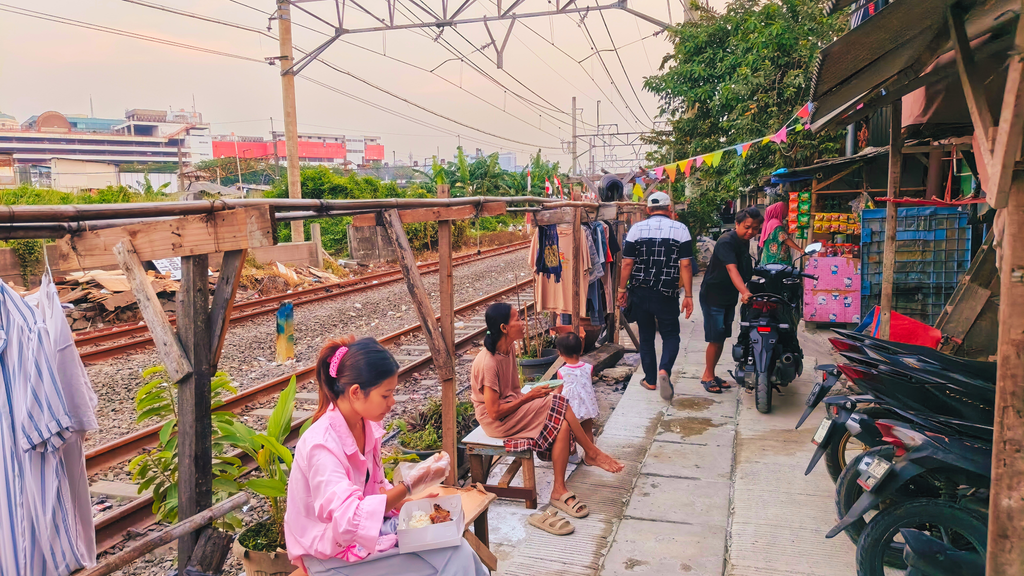
The burden of heat is also not always visible to other family members. In many of the households observed by Rujak, husbands work outside the home and only return at night. As a result, the heat experienced by women throughout the day may not be fully understood by their partners.
“The husband thinks, ‘Oh, it’s fine, nothing unusual.’ Because he’s only home at night,” Dian said.
Beyond the physical impact, Dian points to another issue that she acknowledges has not yet been specifically explored in Rujak’s research: the potential link between domestic violence (KDRT) and the pressure of extreme heat.
While there is not yet data to conclude a link between extreme heat and domestic violence, Dian believes the issue needs to be mapped alongside mental health concerns. Both, she notes, are hard to see and their impacts can emerge gradually.
“There are actually two potential issues going forward that we need to research and respond to carefully — the potential for domestic violence and mental health linked to urban heat. And that’s very gradual, invisible,” she explained.
Meanwhile, Rujak’s research has identified a number of conditions that can add further pressure inside the home. High nighttime temperatures make it difficult for residents to sleep, and recurring sleep deprivation can affect both the physical and emotional condition of household members.
Read more: 2025 Year-End Edition: A Season of Persecution Without Transition in the Age of #DemocracyApocalypse
“Lack of sleep, over days, actually affects health. So people get more irritable faster because of the heat,” Dian said.
The burden of adaptation does not stop at the body either. The need to buy or add fans, secure clean water, or buy ice for children can become additional household expenses. In such situations, women — who handle much of the domestic labor — can face layered psychological pressure.
“When the adaptation changes add extra stress, mothers end up snapping at their children more often,” Dian said.
These findings cannot yet be read as evidence that extreme heat causes domestic violence. However, according to Dian, they show how heat can seep into domestic relationships through exhaustion, sleep deprivation, economic pressure, and the burden of caregiving.
Because of this, Dian stresses, the impact of heat should not be viewed solely through body temperature or health complaints, but also through changes in social relationships within the home.
Dian points to the hazard-vulnerability-risk framework to explain how these pressures can reinforce one another. As extreme weather hazards become more frequent or intense, while the vulnerability of poor urban households remains high due to limited space, poor housing quality, and limited adaptive resources, the resulting risk grows as well.
“The hazard is getting bigger, while the vulnerability is getting higher, so the risk grows bigger too,” she said.
She notes that residents’ capacity to respond must also be factored into how risk is assessed, since limited adaptive capacity can make the pressure even heavier — particularly when adaptation requires additional cost and pushes households into debt.
Read more: Prabowo-Gibran’s One-Year Report Card From A Gender Perspective
For Dian, this is precisely why heat needs to be seen as an issue broader than just weather. Its impacts can ripple from the body to emotional wellbeing, from the space of the home to relationships between family members, and from the need to adapt to economic burden.
“Mothers have to juggle so much dealing with the heat — their child is overheated, uncomfortable, wants to bathe, asks to be bought ice — there are so many cases of buying ice that end in coughing illness. All of that is tension, is a headache, felt by the mother, by the woman. She has to manage the household with this added hazard.”
“So people’s capacity to respond also comes back to whether it increases their vulnerability or strengthens their resilience,” Dian explained.
Children and Shrinking Play Space
Outside the home, children face a similar paradox.
The open spaces that remain end up being the hottest places. Komarudin observes that the two remaining open spaces in the kampung are used mainly by children. One is a field of bare red earth across the tracks with little tree cover or shade.
From the city’s point of view, that space is registered as open space. From the point of view of children who have no large yard in front of their homes, it is the only place to play.
Dian found this paradox recurring throughout her research.
“In these hot open spaces, it’s the children who are there. We were also confused as to why the children like being there, when it’s actually the hottest spot,” she said.
The answer is not that children don’t feel the heat. Dian believes they simply have few other options.
Houses in Kampung Muka stand close together. The space in front of each home is limited. As play space shrinks, children end up using whatever open space remains — even if that space itself offers no shade to protect them from the heat.
Komarudin sees the impact in residents’ daily lives, linking increasingly extreme weather to rising health complaints, including flu and coughs.
“A lot of people have the flu now, coughs. I just recovered myself — three days down with the flu, coughing,” Komarudin said ruefully. “Mothers, and especially children, are vulnerable to such high heat, plus such high air pollution too.”
Read more: Arrests at the End of the Day: Arrested While Hanging Out, Allegations of Sexual Harassment
In a written statement to Konde.co, DLH DKI Jakarta echoed this from a policy perspective. According to DLH, groups with limited access to resources, health services, information, and social protection face greater risk as the impacts of climate change increasingly take hold. Women, children, the elderly, and people with disabilities are among the groups considered particularly vulnerable.
Based on DLH DKI Jakarta’s 2025 data analysis, North Jakarta and West Jakarta are epicenters of the highest concentration of vulnerability. There are at least 20 sub-districts in northern Jakarta where the potential impact of climate change falls into the high-to-very-high category — including impacts on health, access to clean water, and living conditions for vulnerable groups such as women, children, the elderly, and people with disabilities.
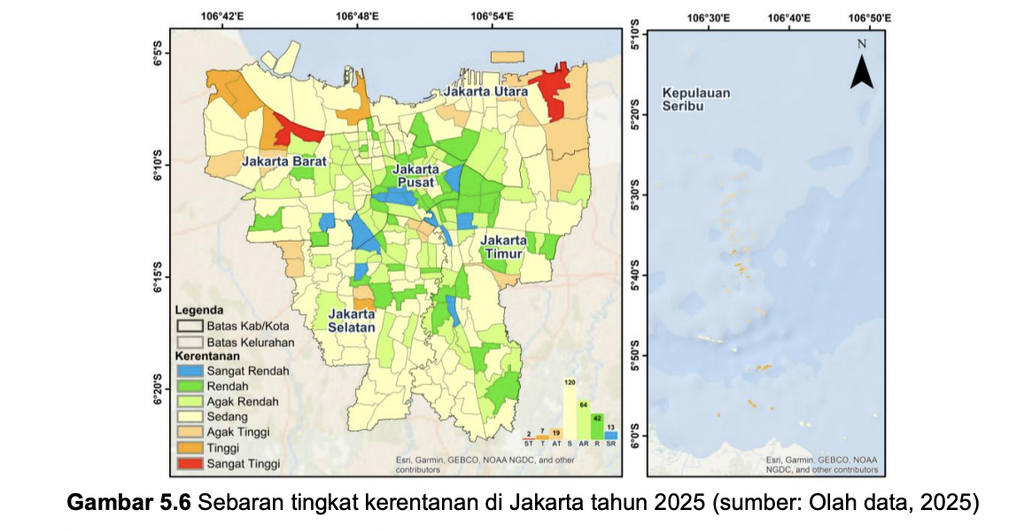
DLH DKI Jakarta further stated it is strengthening coordination between the Regional Development Planning Agency (Bappeda), the Regional Disaster Management Agency (BPBD), DLH, and the Health Agency through the Jakarta Heat Resilience and Health Initiative, a joint initiative with C40 focused on monitoring health risks from extreme heat and developing an integrated early warning system.
But for Kampung Muka’s residents, part of the answer begins much closer to home: making the place where they live at least somewhat more livable.
Read more: From MBG Watch to Protests, Civil Society Demands an End to MBG
In a kampung with limited space, heat reveals that climate resilience is not only a matter of how many degrees a city’s temperature rises. It is also determined by who has a home with good ventilation, who has access to a fan or air conditioning, and who has the privilege of access to shaded green space to play in.
Because of this, residents are not entirely waiting for solutions to come from outside. Renovating homes using a passive cooling approach, alongside managing shared space through a strengthened cooperative, has become part of residents’ independent effort to adapt to the heat.
Even so, Dian cautions that this effort should not mean responsibility for climate resilience stops at the level of residents.
“Residents’ resilience also needs to be recognized by many parties, including the government — that residents, with all their limitations, have already done their best to adapt to the heat. But the hope going forward is that those limitations are reduced,” Dian stressed.
Building a Row-House Kampung on the Breath of Cooperative Solidarity
Amid these structural constraints, the Kampung Muka Cooperative found a middle path: rebuilding residents’ homes not through outright grants alone, but through an interest-free revolving fund scheme.
Komarudin laid out the numbers. Each house receives a funding injection of Rp50 million from a network of donors. But that money is never meant to sit as cash in the recipient’s pocket.
All of it is converted into stacks of bricks, environmentally friendly cement, and labor costs, overseen collectively by a supporting architect, the homeowner, and cooperative administrators.
“We got assistance from JAPRA (Jaringan Perumahan Rakyat/People’s Housing Network), Rp50 million. We give it to residents, 50 million, but not in the form of money. It’s in the form of materials plus labor,” he explained.
Residents then repay Rp594,000 per month over 84 months, or seven years, interest-free. Komarudin stressed that this scheme is far more favorable than borrowing from a bank, which charges interest, and residents also receive design support from young architects.
“If they were to build with a 50 million loan from a bank, there would automatically be interest. And they also wouldn’t have access to a team of experts,” he said.
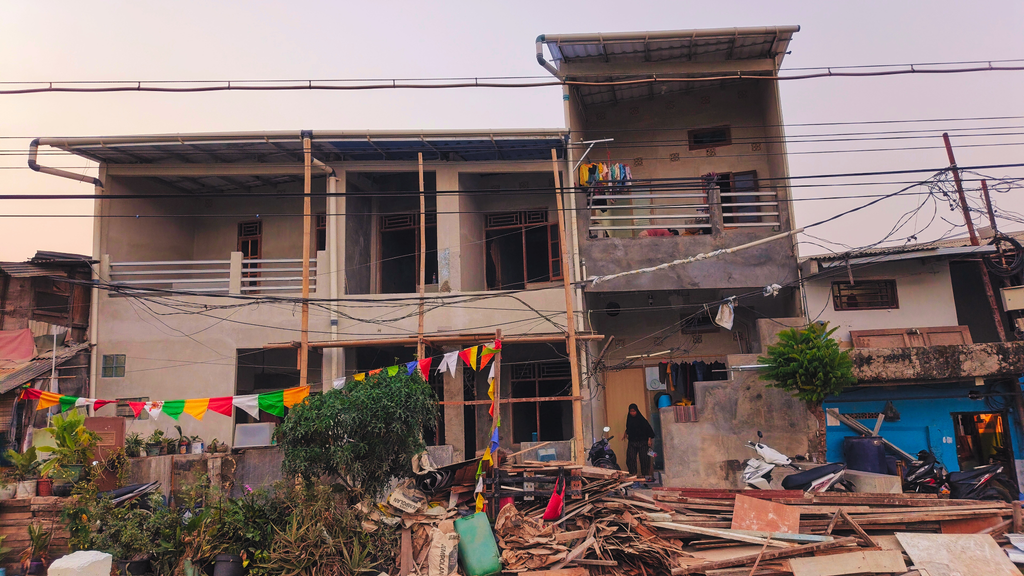
The design itself did not emerge overnight from an architect’s distant drawing table. The team of young designers had to sit cross-legged on the floor for more than two months with each household.
Read more: MBG Must Be Stopped: Poisoning Scandals, Gender Bias, And The Shadow Of The Military
They listened to differing opinions among family members who often shared a single plot of land — negotiating which space should be given up for shared air circulation, and which corner would be agreed upon as a private family space.
Dian Tri Irawaty of Rujak Center for Urban Studies says this design breakthrough rests on the philosophy of passive cooling — an effort to tame the heat architecturally, without relying on electricity or the hum of an air conditioning unit.
“Passive cooling comes from house design, from building materials, from paint — it can affect a building’s heat exposure,” she explained.
Its strategies work through elementary changes. Asbestos sheeting that once baked the rooms has been replaced with more temperature-friendly PVC roofing. Brick walls have been perforated with decorative ventilation blocks and fitted with cross ventilation windows facing each other to draw in the breeze.
Exterior paint was deliberately chosen in bright colors to reflect sunlight, while the orientation of each building was set so as not to take the full brunt of the rising and setting sun.
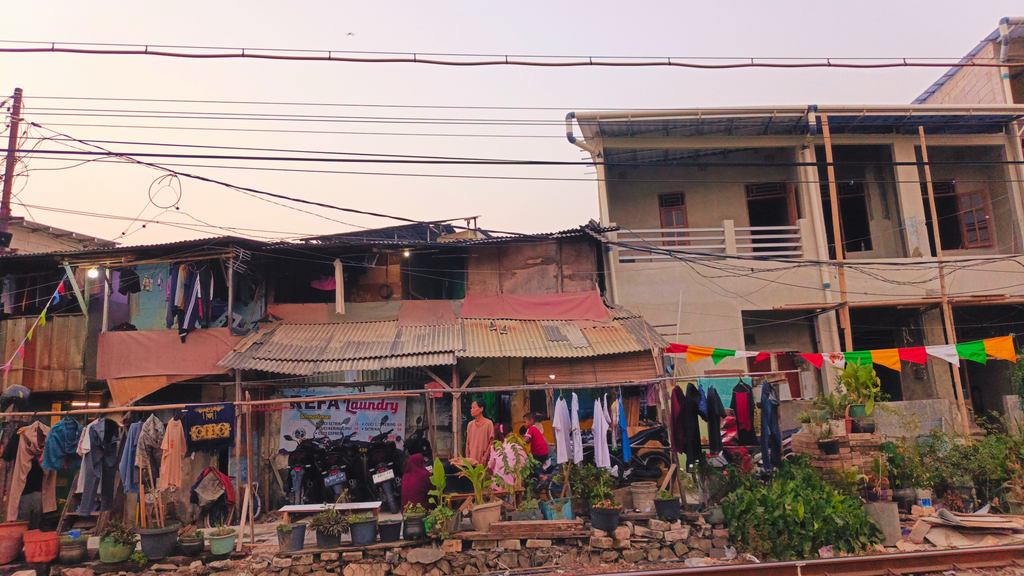
However, Dian also underscores that the effectiveness of these adaptive changes depends heavily on residents’ sense of security in living on the urban fringe.
Read more: Celebrity Politics: How Can We Avoid Being Fooled by Image Polishing?
“In informal kampungs where legal status is unclear, people become afraid, reluctant to make changes that would actually improve their ability to adapt to the heat. Or, because of their limited capacity, their adaptation ends up being inappropriate — for instance, they end up installing asbestos again, or putting up tarpaulin that actually absorbs heat, because of that fear over legal status,” she explained.
This dynamic helps explain why Kampung Muka’s approach — landed housing with ownership that, while not yet fully certified, is recognized by the government through an area-wide Building Permit (IMB) — has become the option most accepted by residents.
“They feel like this is a house they own. Oh, this is my house, even if it’s small,” said Komarudin, chair of the Kampung Muka Cooperative.
The settlement’s legal history has also been key to unlocking access to infrastructure. Before the issuance of Governor’s Decree No. 878 of 2018 on the arrangement of Priority Kampungs, Kampung Muka was essentially erased from city hall’s map of basic services because of its land status.
Read more: Celebrating Pride Month 2025, How LGBT Survives in a Situation of Discrimination: Konde.co Research
That legal umbrella changed the direction of the wind: drainage pipes began to be installed, alley surfaces were raised against the threat of flooding, streetlights began to go up, and residents were able to obtain business permits.
“Even though the governor has changed, that governor’s decree has never been revoked,” Komarudin stressed.
Of course, building ten row houses as a pilot project in RT 6 was not a smooth path. The biggest obstacle came, in fact, from residents’ own collective trauma — convincing neighbors that the Rp594,000 monthly installment was purely a voluntary, self-help effort, not a new debt trap that would take their homes. Through repeated community deliberations, that suspicion gradually faded.
“The effect, once building on the rail side was done, was that other residents eventually joined in too. Oh, it turns out it’s good if we build properly,” Komarudin said.
Komar acknowledges that residents who have not yet had their turn for renovation are now eagerly asking to be taught the principles of passive cooling, so that once they have saved enough, they can arrange their own walls and ventilation in a similar way.
Energy Independence on the Edge of the Steel Line
Senu’s experience of having to flee in search of fresh air when the electrical substation went down underscores just how fragile residents’ dependence on power lines is at the city’s margins.
Out of that constraint, Greenpeace Indonesia has proposed a just energy transition through the installation of solar panels on land in Kampung Muka — an idea welcomed by residents. The effort combines housing design with passive cooling so that residents are better equipped to handle the heat while also building energy independence.
Yuyun Harmono, Climate and Energy Campaigner at Greenpeace Indonesia, said the initiative draws inspiration from the RevoluSolar movement in Rio de Janeiro’s favelas in Brazil — a grassroots movement that has seized control of solar power as a way of freeing the urban poor from the vulnerabilities of city life.
“So far, debates over energy transition have rarely touched on the role of the people most affected,” Yuyun said, pointing to what he sees as an often elitist climate conversation.
The solar panel system on Kampung Muka’s rooftops is deliberately set up off-grid — standing independently, without connecting to the state electricity company —PLN’s—grid. This choice was made so residents would not have to go through the on-grid installation process, which comes with a number of conditions and restrictions set by PLN.
Under an on-grid scheme, solar panels are connected directly to PLN’s network. The electricity generated is used for household needs, while any surplus can be fed back into PLN’s grid through a government-regulated mechanism. Installation also requires PLN’s approval and adherence to certain technical requirements. In practice, these rules and processes are seen as making it difficult for residents to install solar panels independently.
Read more: Sexism in Student Arrests and Maternal Activism Mothers Defend Their Children’s Struggles
“These rules were made by PLN, and in our view, they discourage people who want to install solar panels,” Yuyun said bluntly.
Because of this, the off-grid system was chosen by residents as a middle path. Electricity from the panels is not sent to PLN’s grid but stored in batteries for residents’ use as needed.
The panels installed have a capacity of around 100 watts peak, with storage batteries ranging from 2,100 to 10,000 watt-hours. The electricity generated is not intended to run high-power appliances like air fryers or irons. Priority goes instead to more basic daily needs.
At night, the electricity is used to power lights so homes stay lit. The stored power can also be used to charge mobile phones — essential for communication and work — as well as children’s devices for schoolwork.
The choice of which needs to prioritize, Yuyun said, came directly from discussions with the mothers of Kampung Muka.
“At the start we also discussed this with the mothers there. We asked, for instance, how much they spend on electricity each month, and what for,” he explained.
This independence is designed not to be short-lived. According to Yuyun, Greenpeace is developing a technical training program open to residents regardless of gender or age, so they can carry out routine maintenance and repair of the solar modules themselves.
Read more: Is Our Public Transportation Gender Responsive and Inclusive? Konde.co Research Results (1)
This model follows the success of a similar mentoring program at the Luar Batang Mosque in North Jakarta, which involved local mosque youth as technicians. If the plan proceeds smoothly, this technical capacity will be institutionalized under the Kampung Muka Cooperative.
Amid this optimism at the edge of the tracks, Yuyun leveled sharp criticism at the direction of government energy transition policy, which he views as slow and misdirected.
Research conducted jointly by Greenpeace and the polling institute Indikator in February 2026 found that only 23% of Jakarta residents were interested in installing rooftop solar panels independently, without fiscal assistance. But that enthusiasm jumps sharply to 51% if the state is willing to provide subsidies of 30 to 50% of the cost of initial equipment procurement. Notably, the highest enthusiasm came from the Thousand Islands and the North Jakarta coastline — areas that face scorching extreme heat every day.
“This is actually an opportunity for the government, but of course it needs to be backed by policy and incentives available to those who want to install solar panels, especially for lower-middle-income communities,” Yuyun stressed.
Yuyun also pointed to the imbalance in subsidies between fossil energy and renewable energy.
“The debate has always been that fossil energy, both coal and gas, is heavily subsidized. On the other hand, if renewable energy — especially solar panels — is to be competitive, it deserves to receive the same subsidy,” he said.
Coal-fired power plants (PLTU), Yuyun said, contribute to the climate crisis that is driving rising temperatures and extreme heat events, while air pollution from these plants can worsen residents’ health vulnerabilities as they simultaneously face heat exposure.
Read more: Is Public Transportation Gender and Inclusion Perspective: The Sweet Promise of Inclusivity, Still Broken Here and There (2)
“The climate crisis has causes and impacts that we feel — for example, extremely high rainfall in the rainy season, or, in the dry season, very long stretches of days without rain,” Yuyun said when asked about the contribution of fossil energy projects to the climate crisis.
A 2016 Greenpeace Indonesia report estimated that pollution from coal-fired power plants imposes an economic burden on the state and society of up to Rp351 trillion per year, stemming in part from respiratory illness and lost productivity. Meanwhile, the more recent Toxic 20 (2025) report projects 156,000 premature deaths between 2026 and 2050 due to exposure to pollution from Indonesia’s 20 most toxic coal-fired power plants.
Amid rising extreme heat risk, Yuyun believes it is important to examine how power plant emissions, degraded environmental conditions, and constrained living space converge to create layered vulnerability for nearby communities. Unfortunately, transparency around the source and level of emissions from each power plant remains difficult for residents to access.
Efforts to open up this information have been pursued through legal channels by Greenpeace Indonesia, together with LBH Pers and the AMAR Law Firm & Public Interest Law Office (AMAR), which sued state utility PT PLN (Persero).
That effort culminated in a Supreme Court (MA) ruling rejecting PT PLN (Persero)’s cassation appeal in a public information disclosure case concerning power plant emissions data.
Cassation Ruling No. 911 K/PDT.SUS-KIP/2026, dated 26 August 2026, upholds the South Jakarta District Court’s ruling No. 1371/Pdt.Sus-KIP/2025/PN.Jkt.Sel, giving it permanent legal force.
Read more: Is Public Transportation Gender and Inclusion Perspective: Speeding Driver Doesn’t Follow the Route, Passengers Are Afraid to Reprimand (3)
In other words, the Supreme Court’s cassation ruling reinforces PLN’s obligation to disclose power plant emissions data. The information that must be disclosed includes the roadmap for implementing emissions standards, emissions monitoring reports from before and after 2019, as well as the most recent environmental permit and approval documents and any amendments to them.
This data is needed to monitor pollution, evaluate power plants’ compliance with emissions standards, and help the government map areas facing both environmental burden and heat risk simultaneously.
With open data, steps toward emissions reduction, law enforcement, and protection and adaptation policies for the most vulnerable communities can be designed more precisely.
“The public has the right to know which power plant smokestack is polluting their air. Emissions data can also serve as a basis for monitoring and evaluating pollution sources, taking law enforcement action, and determining emissions mitigation efforts in the energy sector,” Yuyun said in a press release received by Konde.co.
Beyond dependence on fossil fuels, Yuyun says another obstacle to energy independence is the level of support given to residents.
In the context of Kampung Muka’s redevelopment, Yuyun laments the absence of progressive incentives from the Jakarta Provincial Government, especially since a joint energy transition readiness index by Greenpeace and Celios ranks Jakarta at the top among Indonesia’s provinces in terms of fiscal strength and governance capacity.
For this reason, the black panels soon set to glint atop Kampung Muka’s rooftops are, Yuyun hopes, a seed of change that other communities can replicate.
“Kampung Muka has strong institutions and social capital. These same models can actually be replicated in community-based energy provision,” he said.
Read more: The Path of Ojol Women, Betting on the Heat of Asphalt and Algorithms: Konde.co Research Results (1)
He hopes tapak communities like this cooperative can become key players in the energy transition at the grassroots level, so that the resulting prosperity can be shared fairly among residents — including the women and children who have long carried the heaviest burden of heat, yet have had the least say in household energy decisions.
Konde.co raised questions with the Jakarta Environmental Agency about incentives for densely populated kampungs adapting independently, as well as firmer obligations for developers to provide adequate green open space.
In its written response, DLH stated that it has placed the principle of climate justice as one of the foundations in drafting the Regional Regulation on Climate Change Control and Carbon Economic Value (NEK).
According to DLH, that regulation rests on four main principles: sustainable development, precaution, the polluter-pays principle, and integrated governance. These principles form the framework for formulating climate change control policy in Jakarta, including in assessing communities’ needs and capacity to face the impacts of climate change.
In response to a separate question on community involvement in adaptation efforts, DLH explained that communities are encouraged to actively identify environmental problems and determine appropriate actions suited to conditions in their respective areas.
Through outreach and guidance, DLH said it is working to build understanding of climate change while encouraging concrete action at the neighborhood level. This approach is carried out, among other things, through the Climate Village Program (ProKlim), which involves various segments of the community, including environmental cadres, women’s groups, housewives, children, young people, and community leaders.
Read more: Women Ojol’s Path, Betting on Asphalt and Algorithms: Konde.co Research Results (2)
According to DLH, involving these various groups matters because each has different experiences and roles in facing everyday environmental issues.
Women’s groups, DLH noted as an example, can play a role in waste management and resource conservation at home, while children and young people can be involved in environmental education and campaigns.
DLH also encourages adaptation actions that are not uniform, but tailored to the conditions and needs of each area. These can take the form of greening, waste management, water conservation, use of available land, and efforts to address extreme heat risk.
Through outreach, mentoring, and two-way communication with communities, DLH stated it seeks to identify good practices already underway among residents, in order to strengthen and further develop them. In practice, then, DLH’s approach to adaptation places greater emphasis on strengthening community capacity and participation, while its policy framework is grounded in the principles of climate justice, sustainable development, precaution, the polluter-pays principle, and integrated governance.
This report was produced as part of the Media Fellowship under the Cities on Fire initiative in Bangkok, Colombo, Jakarta, and Manila and ‘Cooler Cities. Healthier Children. Brighter Futures.’ Initiative in India.