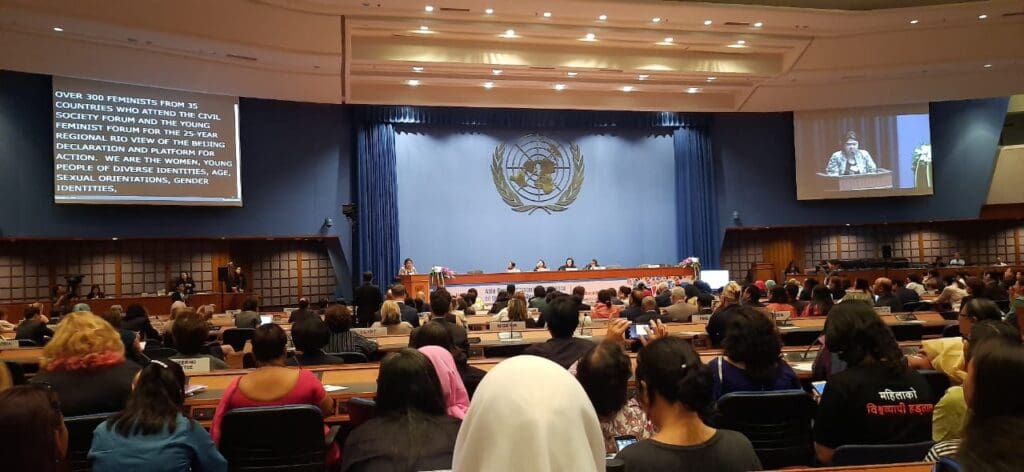





Ahead of Lebaran, Konde.co published 3 (three) special edition series entitled #MenagihTransumAman which aired on March 24, 25 and 26, 2025. This third article is the result of Konde.co’s coverage of Transum’s problems outside Java.
Mama Adriana Lomi (52), a resident of RT 09, RW 05, Lai-lai Bisi Kopan Village, Kota Lama District, works as a seller of drinks and cakes at Kupang Terminal.
She uses public transportation (Transum) to get from her house to the terminal every day. But what she encounters is that the drivers like to speed, do not go according to the lane, and they do not dare to reprimand.
When met by Konde.co, Tuesday (28/1), she revealed that her daily activities are carried out by bemo public transportation. Because it is the only mode of transportation that is cheap and accessible to her because her residence is in the city centre. She can go anywhere by taking a bemo as long as her destination has a bemo route.
Using bemo transportation is not only cheap, but also because Mama Adriana, who is rather clueless, cannot operate the activation of application-based online transportation booking. Her son has taught her but she always forgets. Unless she travels with neighbours to a funeral or party, only then does she dare to go by online taxi. She will also only take a traditional ojek if the destination does not have a bemo route, or if the bemo is no longer operating. The point is, she prefers to take a bemo because it’s cheap.
Before she got a motorcycle loan for her son who works in OEbufu Village, her son also took a bemo to work. Unless he is in a hurry because he needs to get to work quickly, her son will take an ojek online or an online taxi. The family prefers to use the bemo.
Read More: Introducing Mary Wollstonecraft, the ‘Mother’ of First-Wave Feminism
Mama Adriana usually goes to Oeba Market, Fatubesi Village, Kota Lama Subdistrict by bemo and back for only Rp 10,000. Because she sells kerosene and has to get kerosene from the seller in Oeba, if she uses an ojek, she has to pay Rp 7000 to go and Rp 7000 to return. That makes it expensive.
Mama Adriana said that when she goes to church on Sundays, her church is near Oebobo Market, she also takes a bemo on route two. After that, she continues with bemo route seven or 27 to get to her church. This is because on Sunday mornings, there are no bemos on the 10-light route that go directly to his church.
After going to the church, they wait for lamp 10 and only two units are running. Most lamp 10s do not arrive at Kupang City Terminal. They turn their vehicles around at Pasir Panjang gas station to save gasoline and wait for passengers at near that location. In fact, the route must reach Kupang Terminal. Another passenger at Pasir Panjang who was interviewed separately by konde.co said the same thing.
According to Mama Adriana, because her house is near Kupang Terminal, she then observed that almost all bemos at 8:00 pm were no longer operating. Whether it is the route of lamp five, lamp one, lamp two, to Tenau, Oebufu. The only ones that were still operating until 21.00 WITA were the bemos on the Oesapa route because there were many saleswomen working in LLBK Village.
Read More: Is Our Public Transportation Gender Responsive and Inclusive? Konde.co Research Results (1)
She once went to Oesapa with two children because of a family matter. When they were about to return home, it was already 10 p.m. The bemo was no longer operating. She asked the two children to find an online taxi and they got off at Merdeka Village and took an ojek to her house. For her, it was a big waste of money.
She feels that in the future, the government should strive for cheap city transportation like bemos so that it can be accessible to all poor citizens. Public transportation should be available with operating hours until late at night, including public holidays. This includes Christmas and New Year’s Day, because not all people can afford to ride online application-based vehicles.
Furthermore, she added, bemos do stay for a long time waiting for passengers. Except when school children come home from school because the bemo is immediately full. In the past, there were no other alternative transportation except bemo as public transportation. So the driver doesn’t have to wait long for passengers like now.
“Yes, passengers must be patient, because it is impossible for an empty bemo to run. We have to understand that. The bemo entrepreneurs will lose money,” she said, adding that some bemos are dirty and some are very clean.
Read More: Period Pain for Women is Real, How to Deal With It?
Many drivers who bring bemos are no longer speeding like in the past, although nowadays many driver exchange in the middle of the road stops.
“If the driver opens the music tape loudly, I usually ask him to turn it down. The driver follows. At first, they would turn it up again. But what else can we do,” she said.
Public transportation that connects one place to another in Kupang City, East Nusa Tenggara (NTT) and its surroundings is called bemo.
Since the 70s, people have called them bemos. Although bemos in Kupang are not the three-wheeled motorized rickshaws used as public transportation in Indonesia. Bemos in Kupang are four- wheeled vehicles like any other vehicle. The owner or operator of a bemo will dress up the bemo with various accessories, quality audio sound in the bemo so that the music played can be as loud as possible, decorated with dolls, stickers, painted with quality car paint choices clean and fragrant, the bench seat is also made neat, comfortable and there are handles for passengers. Therefore, the driver is dandy and so is the conductor. That’s the condition of bemos from the 1970s to 2000s in Kupang City. So riding a bemo in Kupang City is like being in a walking discotheque.
In the 1970s to 1985, bemos were physically separated from the driver and passengers. The driver and two other passengers were at the front while the other 14 passengers (should have been 11) and the conductor sat at the back.
Read More: From Obligation to Right: Rethinking “Sex as Duty” for Muslimah
Since 1985, mikrolet (minibuses) have entered Kupang City, and the bemos with this physical form have diminished and disappeared. However, mikrolet minibuses are called bemos and are dressed up by their owners in the same way as the previous bemos.
The public transportation business in Kupang requires a lot of money, not only to buy the car, but also the trinkets, branded audio sound, and good paint. Therefore, people in Kupang and its surrounding areas are happier to ride a clean, nice, music-filled bemo.
Passengers are also picky when it comes to riding a bemo. A bemo that has a mediocre appearance and is not dressed up, nor does it have full music, will not get passengers or will be quiet. Except for parents, adults who will ride such a bemo.
Regarding the loud music, adult passengers often complain to the drivers. Even the government, in this case the cooperation of the traffic police, the LLAJ office, the Transportation Agency in the 80s, 90s and 2000s often conducted operations because the music was very loud and had passed the decibel limit of human hearing. But if you have been reminded, it is only temporary and continues to return again and is not a deterrent.
The problem is that young people like bemos with loud music and always open with rock, slow rock, and metal songs. Rarely is there a bemo that plays religious songs (Christian red), which is the majority religion there. If the driver is an adult, they will play Indonesian pop songs, such as keroncong and dangdut. People from outside NTT who come to Kupang always give the opinion that the city transportation (angkota) in Kupang is very unique.
Read More: “Long Live Indonesian Women!” Gazing into the Realities of Women Workers’ Rights
Since the introduction of traditional/conventional ojek in Kupang in 1999, there are people who prefer to go anywhere, especially those whose houses are not exactly on the road that is passed by public transportation, preferring to take a traditional ojek even though the price is expensive because it is not regulated by the Transportation Department like angkota (bemo). The ojek is at will and agreed with the passenger. If the price is suitable, the passenger is delivered to the passenger’s destination address. The reason they ride ojek is faster.
In some routes within the Kupang urban village, the presence of this traditional ojek has caused the routes to be closed by bemo owners/service providers such as Kupang-Perumnas Terminal route, OEpura-BTN-Kolhua Terminal, Pasar Inpres-Labat, Selam-Mantasi-Manutapen. As time goes by and online taxis and motorcycle taxis enter, and many residents already own motorcycles and private cars, some of these routes do not operate.
Online transportation in Kupang City has been present since 2016. The arrival of online ojek has also changed the transportation map in Kupang.
It was 5:20 p.m. on Tuesday, January 28, 2025, but the day was still bright, even though Kupang had been raining non-stop from morning to night. In the afternoon, the rain stopped again. The rainy season is longer in the afternoon, so even though it was already past five o’clock, the sun had not yet set. A conductor ran to meet konde.co who had just gotten off the vehicle, offering to take the city transportation to one of the places. So did a conventional motorcycle taxi.
“Kaka, take me to Fatufeto ko?” greeted the ojek driver in a loud voice, overlapping with the sound of music from the shops and from some of the bemos.
Read More: International Women’s Day 2025: A Call to Action to Accelerate Progress towards Gender Equality
Meanwhile, the conductor slowly asked if konde.co wanted to travel to Tenau so konde.co could take a ride on his bemo. That was the situation on Tuesday afternoon (28/1) at Kupang City Terminal and its surroundings near Kupang Beach, Lai-lai Bisi Kopan Village, Kota Lama Subdistrict.
“Yes, bemos are cheap transportation.”
Mama Marselina Tallo, a resident of Nabois, Fatureto Village, Alak Sub-district also has a story about this Transum. Marselina, who sells vegetables, tofu, tempeh and kitchen spices at the Kupang City Terminal, was contacted on Tuesday (28/1) and said that she still takes a bemo that has a route for family needs to go to a funeral, engagement or other family needs, because it is a cheap and accessible transportation. He has to go from her house to Kupang Terminal, which is almost two kilometres away, and pay Rp 7,000 for an ojek, then take a bemo to her destination. The wait for the bemo was long and she was pressed for time.
In the morning, at 6:30 a.m., she goes to Oeba Market every day by ojek because she needs to speed up her shopping. If she waits for a bemo, it will take a while, because there are only two bemos on the route to her house and the neighbourhood. To get to the market, Mama Marselina has to pay Rp 25,000 for an ojek, which includes transportation from the market to her selling place at the terminal.
Read More: From Obligation to Right: Rethinking “Sex as Duty” for Muslimah
Although the bemos are noisy with the sound of music, and sometimes the driver is speeding, she does not dare to reprimand the driver. So she just gives up when riding a bemo because it is the cheapest transportation.
Returning home at night from selling at 8 p.m., the bemo that runs to her house is no longer operating, so she takes an ojek for Rp 7,000.
“So just one day for transportation is Rp 32,000. That’s just me alone, not my children, husband,” she said. Therefore, she hopes that in the future the government will continue to strive for cheap, safe and comfortable public transportation for small people with an age of 60 years.
A few days ago, she and her family took a bemo to a funeral in Lasiana Village, Kelapa Subdistrict, a distance of 13 kilometers. When they got off the bemo, they had to walk a long way to the funeral home. If you take an ojek, it’s expensive.
Mama Hana Labinte and Mama Yuliana, residents of Pasir Panjang who were met on Tuesday (28/1) at their residence, said that they still use bemo public transportation until now even though there are other alternative transportation.
Read More: Femicide Crisis in Iran: Unveiling the Shadows of Gender-Based Violence
Mama Hana goes to Oeba Market, Fatubesi Village, Kota Lama Subdistrict in the morning from her house on foot, then takes a bemo home. Her house happens to be not far away, only about 30 meters from the road where public transportation passes.
“Bemo is cheap transportation even though it is dirty, noisy and sometimes the driver speeds up and change driver couple times. But it is the only public transportation that is cheap compared to other transportation.”
The 10-light bemo whose route is Mayor-Terminal Kota Kupang was complained about, but many drivers do not follow the route that has been determined according to the route permit. The drivers turn their vehicles around at Pasir Panjang gas station. This is a problem for her children and other children who have to go to school in the morning by bemo or go home and have to get off at Pasir Panjang gas station and walk quite a distance. This complaint is the same as that of Mama Adriana Lomi.
She asked the City Transportation Agency to crack down on reckless drivers like this and strive for cheap, safe and comfortable modes of public transportation for citizens including the underprivileged, public transportation that is friendly to women, children, the elderly. Apart from going to the market, mama Hana to family events, funerals or other needs still uses bemo as long as the destination has a bemo route. Occasionally by online taxi or delivered by her husband.
Read More: The Orgasm Gap: Why Do Women Climax Less Than Men? Calling Out Unrealistic Images of Women’s Pleasure
Mama Yuliana goes to Oeba Market and several places that can be passed by public transportation by bemo, because her house is near the road that is passed by public transportation. Public transportation is cheap. The bemos that exist today are not like the 80s- 90s or early 2000s. Now they are dirty, noisy, speeding and have drivers who shoot.
She remembers there used to be joint operations with the Department of Transportation, LLAJ and traffic police to curb public transportation that played deafening music and speeding.
“In the past, the bemos in Kupang City were clean and the drivers were neatly dressed, not as careless as they are now, and there was even a shooter driver where there was a traffic accident that turned out to be a shooter driver,” she said.
She asked the Kupang City Transportation Agency to create indicators of public transportation that is feasible in terms of infrastructure, drivers, friendly, safe, comfortable and cheap for passengers, especially women, children, people with disabilities and the elderly. It is time for the Kupang City Government to strive for cheap and inclusive mass public transportation modes in Kupang City.
With good public transportation, she said, people will ride public transportation and will not buy private vehicles because it will create traffic jams.
Read More: Why Are Men So Obsessed with Sex? The Urgency of Getting Out of Toxic Masculinity
“We still need public transportation and that’s the government’s job. So that the operating hours are not determined by the operator or service provider but are set because many informal sector workers go home until 10pm. Taking online transportation or conventional motorcycle taxis is 10 times as expensive. Their salary is spent on transportation alone. But if public transportation is cheap, safe, comfortable and friendly for women, children, vulnerable groups, people are not afraid,” she said.
Christin Natalia, a student in Kupang City who lives in Batukadera, said that she has to take a motorcycle taxi to the terminal from her house because the distance is more than one kilometer. The price varies depending on the motorcycle taxi driver, can be Rp 10,000 or Rp 7000. If you take a bemo with a route past her house, it’s too long. Except for going home from college. The price of bemo is Rp 4000 whenever the distance and is friendly to her pocket as a student, especially since she is an orphan.
Sometimes she borrow her brother’s motorcycle, but because the campus is far away, she still has to fill up on gasoline. In addition, she is afraid of being caught in traffic control operations because she has not yet applied for a driver’s license.
“If we want to go to our family’s house, we have to take an expensive online taxi. Or if it’s Christmas, the bemos don’t run, and only a few bemos run on public holidays. This is a model of public transportation that is not friendly to residents, school children, students, women, the elderly and disabled and also the poor. When school children are off, the bemo driver admits that it is quiet,” she said.
Read More: Love Languages Are Hugely Popular. Are They Real?
According to her, good public transportation must operate even at night, public holidays. If people can afford to take transportation on line, it is not a problem. “But those like me are very difficult. The government should try to think of cheap transportation, but comfortable and safe transportation for us,” she said.
Mama Ellen Sirlalang, a resident of Lopo Indah Permai Housing, Belo Village, Maulafa Subdistrict, asked the Kupang City Transportation Agency to create a bemo route for school children in Belo Village. If bemos are deemed unfit as public transportation, mini buses can be provided. During the dry season, riding a conventional or online ojek is not a problem. In the rainy season, it is very dangerous. Moreover, the entrance to the housing estate is rocky, some are muddy. There was once a mother who took her child to school on a motorcycle because of the slippery rain.
In her housing complex, many families use their own private two-wheeled and four-wheeled vehicles. However residents outside the complex must walk nearly two kilometers to Sikumana and take a bemo to schools located in Oebobo, Merdeka Village with a number of other villages. For those who go to school near Belo Village, this is not a problem. If you take a motorcycle taxi, you have to spend Rp 7,000 for traditional motorcycle taxis and Rp 10,000 if it rains, the price changes.
“She also asked city council members from the Belo and surrounding constituencies to pay attention to this issue and fight for it,” She said.
Read more: Four Fundamental Critics of the Inadequate Implementation of Law on Sexual Violence Crimes
In Kupang City around 2005-2008, there was a local taxi entrepreneur who made 10 units of bus public transportation operate in Kupang City from morning to night. The drivers were uniformed, and the conductors were all women in uniform. At that time, the interest of residents in using the buses was quite high. They were very happy because the bus was comfortable, the music wasn’t loud, and it was safe because there was no speeding. However, after the entrepreneur passed away, it was not clear why the bus operation had stopped.
Head of the Kupang City Transportation Office, Bernadus Mere, who was contacted on Monday (27/1) regarding public transportation, to talk about Kupang’s bemos which are cheap, safe and comfortable for women, children and vulnerable groups, disabled and elderly and how many total bemos operate as public transportation in Kupang City. He presented data compiled up to the beginning of 2024, showing that there were 188 legally registered public transportation vehicles (bemos), while the number of vehicles in operation exceeded that number.
Mere admitted that in general, city transportation in Kupang is still used by the community. However, when it comes to the feasibility of public transportation, there are minimum service standards (SPM) for public transportation (AU). When referring to the SPM, angkot in Kupang City has not fully met the SPM.
Read more: Five Reasons for the Problematic of the Draft Law on the Welfare of Mothers and Children
Angkot in Kupang City is served by public passenger cars with a capacity of 11 people, so whether or not it meets the needs of women, children and vulnerable groups, there are still many aspects of public transportation that do not meet the requirements needed for women, children and vulnerable groups.
Responding to passenger complaints about noise caused by drivers playing loud music, drivers shooting and speeding so that it is not safe and comfortable for passengers, to the extent of supervision and enforcement of regulations from the Kupang City Transportation Office, Mere emphasized that supervision and enforcement are routinely carried out by the transportation office on the operation of angkota. Vehicles that use excessive accessories will be dealt with immediately. Regarding the driver who change in the middle the road (or runaway driver), it is rather difficult to track because the Kupang City Transportation Agency does not have data, the driver does not have a driver’s license, will be directly handed over to the police.
Answering konde.co’s question, what is the concept of the Kupang Transportation Agency for cheap, safe and comfortable angkota for women, children and vulnerable groups in Kupang, he said that providing safe, comfortable and cheap transportation for women, children and vulnerable groups is not only focused on transportation facilities, but also comprehensive planning.
“Improving transportation infrastructure, strengthening the regulatory framework and increasing public participation in decision-making are necessary.”
Read more: Four Fundamental Critics of the Inadequate Implementation of Law on Sexual Violence Crimes
In the future, mass transit-based vehicles are a priority in creating inclusive urban mobility.
According to him, the government (Dishub) has never closed or eliminated routes to several points in Kupang. However, the operators (public transport service providers) that serve the routes are no longer operating. It may be seen from the declining passenger potential that the city transportation operators are losing money.
Transum in Makassar not yet suitable for women and vulnerable groups
Trans bus Mamminasata has become one of the modes of public transportation relied upon by the people of Makassar.
With a growing transportation system, passenger comfort and safety, especially for women, the elderly and vulnerable groups such as disabilities, should be an important aspect that must continue to be considered.
However, the current Trans bus Mamminasata infrastructure in Makassar still faces problems in providing friendly services for women, the elderly and disabilities.
Azizah (25), an employee of a private company in Makassar, had an experience riding the Trans bus Mamminasata Makassar, to Galesong beach in Takalar, South Sulawesi, at the end of 2024 yesterday. To get to the bus station, which used to be corridor 1 of the Panakukkang-Galesong Mall route, she had to walk to the bus station at Panakukkang Mall. Then she had to cross the road and walk through the parking lot around Mall Panakukang Makassar, where the buses were parked.
Azizah, who lives in the suburbs of Makassar, complains that it is still difficult to reach the Trans bus Mamminasata base point in Makassar.
“It’s still difficult to access, because you have to walk a long way first and then find the base point which is quite far away. Then you can find the bus,” Azizah told Konde.co on January 29, 2025.
Read More: ‘Divorce Because of Different Political Points of View Until Sexual Violence’: Women Violence in Election
For Azizah, the experience of riding the Trans Mamminasata Bus for about 1 hour which took her to the recreation area in Takalar district, was not comfortable and safe for female passengers like her.
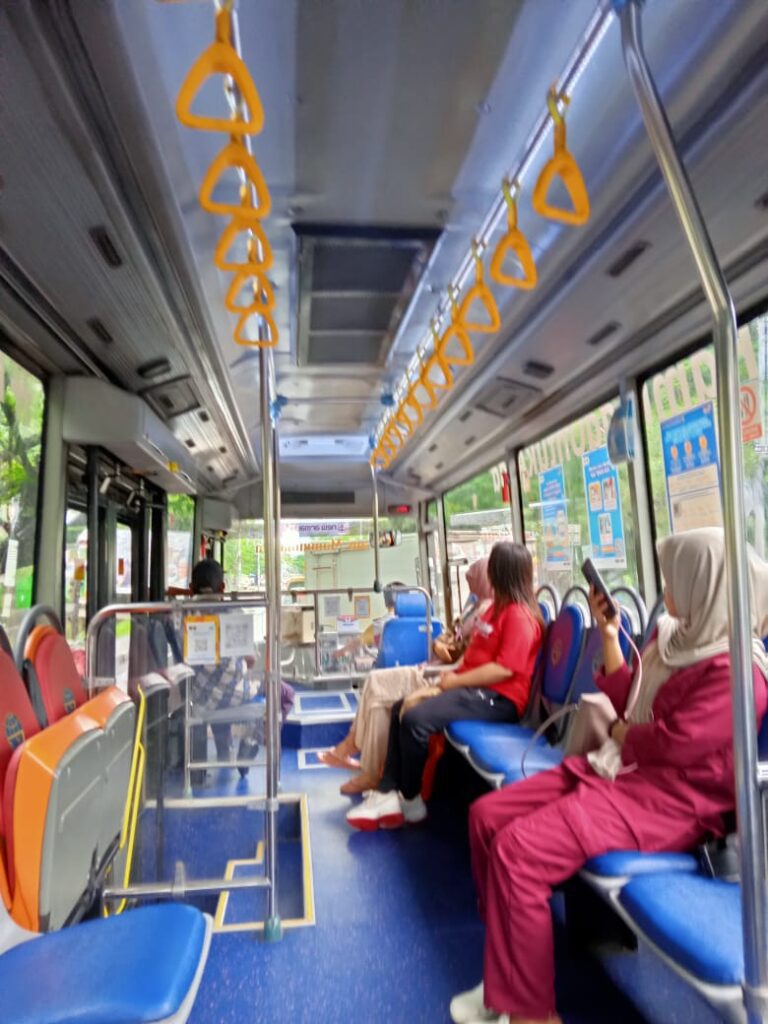
The condition inside the Trans Mamminasata bus. Photo: Ifa Fachridini/Konde.co.
“The road bumps continues, the route is long and circuitous. There were also no bus stops at some of the stops that were passed. In addition, there was no direction from the officer that our destination had arrived,” said Azizah, who had strayed past the bus stop.
She had to take the Trans bus Mamminasata again to return to her original destination.
Konde.co then took the Trans bus Mamminasata on two corridors on Tuesday, January 28, 2025. In this trip, Konde.co followed the corridor 5 bus trip from the Makassar Panakukang Mall point at around 10.30 WITA. Trans Mamminasata ticket payments can only be made using electronic money cards or QRIS.
Passengers must board through the front door and exit through the middle door. There are 20 seats in this bus, 11 seats on the right side, 5 seats on the left side of the bus, 4 seats in a row at the back. There are 20 yellow handles. The bus is very clean and equipped with air-conditioning. Passengers are not allowed to eat or drink inside the bus.
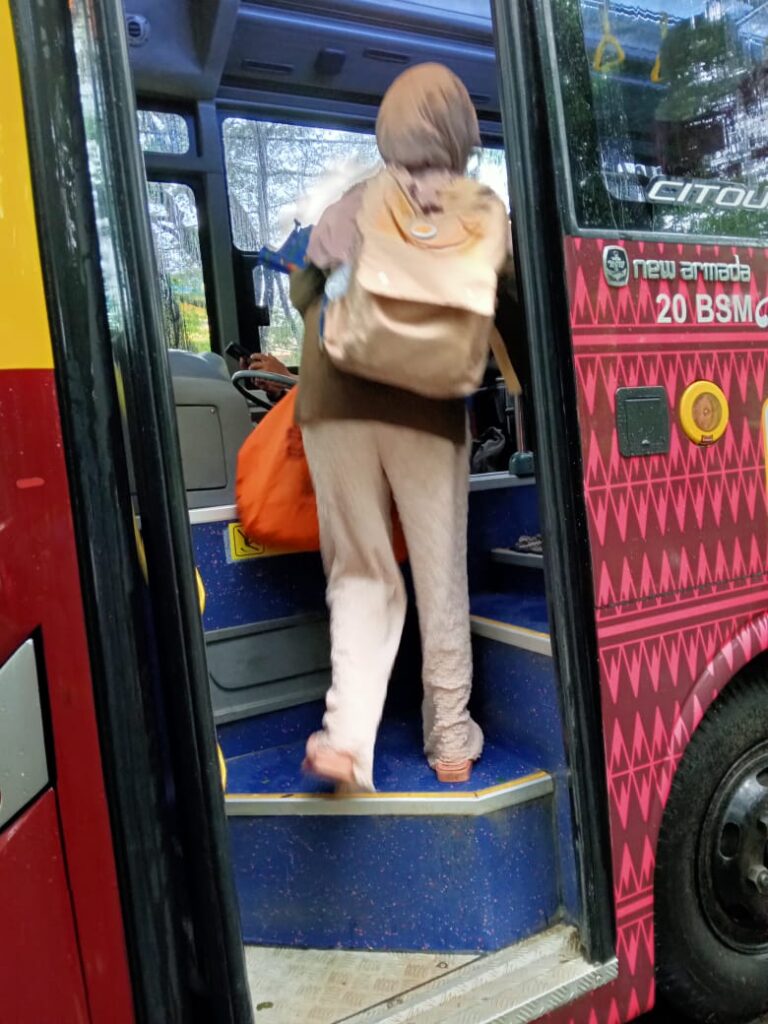
Trans Mamminasata bus passengers board through the front door. Photo: Ifa Fachridini/Konde.co.
There is only one driver without any special officer on this bus. During the first trial in the first year, there was one special officer working to serve passengers. But now only one driver is on duty on this bus.
At 11:15 a.m., the bus left Hasanuddin University through several stops to the Hasanuddin University Technical Campus in Gowa. Several stops such as Patria Arta University, Muhammadiyah Hospital, UIN Samata, as well as Pesantren Guppi Samata, Mutiara Indah Samata to PDAM Borongloe have not provided special stops for passengers who get off.
All passengers passing through this stop must step directly onto the road once they exit the bus. After a brief stop, the bus resumed its journey to the next stop within a few minutes.
Konde.co then followed the bus’s journey as it left the Unhas Gowa Engineering campus at around 13:40 WITA. Many female passengers ride this bus. One of them is Theresia, a housewife who boards at the Borongloe Gowa stop and heads to the Panakukkang Mall in Makassar.
“I am very happy to ride the Trans Maminasata bus because it is cleaner and more comfortable. It is also very helpful for the economy of Makassar residents because it is cheap,” said Teresia, who had just visited her son studying at the Faculty of Engineering, Hasanuddin University.
Read More: ‘Divorce Because of Different Political Points of View Until Sexual Violence’: Women Violence in Election
According to her, if you take a car from Gowa to Makassar, the cost can reach hundreds of thousands. While riding a motorcycle is not necessarily safe. So this bus really helps her mobility and her son who is still studying at Unhas.
“I am comfortable riding this bus, there are no obstacles at all,” said Teresia.
Even so, she did see that the stopping point of this corridor did not provide a special stop for bus passengers. There should be a special stop.
“But passengers have to stop somewhere else, then walk first to get to their destination,” said Teresia, to Konde.co.
Theresia assessed that the Trans bus Maminasata, which has not been equipped with special officers, is not safe for elderly women, disabilities.
“Because you have to get on quickly, so it doesn’t make it easy for pregnant women. We had to rush to get off and on,” she said.
Read More: Rape Survivor From Cilacap Drop Out Of School, But The Rapists Are Free
Women and the elderly face challenges in using the Trans bus Mamminasata service.
While specific data on the experiences of women and the elderly in Makassar city in using these services is limited, it is common for these groups to require facilities such as priority seating, ergonomic handrails, and clear and accessible route information. The lack of such facilities can reduce their comfort and safety when using public transportation. Nevertheless, the city government has implemented several measures to ease the burden on the community.
The level of use of this bus is still relatively low. This shows that the community, including women and the elderly, are not fully comfortable using this service.
A study conducted by Hasanuddin University students on the perception of female passengers towards Trans bus Mamminasata services, revealed that the existing conditions of public transportation in Makassar City are not fully in accordance with the needs of female passengers.
In addition, another study highlighted that although Teman Trans bus Mamminasata offers a high level of safety and affordable fares, the comfort aspect still needs to be improved to meet people’s travel needs. This includes providing special facilities and ensuring safety during the journey. It also involves training staff to be more responsive to the needs of female passengers, the elderly, and people with disabilities.
Thus, it is hoped that Trans Mamminasata can become a more inclusive and comfortable transportation option for all groups in Makassar City.
Read More: The Story of Ria, Tiko, and Erni: The Challenge of Transgender to Have Social Security
Chairman of the Indonesian Consumers Foundation (YLKI) South Sulawesi, Ambo Masse, said that in general, public transportation in Makassar is not yet suitable for vulnerable groups, including the elderly, women and people with disabilities.
For example, pete pete (city transportation) in Makassar is not suitable for vulnerable consumers, because it likes to speed and is reckless. In addition, many people complain about the loud and very large audio music in the car. Ambo said Makassar had tried inclusive-based services in the past with the presence of Damri buses and double-decker buses, then stopped operating.
“One of the important solutions is how the government presents decent vehicles for all users of public transportation, which pay attention to the feasibility of the vehicle, there are standards. Especially the driver must be trained to respect, reprimand and greet,” Ambo Masse told Konde.co in Makassar, January 25, 2025.
To that end, the provision of public transportation requires studies or research to examine its needs, which do not conflict with existing routes.
The Trans bus Mamminasata, whose operation has started since 2021, is an effort to reduce the movement of private vehicles including motorbikes to switch to public transportation.
Read More: ‘My Dream To Be A Football Player To Get Citizenship’: Stories Of Immigrant Children In Malaysia
Since 2021, this bus has gradually undergone trials serving four corridors. Namely Corridor 1 (Panakkukang Square – Galesong Port) and Corridor 2 (Panakukang Mall – Sultan Hasanuddin Airport), Corridor 3 (PNUP Campus 2 – PIP) and Corridor 4 (Unhas Gowa Engineering Campus – Panakkukang Square). These bus operations are subsidized by the central government.
Since October 31, 2022, the South Sulawesi Provincial Government through the Transportation Agency has set a tariff of Rp 4,600 per passenger for all Teman Trans Mamminasata Bus routes. However, there are special policies for students, the elderly, and people with disabilities that allow them to use this service for free. Students only need to show their student card, while elderly people aged 60 years and over need to show their ID card as proof.
The Ministry of Transportation through the Directorate General of Land Transportation has provided public transportation services for people in the Makassar area, South Sulawesi through the Trans Mamminasata Buy The Service (BTS) scheme with 2 corridors as of January 1, 2024.
Due to the low passenger occupancy rate, which is still below 35 percent on several corridors or routes, on January 1, 2024, the Ministry of Transportation will continue to provide Trans Mamminasata services, from four to two corridors. Namely Corridor 1 (Panakkukang Square -Galesong Port) and Corridor 2 (Panakukang Mall – Sultan Hasanuddin Airport). The other two routes, Corridor 3 (Campus 2 PNUP – PIP) and Corridor 4 (Engineering Campus Unhas Gowa – Panakukang Square), are managed by the local government.
Read More: Rape Survivor From Cilacap Drop Out Of School, But The Rapists Are Free
The physical infrastructure of Trans Mamminasata Bus is not yet fully friendly to people with disabilities. Supporting facilities such as bus stops have not provided special spaces, and the available ramps are not in accordance with established standards. This condition contradicts Regional Regulation No. 6/2013 which mandates the provision of public transportation facilities that are friendly to people with disabilities.
Abdul Rahman, chairman of Balla Inclusion, a disabled activist organization in South Sulawesi, said that the Trans bus Mamminasata infrastructure has not supported disabled passengers.
“The infrastructure has not been supportive so far, because the placement of bus stops does not meet the needs of passengers. This is because the policy was not based on a detailed assessment process,” he said.
Abdul Rahman, who was once the chairman of the Indonesian Disability Movement for Equality (Perdik) South Sulawesi, explained that one example of a bus stop in front of UIN Alauddin Makassar was made on the sidewalk, which disrupted the rights of pedestrians. In addition, there are sidewalks built right on top of sewers without any barriers, which makes it unsafe for passengers with disabilities.
“We have submitted the results of this research to the government 2- 3 years ago. But there has been no improvement until now. So the infrastructure is built carelessly and disrupts the rights of other pedestrians, because almost all bus stops are placed on the sidewalk,” Abdul told Konde.co, Thursday, January 30, 2025.
Read More: From Stereotypes to Struggles: How Age Discrimination Hits Women Harder
In addition, he also does not know whether each bus officer has received training on how to serve vulnerable groups such as passengers with disabilities in accessing the Trans bus Maminasata.
According to him, the central government and the city government should coordinate with districts / cities, starting to build infrastructure and facilities that are safe for all groups.
“But coordination was limited to socialization. Civil society organizations were never involved in making this public transportation policy,” Abdul said.
According to him, this transportation facility is not friendly to vulnerable groups including passengers with disabilities. Because friends with disabilities do not use these facilities. Currently they are more comfortable using online transportation, to facilitate their mobility from one place to another.
“If the infrastructure for people with disabilities is adequate and supportive, they will automatically use the Trans bus Mamminasata. Because this facility is a public facility, but if it does not involve the community, then automatically the government project is a failed project,” he said.
He hopes that the government can invite discussions of all community groups in South Sulawesi, to find solutions together, to formulate strategies to improve this transportation service. So that it can review the Trans bus Mamminasata service policy.
Read More: The Portrait Of Waria Religious: They Are Not Immoral
To improve accessibility and comfort for all users, especially women, the elderly, and people with disabilities, several steps can be taken by the city government, including improving physical facilities by improving the design of bus stops and buses to be friendly to people with disabilities, including the provision of ramps with standard slopes, special spaces, and adequate handrails.
As well as providing training to bus and bus stop staff on inclusive services that are responsive to the special needs of passengers. Also socialization and campaigns to raise public awareness, about the importance of giving priority and respecting the rights of passengers with special needs.
With the commitment and joint efforts of the government, transportation agencies and transportation operators, it is hoped that Trans bus Mamminasata services can become more inclusive and friendly for all groups. Thus encouraging safe and comfortable mobility for all Makassar residents, especially women, the elderly and other vulnerable groups including disabilities.
Head of UPT Trans Mamminasata Nurdiyana and Head of Transportation of Makassar city Zainal Ibrahim did not respond when Konde.co sent messages to conduct interviews on Monday, March 10, 2025.
Konde’s Team:
Coordinator: Nurul Nur Azizah
Reporter: Nurul Nur Azizah (Jakarta, Tangerang Selatan), Salsabila Pertiwi (Bandung), Pito Agustin (Yogyakarta), Ika Ariyani (Surabaya), Ifa Fachridini (Makassar), dan Anna Djukana (NTT)
Graphic: Ardiles
Research and Data: Luthfi Maulana dan Laras Ciptaning Kinasih
Editor: Luviana Ariyanti